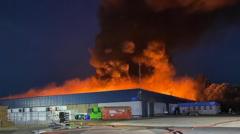
Midnight smells like ozone and cooling asphalt. If you have ever stood on the perimeter of an industrial park at three in the morning, you know the particular stillness of the place. Millions of dollars in inventory sit silently behind corrugated steel walls. Refrigerated units hum. Forklifts recharge in neat rows. It is a city within a city, populated entirely by shadows and motion sensors.
Until the alarm rings.
For Marcus Vance, a twenty-year veteran of the municipal fire department who has spent more nights than he cares to count breathing compressed air through a rubber mask, the call came in at 2:14 AM. The dispatch audio was clipped, urgent, and deceptively simple: commercial structure fire, single-story logistics facility, heavy smoke reported from the roofline.
By the time Engine Four turned the corner onto Industrial Parkway, the sky three miles away was already bruised an angry, flickering amber.
Warehouse fires are a distinct breed of disaster. They are not like residential houses, where drywall and wooden studs offer predictable paths of resistance. Modern distribution centers are massive, wide-open caverns designed for maximum spatial efficiency. They are filled with high-density plastic pallets, corrugated cardboard boxes stacked four stories high, and rows of lithium-ion batteries powering fleets of material handling equipment. When combustion takes hold in an environment like that, the air changes. It becomes heavy, toxic, and unpredictably hungry.
Consider what happens next: the thermal column rises, hitting the flat roof, spreading horizontally, pushing superheated gases down toward the floor long before the flames themselves are visible. To walk into that building is to step blind into an oven where the rules of physics have been rewritten.
Marcus parked the rig fifty yards from the loading bays. The radiant heat hit his face instantly through his turnout gear, a physical wall of warmth that made his skin prickle.
"Roof's compromised," a younger firefighter shouted over the roar of the diesel engines and the deafening whine of air sirens.
They did not hesitate. They never do, though every instinct screams against it.
To understand the reality of a warehouse blaze, you have to look past the dry police blotters and the insurance adjusters' cold estimations of structural loss. You have to look at the geometry of the risk. Modern supply chains depend entirely on these monoliths of concrete and steel. When one burns, the disruption ripples outward with terrifying speed. Small businesses waiting on seasonal stock suddenly find their shelves empty. Local workers face weeks or months of uncertainty while management scrambles to find a temporary footprint.
Yet, standing on the tarmac with water cannons chewing through three thousand gallons a minute, economics are the furthest thing from anyone's mind.
The immediate battle is chemical and chaotic. Plastics do not just burn; they melt, pool, and release a thick, black smoke that clings to the lining of the lungs. Water alone often fails against chemical accelerants or deep-seated pallet fires, requiring foam trucks to blanket the interior in a smothering white blanket.
Marcus led his crew through the side personnel door, crouching low beneath the rolling black ceiling. Visibility was absolute zero. The beam of his flashlight cut through the smog only inches before disappearing into the murk. The sound was deafening—the structural groans of steel purlins twisting under extreme heat, the crackle of burning cardboard, the hiss of water hitting superheated metal.
You rely entirely on your training, and on the steady rhythm of the man breathing beside you through an air tank. In-two, out-two. In-two, out-two.
Hours bleed together in environments like that. Time stops being a clock and becomes a remaining psi reading on a steel cylinder strapped to your back. At 4:45 AM, the eastern horizon began to streak with a pale, indifferent grey, indifferent to the chaos unfolding in the asphalt basin below.
The flames were beaten back, confined to the western quadrant of the facility, thanks to a coordinated perimeter defense that kept the fire from jumping to the adjacent chemical storage unit. No lives were lost. That remains the only metric that truly matters when the smoke finally clears and the sun rises high enough to illuminate the blackened skeletal remains of the loading bays.
The fire trucks rolled slowly back to the station just as the morning commute began. Sirens silent. Lights off. The asphalt was slick with runoff.
Back at the precinct, after peeling off soot-stained coats and washing the grit from their eyes, the crew sat in silence around a battered metal table, drinking bitter black coffee from chipped mugs. Nobody spoke about the inventory lost, or the corporate ledgers waiting to be balanced, or the insurance claims that would take months to untangle. They just stared at their hands, watching the faint tremors fade, listening to the quiet tick of the wall clock as the world outside woke up and started all over again.