We talk about distance in miles, in hours, in tankfuls of gas. We measure road trips by playlists finished and coffees gone cold. But asphalt has another metric entirely. Asphalt measures distance in heartbeats. It measures it in the microscopic fraction of time it takes for a stray thought to turn into a white-knuckled grip on the steering wheel, for a routine Tuesday afternoon to splinter into a permanent before and after.
I still smell the rain on hot tar whenever the news ticker updates with another highway tragedy.
It happens on stretches of road that look entirely ordinary. These are not treacherous mountain passes with hairpin turns or cliffside drops that demand every ounce of a driver's terror. They are wide, grey ribbons. They are the corridors connecting the places we have to be with the people we actually want to hold. That familiarity breeds a dangerous kind of quiet. The mind drifts. The speedometer creeps up just a fraction.
Consider the anatomy of a head-on collision. It is rarely a cinematic explosion of screeching tires and slow-motion realization. It is sudden. It is violent physics doing what physics always does when two massive objects traveling at highway speeds decide to occupy the exact same coordinate in space.
On a standard dual-lane motorway, the dividing line between safety and catastrophe is often nothing more than a strip of white paint, or perhaps a shallow grassy median. No concrete Jersey barrier. No steel cable fence to catch a wandering vehicle. Just intention, attention, and luck keeping two opposing streams of humanity from tearing past one another at a combined velocity that defies human biology to survive.
When that line is crossed—whether by exhaustion, a momentary glance at a glowing screen, a sudden medical emergency, or a blown tire—the math turns fatal in milliseconds.
At sixty miles per hour, you are covering eighty-eight feet every single second. Close your eyes to sneeze, and you have flown the length of a bowling alley blind. Now, imagine two cars, each moving at that pace, hurtling toward each other. The closing speed is not sixty. It is one hundred and twenty. The kinetic energy does not just transfer; it shatters. Metal crumples like paper, engine blocks are driven backward into cabins designed to protect human ribs and lungs, and the air is violently displaced by the sudden, brutal deceleration of mass.
And inside those cabins are lives. Not statistics. Not bullet points in a morning dispatch.
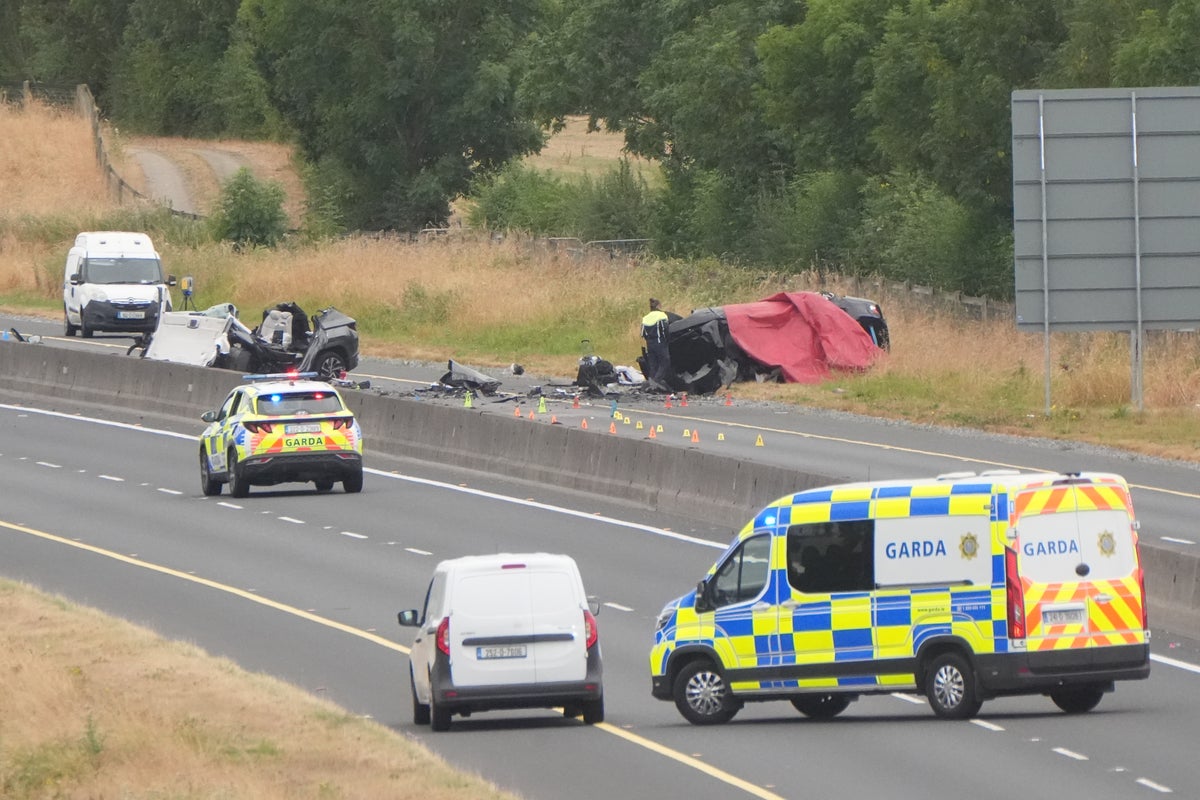
Lives like the ones extinguished and fractured on the motorway.
When emergency responders arrive at scenes like this, the first thing they notice is the silence. Not peace, but the heavy, unnatural quiet that settles after the sirens cut out and the crushing weight of reality sets in. Firefighters, paramedics, and state troopers walk through a surreal debris field of everyday existence. A child’s sneaker on the shoulder. A spilled travel mug. A grocery bag split open against the guardrail, its contents rolling into the weeds.
They train for this. They go through academies, they earn certifications, they run drills in heavy gear until their muscles remember the sequence by heart. But no amount of training prepares a human brain to look into the back seat of a mangled sedan and see a shattered booster seat, or to lift a broken body out of twisted wreckage while holding back the sick taste of adrenaline and grief.
First responders carry those images home. They put their uniforms in the laundry, they wash the smell of scorched rubber and hydraulic fluid off their skin, and they sit at their own kitchen tables wondering how to look at their families the same way. We ask them to run toward the worst moments of our lives, expecting them to emerge unscathed on the other side.
The human body is an exquisite, fragile architecture of water, bone, and electrical impulses. It is built to withstand walking, running, the occasional stumble. It was never engineered to absorb the deceleration force of a 4,000-pound machine stopping from highway speed in zero feet.
When a child is caught in the middle of such a catastrophic failure of safety, the cruelty of the physics feels intensely personal. A child's skeleton is still forming, still malleable, lacking the dense skeletal reinforcement of an adult. Even with the most advanced engineering in modern child safety seats—five-point harnesses, side-impact protection, energy-absorbing foam—the sheer G-force of a frontal impact can cause internal trauma that defies the best efforts of trauma surgeons.
When news reports dryly state that a child was seriously injured in a head-on collision, they are sanitizing a nightmare. They are hiding the frantic sterile lights of the pediatric intensive care unit. They are masking the steady, rhythmic hiss of ventilators, the quiet murmurs of exhausted parents sleeping in vinyl chairs, and the agonizing uncertainty of whether a young brain will heal from the shock of the blow.
We look away from these stories because they terrify us. We scroll past the headlines on our phones, telling ourselves that it was an anomaly, a fluke, something that only happens to other people on other roads. We blame bad weather, or bad drivers, or bad luck.
We do this because the alternative requires a terrifying admission.
It requires admitting that we are all participating in a daily act of collective faith every time we merge onto the highway. We are trusting absolute strangers—people we will never meet, whose names we will never know, who might be exhausted, distracted, grieving, or reckless—to stay on their side of the paint. We are hurtling through space inside aluminum cages, trusting that a momentary lapse in someone else's concentration will not cost us everything we love.
That is the invisible stakes of the commute. Not whether you will make it to the office by nine, or whether you will beat the traffic on the way back for dinner. The stakes are everything.
Every time we get behind the wheel, we carry our entire world with us. We carry the mortgage, the inside jokes, the future plans, the quiet worries, the love we haven't finished expressing. And we hand the safety of all of it over to a collective social contract written in lane markers and speed limits.
When that contract breaks, the fallout ripples outward in concentric circles of devastation. It hits the families. It hits the coworkers who notice an empty desk on a Tuesday morning. It hits the first responders who stare at the grey line of the road and wonder why this time had to be different.
The asphalt remains. The road crews come out with sweepers and fresh coats of black paint, covering the scars, sweeping away the shattered glass and the plastic fragments until the surface looks smooth and benign once more. Traffic resumes. Cars line up bumper-to-bumper. People glance at their dashboards, turn up the radio, and press down on the gas.
And the motorway waits, carrying its invisible weight through the quiet afternoon, holding our collective breath between one heartbeat and the next.