Silence has a weight. In the vast, sweeping expanses of central Eurasia, where the wind carries the dust of empires long crumbled and the bitter chill of Siberian winters, silence is not merely the absence of sound. It is a vacuum. For seventy years, that vacuum belonged exclusively to the wind, the biting cold, and the ghosts of an apex predator that vanished before most living people were born.
Listen.
Can you hear it?
Nothing.
That was the problem.
I remember sitting around a small, wood-stoked iron stove in a remote ranger outpost near the Ili River delta decades ago, listening to old men talk about the kaplan. They spoke of the Caspian tiger not with scientific detachment, but with the reverence usually reserved for ancestral deities. To them, the great striped cat was not just an animal; it was the punctuation mark of the ecosystem. When it disappeared in the middle of the twentieth century—hunted out of existence by agricultural expansion, military campaigns, and the systematic erasing of the reed beds—the landscape didn't just lose a species. It lost its balance. The ecosystem forgot how to breathe.
Dust storms grew more violent. Wild boar populations exploded, turning delicate marshlands into churned mud. The local ecology slumped into a listless, static exhaustion. When you pull the keystone from an arch, the stones don't just shift. They tumble.
And then, history turned a corner.
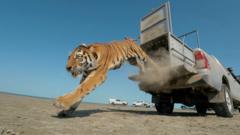
Imagine standing on the frozen banks of the Ili-Balkash region, watching a heavy crate door slide open with a dull metallic screech. Inside that crate is not a Caspian tiger—for that specific subspecies is gone, locked forever in the amber of extinction. Instead, stepping out onto the frost-crusted soil is its closest living genetic proxy: a magnificent Amur tiger, brought thousands of miles from the Russian Far East to reclaim a throne left vacant for seven decades.
It hesitated.
One massive, snow-padded paw hovered in the air. The amber eyes scanned the horizon, taking in the endless yellow reeds, the freezing gray sky, and the absolute, piercing emptiness.
Then, it stepped forward.
That single step broke a seventy-year silence.
To understand why this moment matters, we have to look past the romantic imagery of big cats roaming free. Conservation is rarely about sentimentality; it is about architecture. Reintroducing apex predators is a brutal, calculated engineering problem. You cannot simply drop a two-hundred-kilogram carnivore into a landscape and hope for the best. Years of painstaking scientific groundwork preceded that metal door opening. Government officials, international zoologists, and local conservationists spent over a decade restoring the Ili Delta, bringing back wild deer, rebuilding anti-poaching patrols, and convincing local communities that the return of the striped shadow was an asset rather than a threat.
People ask me why we bother. Why spend millions of dollars and countless hours trying to resurrect ghost stories when our modern world is fractured by so many human crises?
The answer is simple, though difficult to swallow. We are trying to fix what we broke.
Nature has a remarkable, stubborn resilience, but it cannot heal itself when its immune system has been surgically removed. By returning tigers to Kazakhstan, scientists are initiating a massive trophic cascade. The presence of a predator forces herbivores to keep moving, preventing overgrazing along riverbanks. As the riverbanks recover, stabilizing vegetation returns. Beavers come back. Fish stocks improve. Birds nest in safety. A single tiger anchors an entire web of life.
It is a domino effect of restoration.
Consider what happens next. The tiger wanders deeper into the dense tugai forests, blending seamlessly into the dry yellow reeds. To the casual observer, the landscape looks unchanged. But beneath the surface, a biological clock has been reset. The food web wakes up. The land remembers what it once was.
We live in an age of ecological grief. Every day brings fresh headlines about melting ice, burning forests, and ticking extinction clocks. It is easy to grow numb, to accept that the story of the natural world is a tragedy heading inevitably toward a silent curtain call.
The first rare tiger released in Kazakhstan after seventy years is a direct challenge to that despair. It proves that endings are sometimes just difficult transitions. It reminds us that humanity possesses not only the capacity to destroy, but the astonishing, stubborn patience to undo our mistakes.
The wind still howls across the steppes. The winter frost still bites at the skin. But the vacuum is gone.
Somewhere out there in the high reeds, a heavy paw hits the earth, and the ghost walks again.