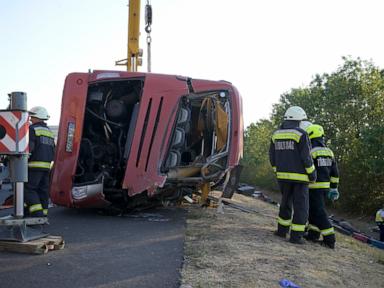
Twelve people are dead and at least ten others are seriously injured following an overnight bus crash on Hungary's M3 motorway. The vehicle, a Polish-registered coach carrying pilgrims returning from Medjugorje, veered off a straight stretch of highway near Mezőkeresztes and plunged into a roadside ditch. Preliminary police findings point to driver fatigue as the primary trigger for the disaster, resulting in a criminal investigation and an immediate spotlight on long-distance bus safety regulations across Europe.
Tragedies of this magnitude rarely happen in a vacuum. When a 24-ton vehicle carrying nearly sixty people leaves an asphalt road at high speed during the dead of night, the investigation quickly moves past human error and into systemic vulnerabilities.
The Anatomy of Long Distance Exhaustion
Driver fatigue is an insidious hazard. Unlike mechanical failure, which leaves physical debris or diagnostic codes, exhaustion rewires cognitive function quietly before manifesting in catastrophic ways.
The M3 motorway crash occurred at approximately one in the morning. This timeframe aligns with the human body's natural circadian nadir, a window of profound biological vulnerability where alertness plummets. Even professional drivers with years of experience are bound by human physiology.
Commercial passenger transport relies heavily on compliance logs and tachographs. Yet, checking boxes on a regulatory sheet does not guarantee restorative rest. Long-range international routes, such as the cross-border journey from Bosnia and Herzegovina back to Poland, impose grueling schedules on transport crews. Tight turnarounds, traffic delays at international borders, and unpredictable road conditions routinely eat into mandatory rest periods.
When a driver sits behind the wheel for hours in the dark, monotony compounds exhaustion. Modern motorways are engineered for efficiency with long, sweeping lines and minimal tactile feedback. Without sharp curves or sudden grade changes to demand physical engagement, the brain enters a state known as highway hypnosis.
Structural Blind Spots in Cross Border Enforcement
Cross-border transit exposes the limits of regional safety oversight. While individual nations enforce strict national rules regarding driving hours, tracking an international itinerary across multiple jurisdictions creates loopholes.
A coach might clear inspection at its departure point, but by the time it crosses into a third or fourth country mid-journey, enforcement continuity breaks down. Transport ministries often react to disasters with temporary spikes in roadside inspections. These crackdowns catch isolated violations, but they fail to fix the underlying economic pressures forcing operators to stretch human resources to the absolute limit.
Profit margins in budget coach travel are razor-thin. To compete with low-cost airlines and high-speed rail, charter operators must keep ticket prices low. Lower ticket prices mean higher passenger capacities and minimized layover times.
When a bus company deploys a dual-driver setup, the expectation is that rotation will prevent exhaustion. In reality, sleeping in a moving, vibrating sleeper compartment or a cramped co-driver seat rarely provides the deep, restorative sleep necessary to reset cognitive performance.
The Physics of Secondary Impact
Once a vehicle leaves the roadway, the severity of the outcome is dictated by infrastructure design and vehicle engineering. The M3 motorway features deep drainage ditches alongside the tarmac. These trenches, necessary for preventing hydroplaning during heavy rains, transform into severe hazards when a stray vehicle drifts off course.
A 24-ton coach tipping into a ditch undergoes extreme structural stress. Passengers unrestrained by seatbelts become projectiles within the cabin. While European Union regulations mandate seatbelt usage in buses registered after specific dates, enforcement among passengers remains notoriously lax. Many travelers fail to buckle up on long-haul coaches, viewing them with the casual safety mindset of city transit rather than high-speed highway transport.
Rescue operations following the M3 collision highlighted further logistical hurdles. Emergency responders had to deploy heavy cranes to lift the overturned hull and extract trapped passengers from the wreckage. In rural motorway segments, response times depend heavily on the proximity of regional rescue hubs. Every minute lost waiting for heavy extrication equipment in the dark directly impacts survival rates for those trapped with critical injuries.
Addressing the Systemic Risk
Preventing future disasters requires moving beyond punitive measures against individual drivers. Punishing a surviving driver with criminal custody addresses legal accountability, but it does nothing to alter the structural conditions that allowed exhaustion to take over in the first place.
Transport authorities must reevaluate how rest quality is measured, moving beyond simple compliance logs to incorporate technological solutions like real-time driver monitoring systems. Infrared eye-tracking and steering-input analysis can detect micro-sleeps before a vehicle drifts out of its lane.
Mandatory infrastructure audits along major transit corridors could eliminate high-risk roadside drop-offs and redesign drainage ditches to absorb impact rather than destabilize rolling stock. Until regulatory bodies match the economic realities of international passenger transport with uncompromising safety standards, long-distance coach travel will remain vulnerable to the quiet danger of human exhaustion.