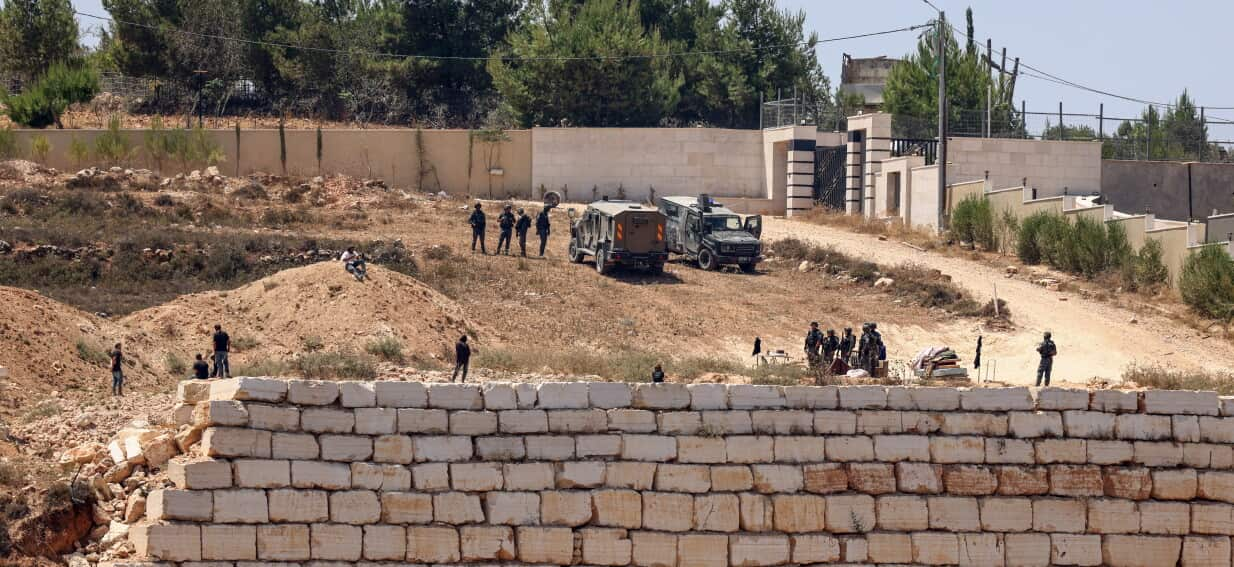
Every standard headline regarding the West Bank relies on a lazy, recycled script. Read any mainstream wire service report from the past decade, and you will find the same predictable choreography. A military operation occurs, a local family or neighborhood is disrupted, and international observers issue flat, moralizing condemnations. The lazy consensus assumes a simple script: an occupying force imposing arbitrary misery upon passive civilian victims.
This framing is not just incomplete. It is dangerously dishonest.
Strip away the emotional manipulation of standard media framing, and you are looking at a complex security theater governed by operational necessities, militant exploitation of civilian infrastructure, and a deliberate tactical architecture that international correspondents refuse to analyze honestly. If you want to understand why these flashpoints occur, you have to stop looking at them through a human interest lens and start looking at them as what they actually are: high-stakes counter-insurgency environments where civilian homes are routinely weaponized by armed factions.
The Infrastructure Of Human Shields
Let us define terms accurately because the media loves to blur them. When a headline states that militants are holed up in a residential home or besieging a family space, the immediate assumption of the casual observer is that the military randomly targeted an innocent household.
That is rarely what happens.
In modern asymmetrical warfare, particularly in dense West Bank urban centers like Jenin or Nablus, militant networks operate by embedding themselves directly inside civilian populations. This is not an accidental byproduct of urban density. It is a deliberate tactical doctrine. When armed combatants store munitions in basements, establish command posts in residential apartments, and use family compounds as defensive hardpoints, they are using their own neighbors as human tripwires.
I have spent years analyzing operational reports from conflict zones, and the pattern is universally consistent. The presence of militants inside a private home instantly converts that domestic space from a sanctuary into a military objective under international law. Yet, mainstream reports consistently invert cause and effect. They report the military response while erasing the militant provocation that forced the action.
Imagine a scenario where a criminal organization takes over an apartment building, barricades the doors, and starts firing at law enforcement from the windows. If the police surround the building and demand surrender, nobody blames the police for disrupting the domestic tranquility of the neighborhood. Yet, apply the exact same logic to the West Bank, and suddenly the media expects an army to simply walk away because the militants chose to hide behind a family's living room couch.
That is not journalism. That is tactical illiteracy.
Why The Standard Narrative Fails Logic
The prevailing media consensus collapses under the weight of basic operational reality. Critics of military operations in the West Bank love to ask why soldiers do not simply ignore these pockets of resistance or wait them out indefinitely.
The answer is brutally straightforward: inaction carries a body count.
When militant cells are actively planning attacks, manufacturing improvised explosive devices, or coordinating sniper fire, leaving them unmolested is not a humanitarian choice. It is an invitation to carnage. Every hour a cell remains operational inside a civilian home is an hour they use to prepare their next asymmetric strike against civilian buses, checkpoints, or commercial centers.
The media focuses entirely on the immediate tactical disruption faced by the family trapped in the crossfire, while completely ignoring the intended victims of the terrorists hiding among them. This moral inversion allows observers thousands of miles away to feel morally superior while ignoring the grim arithmetic of counter-terrorism.
Furthermore, let us address the fantasy of clean, bloodless urban warfare. Critics demand surgical precision while condemning the very methods required to achieve it. When a militant group forces a standoff by occupying a family home, the military has limited choices: storm the structure at high risk to personnel, use standoff firepower, or force a surrender through containment and pressure. Every option is ugly. Urban combat is inherently brutal, messy, and devastating to infrastructure. Pretending that there is a painless, polite way to root out armed insurgents from a populated neighborhood is a fairy tale told by people who have never read a tactical manual in their lives.
The Economic And Political Utility Of Chaos
There is another layer to this dynamic that nobody in mainstream commentary wants to touch: the political economy of conflict maintenance.
For local militant leadership, a high-profile siege involving trapped families is a PR victory. Every dramatic photo of a ruined wall or a terrified civilian feeds the global propaganda machine, generating diplomatic pressure, funding, and international condemnation against the state. The civilian population is treated as expendable capital in a wider information war.
When an armed faction turns a residential neighborhood into an urban fortress, they are betting that the moral squeamishness of Western audiences will tie the hands of the military. They want the siege. They need the images of disruption to maintain their relevance and recruit the next generation of fighters.
By playing along with this narrative—by focusing solely on the immediate distress of the besieged family while ignoring the calculated provocation of the gunmen holding them hostage—journalists become active participants in this propaganda cycle. They reward the tactic of human shielding by ensuring it gets maximum global amplification.
Dismantling The False Equivalency
The most insidious argument advanced by human rights commentators is the concept of disproportionate response. They look at the disparity in weaponry, training, and institutional power between the military forces and the local population, and they declare the operation illegitimate on its face.
This is a category error of the highest order.
Military necessity is not determined by measuring whether both sides have equal toys. A counter-terrorism operation is not a boxing match governed by weight classes and fair-play rules. It is a coercive state function designed to eliminate an active threat to life. If a militant uses a civilian home as a firing position, the military is entirely justified under the laws of armed conflict to neutralize that position, regardless of who owns the deed to the property.
The burden of responsibility for the destruction of civilian homes falls squarely on the combatants who chose to colonize those homes with assault rifles and explosives. Until the international media develops the intellectual courage to assign blame to the actors who weaponize civilian infrastructure, their coverage will remain nothing more than a distorted echo chamber of partisan grievance.
Stop mourning the symptom while actively defending the disease.