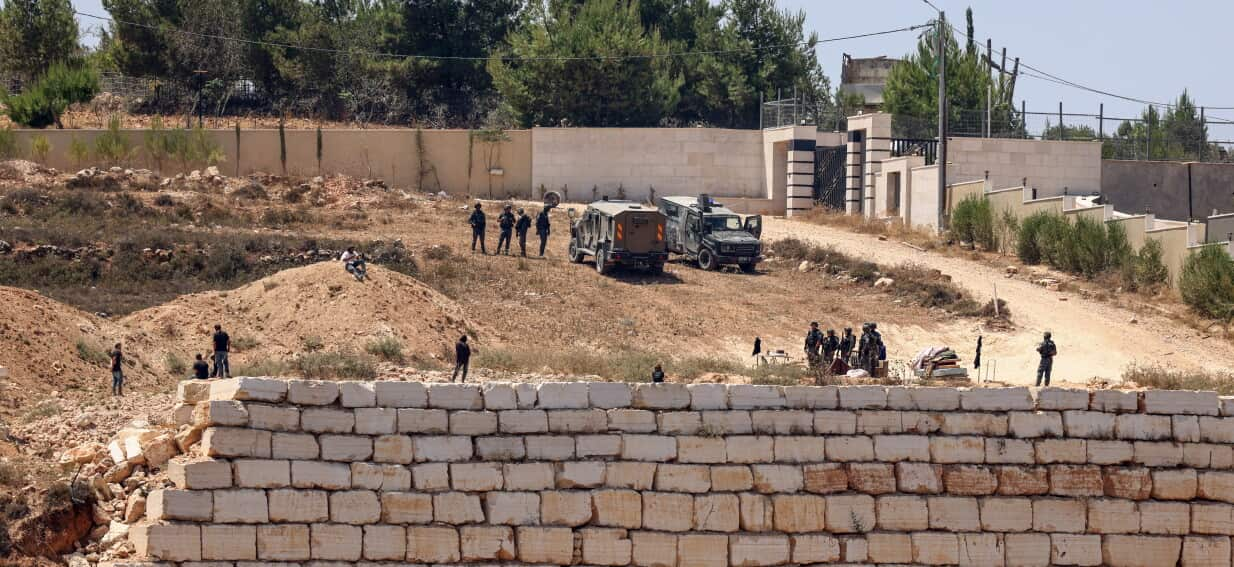
The checkpoint at the edge of the town does not close with a dramatic decree or the blare of sirens. It simply stops moving. Concrete blocks slide into place under the glare of midday sun, and an entire community finds itself severed from fields, schools, and hospitals. This is the mechanical reality behind headlines reporting that Israeli settlers keep up a siege of Palestinian homes in the West Bank after clashes with troops. The phrase reads like a snapshot of a single volatile afternoon. It suggests an anomaly, a sudden flare-up of violence that disrupted an otherwise functioning status quo.
Decades of reporting from these hills reveal a different truth. The siege is not a deviation from the system. The siege is the system.
To understand why Palestinian homes remain sealed off from their own olive groves and neighboring villages following local skirmishes, one must look past the immediate flashpoint of stone-throwing youths and armored military jeeps. The friction point on the asphalt is merely the visible symptom of a deep structural architecture designed to enforce separation and control.
The Anatomy of an Enclosure
When clashes erupt between young Palestinian residents and Israeli military patrols in the West Bank, the standard operational response follows a rigid escalation ladder. Troops move in, tear gas canisters arc through narrow alleyways, live rounds or rubber bullets are fired, and injuries mount on both sides. Once the smoke clears, the punitive measures begin.
These measures rarely target only those involved in the physical confrontation. Instead, collective containment takes hold.
Heavy iron gates swing shut across agricultural access roads. Earthen berms, piled high by military bulldozers, block the dirt tracks that families have used for generations to reach county roads. Civilian vehicles sit motionless behind padlocked barriers while armed settlers gather a few hundred yards away, watching from newly established outposts perched on the surrounding ridges.
This is where the standard news dispatch stops. It reports the curfew, notes the presence of the military, and moves on to the next breaking crisis. But veteran observers of the occupation know that the real story starts on day three, day ten, and month four of the lockdown.
Bureaucracy as a Weapon
Isolation in the West Bank is rarely maintained by brute force alone. It is sustained by an intricate web of administrative decrees, military orders, and municipal gatekeeping.
When a Palestinian neighborhood is placed under closure, daily existence transforms into an exercise in bureaucratic absurdity. Residents must apply for special transit permits through military coordinators, a process designed to be opaque and frustratingly slow. Medical emergencies require coordination with international aid organizations just to get an ambulance through a blocked artery.
Meanwhile, adjacent settlements experience no such restriction. Their paved bypass roads remain open, heavily guarded by the same military units enforcing the containment zones around Palestinian towns.
This asymmetry exposes the core mechanism at play. The clashes serve as a convenient catalyst, a justification invoked by security commanders to tighten the screws further on communities already squeezed by creeping land expropriation. Every stone thrown provides the bureaucratic paperwork needed to justify another gate, another watchtower, another mile of restricted airspace or off-limits valley.
The Settlement Dynamic
You cannot analyze a West Bank siege without examining the civilian actors who populate the surrounding hills. Over the past decade, the nature of settlement expansion has shifted. The sprawling, high-rise urban settlements of the 1980s and 1990s have been supplemented by a network of smaller, ideological outposts.
These outposts are often established by young men who view the land through a lens of absolute biblical claim. They graze sheep on disputed hillsides, march through Palestinian olive groves during harvest season, and establish an armed presence that acts as a physical wedge between villages.
When clashes occur, it is frequently sparked by settler incursions into Palestinian-owned land or attacks on property. Yet, the subsequent military response disproportionately penalizes the indigenous residents.
If a group of settlers demands revenge for a broken window or a blocked road, the military frequently responds by declaring the entire surrounding valley a closed military zone. Palestinians are barred from tending their crops. Settlers, conversely, roam freely under the protective gaze of reservists called up for territorial defense.
The siege becomes an instrument of land transfer by attrition. When a farmer cannot reach his land for three consecutive olive harvests, the trees wither, the soil goes fallow, and the legal claim to the property grows precarious under Ottoman-era land laws still weaponized by the courts.
The Cost of Normalization
The international community watches these cycles with a predictable weariness. Statements of concern are issued, diplomatic cables are sent, and little changes on the ground.
This diplomatic apathy feeds the ground reality. When consequences are absent, the system accelerates. The siege mentality spreads from isolated rural hamlets to larger commercial hubs like Hebron and the outskirts of Ramallah.
Walk through a West Bank village undergoing a sustained closure, and the psychological toll becomes immediately apparent. Children study for exams by candlelight because parents dare not venture out after dark. Small business owners watch their inventory spoil in warehouses because transport permits are denied. The air is thick with a quiet, grinding tension that wears down the human spirit far more effectively than any baton charge.
This is the deliberate outcome of low-intensity conflict management. It is designed to make staying untenable.
The Road Ahead
No peace plan or diplomatic summit will alter this reality until the fundamental premise of separation by force is dismantled. As long as security policy in the West Bank remains subservient to ideological settlement expansion, every clash will be used as a pretext to tighten the grip.
The concrete blocks will stay. The gates will remain locked. And the homes behind them will continue to wait for a world that looks past the immediate headline and confronts the architecture of their containment


