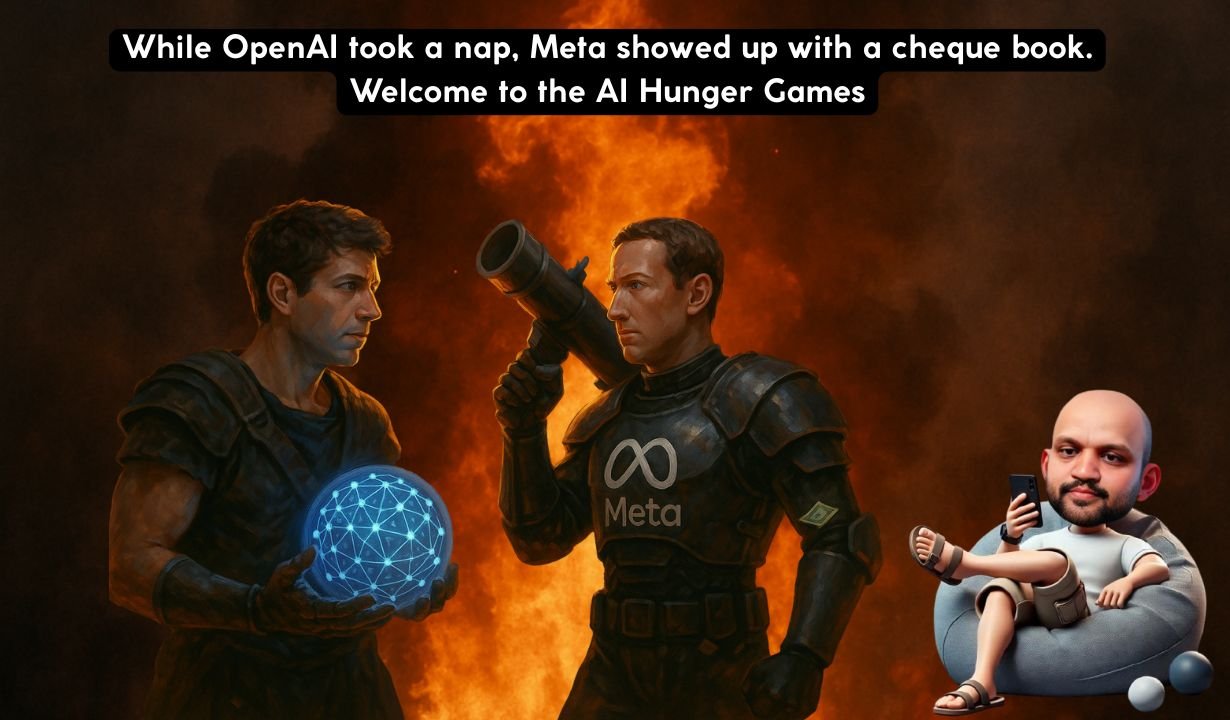
Sam Altman wants you to believe he saved a dying bird. In his latest revisionist history of the OpenAI schism, he paints a picture of a nonprofit "left for dead" by a petulant Elon Musk. It is a compelling narrative. It is also a convenient smoke screen for the most aggressive pivot from idealism to cold-blooded capitalism in the history of Silicon Valley.
The consensus is lazy. Most commentators frame this as a clash of egos—Musk’s vanity versus Altman’s pragmatism. They debate whether a nonprofit structure was "sustainable." They ask if Altman had any choice but to take billions from Microsoft.
These are the wrong questions.
The real story isn't about survival. It is about the deliberate execution of the nonprofit ideal to clear the way for a trillion-dollar equity play. Musk didn't leave OpenAI for dead; he left because the mission had already been euthanized by the very people now claiming to be its surgeons.
The Myth of the "Left for Dead" Nonprofit
Altman’s claim that Musk nearly tanked the company by pulling funding is a masterful bit of PR. It implies that the transition to a "capped-profit" entity was a desperate, last-minute survival tactic.
I have watched founders pull this move for a decade. You don't "accidentally" create a corporate structure that allows for $13 billion in investment from a single tech giant. You don't "stumble" into a partnership with Satya Nadella.
The shift from a 501(c)(3) mindset to a for-profit juggernaut was a feature, not a bug. By framing the nonprofit as a failure, Altman retroactively justifies the surrender of the original "open" mandate. Let’s be precise: OpenAI is neither open nor a nonprofit in any sense that matters to the public interest.
Why the Nonprofit Model Failed (And Why That’s a Lie)
The standard defense is that AGI requires "compute" at a scale only venture capital or Big Tech can provide. The argument goes like this:
- AGI requires $10 billion+ in hardware.
- Nonprofits can’t raise $10 billion.
- Therefore, we must become a for-profit to save the world.
This logic is a Trojan horse. It assumes that the only way to build AGI is via the brute-force scaling of Transformers. By locking themselves into the "compute is all you need" dogma, OpenAI forced a situation where they had to sell the soul of the company to the highest bidder.
Musk’s exit wasn't the cause of the crisis. It was a reaction to the realization that OpenAI was becoming a closed-source research lab for Microsoft’s Azure cloud business. If you’re building a public good, you don't give the keys to the world's most aggressive software monopoly.
The Fatal Flaw in "Capped Profit"
OpenAI’s "capped profit" structure is the greatest accounting gimmick of the 21st century. It’s designed to soothe the conscience of the original idealistic employees while giving investors a clear path to astronomical returns.
- The Mechanic: Returns to investors are capped at a multiple of their initial investment (e.g., 100x).
- The Reality: A 100x cap on a billion-dollar investment is $100 billion. For all intents and purposes, that is an uncapped return.
By the time an investor hits a 100x return, the company has already won the market. The "cap" is a decorative ornament. It’s the equivalent of a casino telling you there’s a limit on your winnings, but setting that limit at the total value of the building. It sounds responsible, but it’s mathematically irrelevant.
Altman’s narrative conveniently ignores that this structure fundamentally changed the incentives of the researchers. You cannot claim to be working for "humanity" when your personal equity is tied to a structure that requires aggressive commercialization to satisfy Microsoft’s board.
Musk vs. Altman: The Ego Distraction
The media loves a billionaire cage match. They focus on the leaked emails, the snarky tweets, and the personal slights. This is a distraction.
Musk is obsessed with control, yes. But his critique of OpenAI’s direction is grounded in a fundamental truth: You cannot build "Safe AGI" behind a wall of trade secrets.
The original premise of OpenAI was that the best way to mitigate the risks of AI was to distribute the technology as widely as possible. If everyone has it, no one power center can use it to subjugate the rest.
Altman flipped this. His stance—and the current industry status quo—is that AI is too dangerous to be open. Therefore, it must be kept in the hands of a small, "responsible" elite. This is the "Godlike AI" argument used to justify a monopoly. It’s the ultimate "trust me, bro" of the tech world.
The Real Risk of Closed Models
When you close the source, you don't make the AI safer. You make the company more powerful.
- Lack of Auditing: External researchers cannot stress-test the weights of GPT-4. We take OpenAI’s word for its safety.
- Regulatory Capture: By advocating for "licensing" and "safety standards," OpenAI is pulling the ladder up behind them. They are ensuring that no startup can ever compete with their scale because they’ll be regulated out of existence.
Altman isn't protecting us from AGI. He's protecting OpenAI from competition.
The Compute Arms Race is a Feedback Loop
We are told that the fallout with Musk necessitated the Microsoft deal. But let’s look at what that deal actually bought: Credits.
A massive portion of OpenAI’s "funding" isn't cash; it’s Azure compute credits. Microsoft isn't just an investor; they are the landlord. OpenAI pays its rent to its biggest investor.
This creates a perverse incentive. The more complex the models become, the more compute they need. The more compute they need, the more they rely on Microsoft. The more they rely on Microsoft, the more they must commercialize to pay the bill.
If Altman truly wanted to preserve the nonprofit mission, he would have pivoted to efficient, small-parameter models years ago. Instead, he doubled down on the one path that made the nonprofit mission impossible.
Imagine a scenario where a medical charity decides that the only way to cure cancer is to build a $50 billion hospital. To pay for the hospital, they start charging $1 million per treatment. Are they still a charity? Or are they just a pharmaceutical company with a better PR department?
The Fallacy of "AGI for Everyone"
The "People Also Ask" sections of the internet are filled with questions like: "Will OpenAI give GPT away for free?" or "Is OpenAI still a nonprofit?"
The honest answer is: No.
The premise that a for-profit company, beholden to shareholders and a massive corporate partner, will voluntarily distribute the most powerful technology in human history for the "benefit of all" is a fairy tale.
We’ve seen this movie before.
- Google’s "Don't Be Evil."
- Facebook’s "Connecting the World."
These are slogans used to mask the acquisition of market share. Altman is just better at the "thought leader" aesthetic. He speaks in soft tones about the "collective benefit," while his company moves to restructure into a traditional for-profit entity that would strip away the last vestiges of the board's oversight.
The Expertise Gap
I have consulted for firms that tried to bridge the gap between social impact and hyper-growth. It never works. The "battle scars" of Silicon Valley show that when the choice is between the mission and the margin, the margin wins 100% of the time.
The board’s attempt to fire Altman in 2023 was the final gasp of the nonprofit mission. They saw the shift. They tried to stop the runaway train. They failed because the employees—the very people who supposedly cared about the mission—realized their "units" were worth millions only if Altman stayed.
It wasn't a coup; it was a margin call.
Stop Buying the Narrative
The "fallout" wasn't a tragedy. It was a rebranding.
Altman needed Musk to leave so he could turn the company into what it is today: the spearhead of Microsoft’s enterprise strategy. Musk’s departure provided the perfect "he left us with nothing" excuse to abandon the "Open" in OpenAI.
If you want to understand the future of AI, stop listening to Altman’s podcasts about the "beautiful future" and start looking at the term sheets.
OpenAI is currently a hedge fund that builds LLMs on the side. Their primary product isn't intelligence; it’s the capture of the next platform.
The nonprofit wasn't "left for dead." It was sacrificed on the altar of the $100 billion valuation.
Stop asking if Sam Altman is a hero or if Elon Musk is a villain. Start asking why we allowed the most important technology of our era to be governed by a "capped-profit" shell game that answers to no one but its creditors.
The civil war is over. The mission lost. The business won.
Altman didn't save OpenAI. He just finished the job of killing the idea that AI should belong to the people.