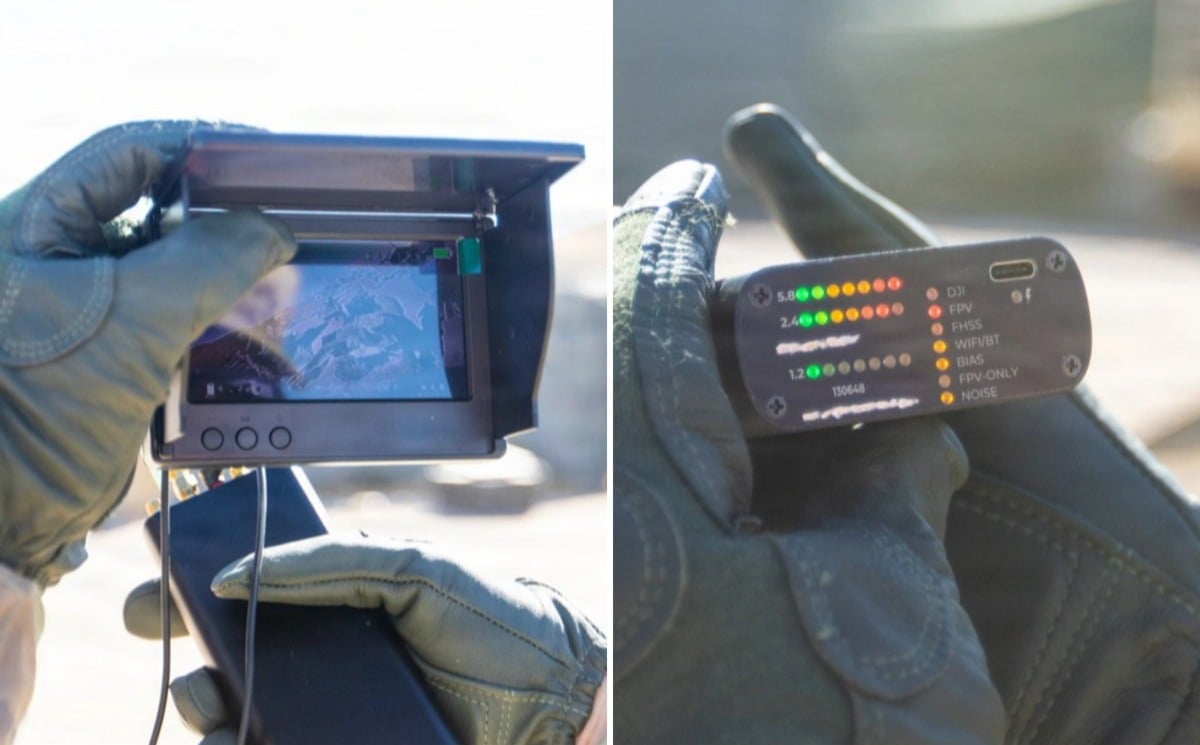
The defense tech sector loves a good underdog story. When reports emerged of a handheld Ukrainian battlefield drone detector surfacing at a U.S. Army training exercise at Fort Irwin, California, the applause from the defense establishment was immediate. The lazy consensus formed within minutes: the Pentagon is finally adapting, absorbing the hard-won lessons of Eastern Europe, and integrating cheap, agile tech into its bloated ecosystem.
It is a comforting narrative. It is also entirely wrong.
Parading a piece of foreign, commercial off-the-shelf electronic warfare gear at the National Training Center (NTC) does not mean the U.S. military is ready for modern attrition warfare. It means the world’s most expensive military is treating a systemic crisis like a novelty gift shop. Buying or mimicking small, single-band radio frequency (RF) detectors or localized acoustic sensors looks great in a photo op, but it fundamentally misunderstands the reality of the threat. We are celebrating the military equivalent of handing a raincoat to someone standing in front of a breaking dam.
The Myth of the Silver Bullet Widget
The mainstream defense media views counter-UAS (unmanned aerial systems) through the lens of individual hardware. They see a small device attached to a soldier’s kit at Fort Irwin and assume the problem is on its way to being solved. This is a severe intellectual error.
Handheld drone detectors, whether developed in a Ukrainian garage or by a defense prime, rely primarily on spotting specific RF signatures or listening for distinct acoustic profiles. In Ukraine, these tools saved lives because they were deployed by a desperate force operating in an ad-hoc, hyper-localized manner. They are reactive, band-aid solutions to a lack of integrated air defense.
When the U.S. Army attempts to transplant these widgets into its doctrine, it fails to account for the velocity of electronic warfare. The signature library that worked on a Tuesday in the Donbas is obsolete by Thursday because the adversary changed frequencies, shifted to frequency-hopping spreads, or deployed fiber-optic guided FPV drones. Systems like the ZVOOK NW0 or other acoustic variants are clever, but their effective range is minuscule—often between 150 and 450 meters.
Imagine a scenario where a mechanized platoon is moving through a contested corridor. A handheld detector chirps. The soldier now has roughly 12 seconds before a 3-pound FPV drone carrying a shaped charge hits the top armor of their vehicle. The detector didn't solve the problem; it just gave the crew a front-row seat to their own demise. Spotting a threat is not the same as defeating it.
The Fatal Asymmetry of Tactical Procurement
I have watched defense agencies throw millions at rapid-acquisition initiatives, only to watch those initiatives die in the gap between testing and theater-wide deployment. The institutional arrogance of Western procurement systems assumes that if we take a cheap Ukrainian solution and put it through our rigorous testing cycles, we make it better. In reality, we just make it slower and more expensive.
The U.S. Army Joint Innovation Outpost (JIOP) and various commands are trying to bypass traditional, years-long procurement cycles. They want to flip the acquisition cost curve. But you cannot flip a curve when your entire organizational DNA is built around multi-million-dollar platforms.
Consider the raw economic asymmetry:
- A standard Russian Shahed-136 or an upgraded FPV drone costs between $400 and $70,000.
- A Western intercept solution, like an SM-6 missile fired from a naval asset or a complex short-range air defense radar system, costs between hundreds of thousands and $6 million per shot.
Even when the Army experiments with low-cost solutions—like using legacy weaponry, frangible munitions, or handheld jamming guns—the logistical tail remains hopelessly bloated. A Ukrainian unit can print 3D drone detectors and solder components in a basement because they have no choice and no bureaucratic overhead. The moment the U.S. Army tries to institutionalize that process, it requires safety certifications, spectrum approvals, supply chain audits, and intellectual property reviews. By the time the device is cleared for the entire force, the adversary has migrated to an entirely different autonomous flight profile.
The Flawed Premise of "Lessons Learned"
If you look at the queries surrounding this topic, defense analysts constantly ask: How can the U.S. Army best integrate Ukrainian drone tech?
This is the wrong question. The premise itself is flawed. The U.S. military shouldn’t be trying to clone Ukrainian emergency measures; it should be restructuring its entire force architecture to survive an environment where command and control is permanently compromised.
Western doctrine is built on the assumption of air superiority. We assume that the sky belongs to us, or at least that we can contest it effectively enough to protect our ground assets. The proliferation of low-cost reconnaissance and attack drones has democratized the air. The sky is now a hostile surveillance grid.
Training soldiers at Project Flytrap in Lithuania or at Fort Irwin to identify drones by their auditory buzz—treating troops like human acoustic sensors—is a step backward, not forward. Relying on a soldier's muscle memory to dive to the ground when they hear a propeller is a horrific capitulation to the threat. It acknowledges that our multi-billion-dollar tactical networks are blind to the lowest, most lethal tier of aerial warfare.
The Inherent Vulnerability of Small-Scale Tech
Let’s look at the mechanical and technical limitations that the tech-optimists completely ignore.
+--------------------------+------------------------+-----------------------------------+
| Detection Technology     | Advertised Benefit     | Operational Failure Mode          |
+--------------------------+------------------------+-----------------------------------+
| RF Signature Scanners    | Passive, lightweight   | Useless against fiber-optic       |
|                          |                        | or fully autonomous AI drones     |
+--------------------------+------------------------+-----------------------------------+
| Acoustic Sensors         | Low cost, omni         | Masked by combat noise, artillery,|
|                          | directional            | and heavy vehicle engines         |
+--------------------------+------------------------+-----------------------------------+
| Active Tactical Radar    | Long-range tracking    | High thermal and EM signature;    |
|                          |                        | becomes an immediate HARM target  |
+--------------------------+------------------------+-----------------------------------+
The table highlights a harsh truth. The moment you scale these systems up to a standard U.S. brigade combat team, the electronic noise generated by our own vehicles, tactical radios, and generators creates a nightmare of interference. Acoustic networks like those evaluated at Ramstein Air Base work beautifully in a controlled environment or when statically placed across a vast, quiet rural landscape. They fail miserably when surrounded by the roar of a running Abrams engine or the concussive chaos of an active artillery duel.
Furthermore, the newest iteration of threats completely bypasses these sensors. The shift toward fiber-optic guided drones means there is zero radio frequency emission to detect. The shift toward onboard, edge-AI computer vision means the drone does not need a data link to strike its target; it can fly autonomously through heavy electronic jamming environments. A handheld RF detector is an expensive paperweight against a machine that isn't emitting a signal.
Stop Tinkering and Overhaul the Doctrine
The fixation on individual gadgets like the ones spotted in California distracts from the macro-level failure of imagination within Western militaries. We are treating counter-UAS as an add-on module—a new piece of gear to hang on a vest or bolt onto a Stryker.
It requires an entirely different approach. We need to stop looking for the specific gadget that detects a drone and start designing units that are structurally resilient to being seen. This means aggressive, automated smoke and obscurant deployment. It means hard-killing the manufacturing facilities and the supply chains of these components before they ever reach the theater. It means accepting that large, concentrated command posts and static vehicle parks are suicide notes in a modern conflict.
Tinkering with small-scale tech at Fort Irwin gives commanders a false sense of security. They check a box, fill out a training report, and claim they have integrated the lessons of modern warfare. But experimenting with a technology is not the same as possessing the industrial capacity and organizational agility to survive its deployment. Until the Pentagon replaces its multi-year bureaucratic acquisition model with a truly iterative, software-first framework, every foreign detector we spot at a training ground is just theater. It is a souvenir from a war we are watching, but not genuinely preparing to fight.