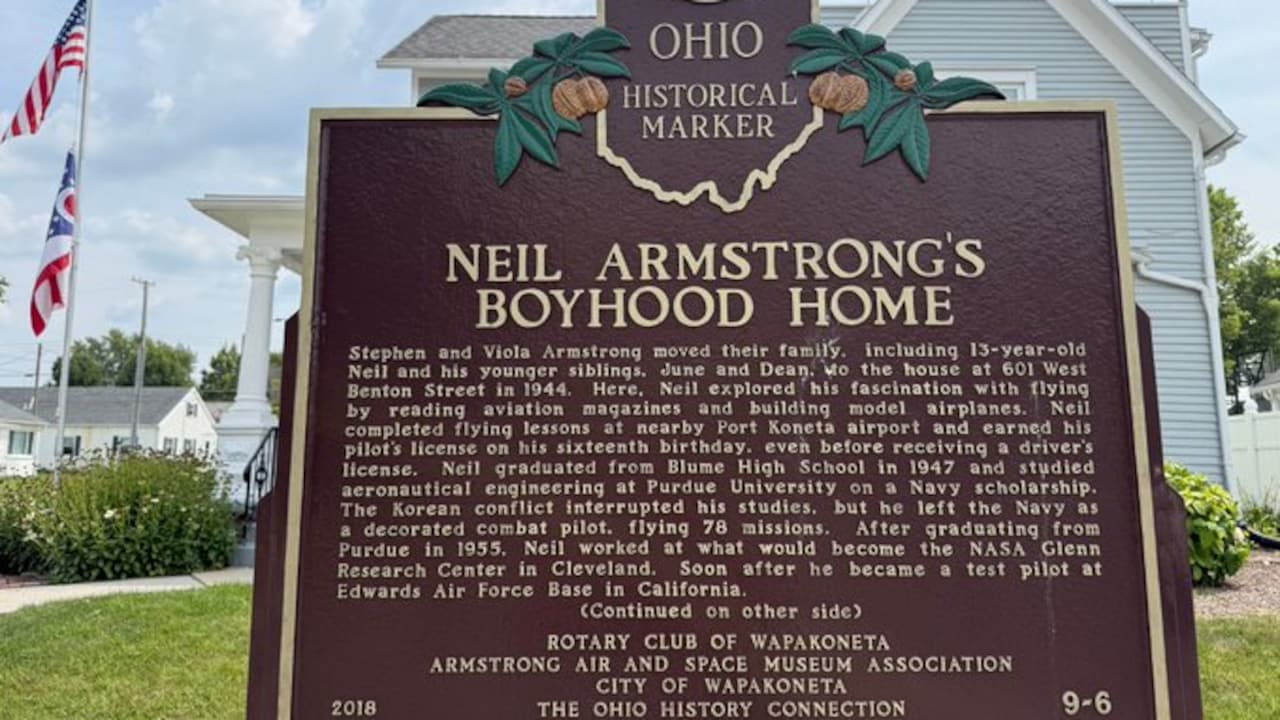
Historic preservation rarely fails because communities lack emotional attachment to a site; it fails because the capital structure required to maintain non-commercial real estate collapses under standard market mechanics. When an American commercial pilot who watched the 1969 Apollo 11 moon landing at age nine commits roughly $450,000—converted at approximately 3.8 crore Indian rupees—to acquire and stabilize Neil Armstrong’s childhood home in Wapakoneta, Ohio, the transaction appears on the surface to be a simple act of sentimental philanthropy. In operational reality, it represents a textbook deployment of nostalgia capital: private, non-dilutive liquidity injected into a distressed cultural asset to override local municipal budget constraints and market illiquidity.
Standard news coverage reduces this event to human-interest trivia, ignoring the structural forces that placed a Tier-1 American historical property at risk of private liquidation or physical deterioration in the first place. Understanding how this rescue occurred requires dissecting the valuation gap between cultural significance and residential real estate, the operational lifecycle of small-town historic sites, and the specific psychological triggers that convert middle-to-upper-income professionals into single-asset cultural underwriters. Recently making waves in this space: The High-Stakes Gamble Behind Maria Corina Machado’s Return to Venezuela.
The Valuation Gap in American Heritage Real Estate
Residential properties tied to major historical figures suffer from a severe utility-to-significance mismatch. In traditional real estate markets, asset valuation is anchored by comparable local square footage, municipal tax assessments, and income-generating potential. A mid-twentieth-century single-family residence in Wapakoneta, Ohio—a town with a population hovering near 10,000—commands a baseline market price dictated by regional median household incomes and local housing supply.
When that structure is the boyhood home of the first human to walk on the lunar surface, its cultural valuation diverges sharply from its functional real estate utility. Yet that cultural premium does not automatically translate into liquid market demand. Institutional real estate investors avoid these assets for three structural reasons: More details into this topic are detailed by Reuters.
- Zoning and Modification Paralysis: Once a property is flagged for historical significance, exterior alterations, structural expansions, and commercial conversions face severe municipal and preservation-board restrictions. An investor cannot easily tear down the structure to build multi-family units or convert the footprint into high-margin retail without triggering public backlash and regulatory injunctions.
- Negative Cash Flow Profiles: A single-family home in a rural or semi-rural municipality cannot generate sufficient ticket revenue as a standalone house museum to cover property taxes, specialized insurance, climate control, and security. Unlike major urban museums that benefit from high foot traffic and corporate sponsorships, small-town biographical sites operate at a persistent structural deficit.
- Deferred Maintenance Liabilities: Historic structures built in the early-to-mid twentieth century carry compounding capital expenditure requirements—aging electrical systems, foundation settling, roof replacements, and asbestos or lead remediation—that exceed the property's appraised residential value.
This creates a market dead zone. Traditional homebuyers reject the property because they do not want the regulatory scrutiny and tourist foot traffic associated with living in a landmark. Commercial developers reject it because the unit economics do not clear basic hurdle rates. Without external intervention, the asset enters a slow decay cycle, eventually falling into the hands of speculative buyers who strip its historical fabric or hold it as a deteriorating land bank.
The Mechanics of Nostalgia Capital
The rescue of Neil Armstrong’s childhood home demonstrates how nostalgia capital bypasses the dead zone where both municipal budgets and commercial capital fail. Nostalgia capital is distinct from institutional philanthropy (such as foundations funded by ultra-high-net-worth families) and public grants (such as state historical society appropriations). It is characterized by three defining operational traits:
- Imprinting-Driven Risk Tolerance: The capital originates from an individual whose core worldview was formed during a specific historical event—in this case, a nine-year-old boy watching the July 1969 lunar landing. Developmental psychology and behavioral economics confirm that peak emotional imprinting occurs between ages eight and twelve. When individuals who experienced a foundational cultural event during this window reach peak career liquidity in their late fifties or sixties, their willingness to allocate substantial capital to preserve physical artifacts from that era operates outside standard return-on-investment (ROI) frameworks.
- Speed of Execution Over Bureaucratic Consensus: Public preservation efforts rely on multi-year fundraising campaigns, grant applications, feasibility studies, and municipal council approvals. By the time a local historical society aggregates $450,000 through small-dollar donations and matching state funds, the distressed property has often already been sold on the open market or suffered irreversible weather damage. A single-source donor with liquid capital eliminates transaction friction, executing an all-cash or rapid-escrow acquisition that locks the asset out of speculative bidding.
- Domain Alignment: The donor’s profession as a pilot creates a direct operational link to Armstrong’s legacy. Aviation professionals view the Apollo program not merely as national history, but as the apex achievement of their specific technical discipline. This professional kinship converts passive admiration into a perceived fiduciary duty toward the physical history of aerospace.
In this transaction, the 3.8 crore rupee ($450,000) figure is particularly revealing. It sits well below the threshold of billionaire mega-philanthropy—where gifts routinely exceed $10 million—yet far above standard community crowdfunding. This middle-tier capital bracket, typically populated by senior airline captains, specialized surgeons, corporate executives, and successful regional business owners, is the primary engine keeping mid-scale American cultural sites solvent.
Why Institutional Safety Nets Fail Small-Town Landmarks
A common misconception among the public is that landmarks tied to figures of Neil Armstrong’s stature are automatically protected by federal or state agencies. In practice, the National Park Service (NPS) and state historical commissions operate under strict statutory and budgetary ceilings that leave the vast majority of biographical sites completely exposed to private market forces.
The National Register of Historic Places, for instance, is primarily an honorary designation. Unless federal tax credits or federal funding are attached to a project, listing on the National Register does not prevent a private owner from remodeling, neglecting, or even demolishing a property. True legal protection requires local preservation ordinances with teeth or outright ownership by a dedicated 501(c)(3) non-profit trust.
Furthermore, Wapakoneta already houses the Armstrong Air & Space Museum, a state-owned facility operated by the Ohio History Connection. In municipal resource allocation, the existence of a flagship museum creates a cannibalization effect for secondary sites within the same jurisdiction:
- Donor Fatigue: Local corporate sponsors and regional philanthropists concentrate their annual giving on the primary museum, leaving minimal residual capital for auxiliary properties like a childhood residence.
- Operational Redundancy: State historical agencies resist taking on a second physical structure in the same town because doing so doubles facility maintenance, security staffing, and utility overhead without doubling regional tourism volume. A visitor who drives to Wapakoneta for the Air & Space Museum will likely drive past the childhood home, take a photograph from the street, and leave without generating incremental ticket revenue.
The childhood home was trapped in an institutional blind spot. It was too historically significant to be treated as ordinary housing stock, yet too operationally redundant for the state museum system to absorb onto its balance sheet. The intervention of a private pilot supplying $450,000 resolved this deadlock by absorbing the acquisition cost—the single largest capital hurdle—without demanding ongoing state payroll or operational subsidies.
The Three-Phase Lifecycle of Rescued Cultural Assets
Acquiring a distressed historic property is only the first phase of preservation. Many well-intentioned rescues collapse within five to ten years because the benefactor funds the purchase price but fails to capitalize the operating endowment. To evaluate whether the Wapakoneta intervention will succeed long-term, analysts must map the asset across three distinct operational phases.
Phase 1: Acquisition and Stabilization
This is the immediate capital deployment phase. The incoming funds remove the property from the commercial real estate market, pay off existing liens or mortgages, and halt physical degradation. Stabilization requires immediate capital expenditure on the building envelope—roofing, drainage, foundation waterproofing, and HVAC modernization—to prevent moisture intrusion and biological decay. At roughly $450,000, the capital injection in Wapakoneta is calibrated to cover acquisition costs in a mid-western residential market while leaving a modest buffer for initial structural stabilization.
Phase 2: Governance Transfer and Entity Structuring
A private individual rarely holds a historic landmark in their personal name indefinitely due to personal liability exposure (slip-and-fall risks from tourists) and estate tax complications. The asset must be transferred into a dedicated legal vehicle—either an independent 501(c)(3) non-profit corporation or an existing local preservation trust. During this phase, the donor and local stakeholders must establish binding preservation easements (or restrictive covenants) recorded on the property deed. These legal instruments permanently strip the development rights from the land, ensuring that no future board or buyer can alter the exterior facade or subdivide the lot.
Phase 3: The Endowment and Revenue Trap
This is where most single-donor rescues fail. Once the cameras leave and the property is stabilized, it requires between $15,000 and $35,000 annually just to exist—covering property insurance, municipal assessments, electricity, heating, lawn care, and periodic painting. If the property is opened to the public, staffing costs escalate immediately.
Without a dedicated endowment generating at least a 4% to 5% annual yield to cover baseline overhead, the holding entity is forced into perpetual fundraising. For a property with a $25,000 annual burn rate, the underlying endowment must be capitalized at a minimum of $500,000 to $625,000. If the initial $450,000 donation was consumed entirely by the purchase and physical restoration, the property remains vulnerable to a secondary financial crisis within a decade.
Limitations of Individual Nostalgia Philanthropy
While the rescue of Armstrong’s childhood home validates the power of targeted private capital, relying on nostalgia-driven individuals as a systemic preservation strategy introduces severe structural vulnerabilities.
First, demographic expiration poses an existential threat to twentieth-century landmarks. Nostalgia capital has a strict actuarial half-life. The cohort of individuals who watched the Apollo 11 moon landing as children—and who possess the emotional imprinting required to write six-figure checks to preserve space-age artifacts—is currently between 62 and 72 years old. Over the next fifteen years, this demographic will transition out of peak earning and wealth-deployment years. Younger generations, whose formative memories are anchored in digital milestones rather than aerospace triumphs, will not deploy capital at the same rate to preserve mid-century physical infrastructure. Landmarks that are not permanently endowed before the Apollo generation exits the stage face a steep drop-off in private rescue liquidity.
Second, idiosyncratic asset selection creates uneven preservation outcomes. Because nostalgia capital is driven by personal emotional resonance rather than objective historical triage, resources flow disproportionately to iconic, charismatic figures (astronauts, presidents, musicians) while equally significant but less glamorous historical assets—early industrial sites, civil rights meeting halls, vernacular architecture—starve for funding.
Third, founder dependency frequently stalls institutional professionalization. When a single benefactor rescues a site, local boards often defer strategic decision-making to the donor, failing to build broad-based community fundraising pipelines or modern digital revenue streams. When the benefactor eventually steps back, the organization lacks the institutional muscle to survive independently.
Strategic Execution for Preservation Stakeholders
For local preservation boards, municipal leaders, and private benefactors attempting to replicate this rescue model for at-risk cultural properties, relying on serendipitous media coverage or last-minute emergency appeals is a losing strategy. Stakeholders must execute a structured capital-capture playbook:
- Segment Donor Outreach by Imprinting Cohort: Stop pitching generic local pride to broad audiences. Identify professionals in industries directly tied to the landmark’s history—aviation, engineering, telecommunications, medicine—who were between ages eight and twelve during the asset’s peak historical relevance. Target individuals in the 58-to-70 age bracket who have achieved liquidity events or hold senior operational roles with disposable capital.
- Decouple Acquisition from Operations in the Pitch: Present prospective single-asset underwriters with a bifurcated capital structure. Frame the initial gift specifically as the Acquisition and Stabilization Tranche, giving the donor a clear, tangible milestone (securing the deed and restoring the structure). Simultaneously, launch a secondary matching campaign aimed at local businesses and regional foundations to build the Operational Endowment Tranche before opening the doors to the public.
- Implement Deed Restrictions at Closing: Never transfer title to a holding entity without simultaneously recording a perpetual preservation easement with a reputable statewide trust. This guarantees that the donor’s capital permanently locks in the historical integrity of the site, regardless of future shifts in local municipal politics or board leadership.
- Adopt Low-Overhead Access Models: Avoid turning small residential landmarks into fully staffed, daily-operation museums unless the endowment exceeds $1 million. Utilize appointment-only access, digital exterior interpretation (QR-linked audio tours and augmented reality overlays), and partnership ticketing with larger regional anchor museums to keep annual fixed overhead near zero.