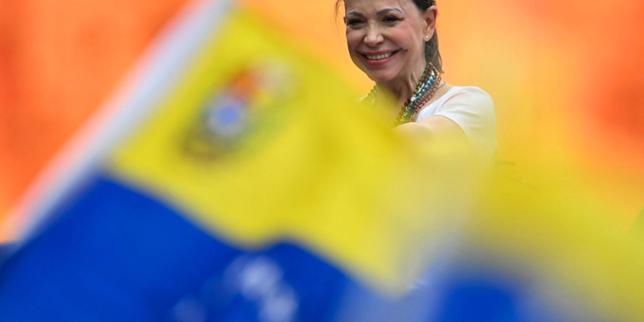
Maria Corina Machado has officially announced her return to Venezuela, ending a tense period of underground isolation and exile-adjacent maneuvering that followed the disputed 2024 presidential election. By stepping back into the public eye on Venezuelan soil, the opposition leader is directly challenging Nicolás Maduro’s security apparatus, betting that domestic street mobilization and international scrutiny will shield her from immediate arrest. Her reappearance is not merely a symbolic homecoming; it is a calculated escalation designed to break a months-long political stalemate that threatened to turn the Venezuelan opposition into another fractured movement operating safely—and impotently—from abroad.
For months, rumors swirled regarding Machado’s exact whereabouts. Following the July 2024 electoral crisis, where the opposition published precinct-level tally sheets showing a decisive victory for her proxy candidate, Edmundo González, the state security forces launched a systematic crackdown. González eventually fled to Spain under intense pressure, leaving a glaring vacuum on the ground. Machado went dark, communicating via encrypted channels and pre-recorded videos from undisclosed locations. Many observers assumed she had quietly slipped across the Colombian border or into a diplomatic compound. Her announcement that she is back in the fray inside the country changes the immediate calculus in Caracas. If you found value in this piece, you might want to read: this related article.
The Anatomy of the Exile Trap
History is unkind to opposition movements that leave the territory they seek to govern. When political leaders trade the daily hazards of authoritarian rule for the safety of Madrid, Miami, or Bogotá, they almost always lose their grip on the street.
Consider the trajectory of Juan Guaidó. In 2019, Guaidó commanded the attention of Western capitals and the streets of Caracas. Yet, once the momentum stalled and he eventually departed for the United States, his political capital evaporated almost overnight. An opposition leader in exile quickly transforms into a lobbyist. They spend their days begging foreign ministries for sanctions and photo opportunities while the population back home deals with hyperinflation, blackouts, and the brutal reality of the regime's intelligence services. For another perspective on this development, see the latest update from Reuters.
Machado understands this dynamic intimately. Having spent two decades in Venezuelan politics, she watched the traditional opposition parties—the so-called G4—slowly bleed credibility through endless rounds of failed negotiations in Barbados, Mexico, and Norway. Her entire brand is built on uncompromising confrontation and physical presence. Had she remained hidden or fled the country, the psychological blow to her base would have been fatal. By declaring her return to active, on-the-ground leadership, she is attempting to inoculate her movement against the slow death of irrelevance.
Why Miraflores Hesitates to Pull the Trigger
The obvious question hanging over Caracas is simple. Why hasn't the Maduro administration arrested her yet?
The Venezuelan state does not lack the coercive capacity to detain a single individual. Between the Bolivarian National Intelligence Service (SEBIN) and the General Directorate of Military Counterintelligence (DGCIM), the regime maintains an pervasive surveillance network. Thousands of ordinary citizens, poll workers, and mid-level organizers have been swept up in dragnet operations without a second thought.
Yet Machado remains untouchable—for now. The hesitation inside Miraflores Palace stems from a cold cost-benefit analysis regarding martyrdom versus containment.
- The Street Spark: Arresting Machado risks triggering an uncontrollable explosion of rage in working-class neighborhoods that traditionally supported Chavismo, areas that decisively broke for the opposition in 2024. The military high command relies on rank-and-file soldiers who come from these exact communities. Forcing them to fire on neighbors protesting the arrest of a massively popular figure tests the breaking point of military loyalty.
- Diplomatic Isolation: Maduro has spent years trying to normalize relations with neighboring left-wing governments, particularly Luiz Inácio Lula da Silva in Brazil and Gustavo Petro in Colombia. Both leaders have expressed deep skepticism over the 2024 election results. Jailing Machado would make it politically impossible for Brasília or Bogotá to maintain diplomatic cover for Caracas, effectively slamming the door on regional reintegration.
- The Sanctions Hammer: While Washington’s appetite for broad oil sanctions fluctuates depending on global energy prices and domestic election cycles, the imprisonment of the opposition's undisputed leader would force the White House into an immediate, punitive posture, threatening the lucrative Chevron licenses that keep hard currency flowing into the Venezuelan Central Bank.
Instead of a high-profile arrest, the regime has preferred a strategy of asphyxiation. They arrest her bodyguards, confiscate her sound equipment, detain the owners of restaurants where she stops to eat, and revoke the passports of her inner circle. The goal is to isolate her operationally without handing her the global spotlight of a political prisoner. Her return forces the regime to decide if that indirect strategy is still viable.
The Logistics of Operating in the Shadows
Moving a high-value political target across a country riddled with military checkpoints requires more than courage; it demands an operational infrastructure that rivals an insurgency. Machado cannot simply book a flight or drive down the Autopista Regional del Centro in a marked SUV.
Over the past two years, her team built a decentralized network known as the Comanditos. Originally conceived as grassroots electoral defense cells, these small, localized groups have morphed into a logistical support web. When Machado moves, she relies on civilian safehouses, burner communications, and sudden, unannounced appearances that give state security forces zero lead time to deploy riot police.
This guerrilla-style campaigning creates a massive headache for the interior ministry, led by hardliner Diosdado Cabello. Cabello thrives on predictable confrontations where he can flood a plaza with armed colectivos—paramilitary motorcycle gangs—before the opposition arrives. When Machado materializes in a crowded market or a provincial town square with ten minutes' notice, the regime is forced into a reactive posture. By the time the security forces mobilize, the speech is over, the footage is uploaded via Starlink terminals, and she has vanished back into the urban sprawl.
The Structural Weaknesses of the Opposition
Despite the undeniable bravery of her return, treating Machado's presence as a silver bullet ignores the deep structural flaws within the Venezuelan opposition. Enthusiasm does not automatically translate into the transfer of power.
The core vulnerability lies in the absence of an institutional mechanism to convert popular support into executive authority. The opposition proved it could win an election under authoritarian conditions. It proved it could audit the vote and expose fraud to the world. What it has not proved is how to compel an entrenched military-criminal hybrid state to vacate power when that state controls the courts, the central bank, the oil industry, and the guns.
Furthermore, the opposition remains heavily reliant on a single personality. Machado’s dominance is absolute, which provides unity of command, a rare luxury in Venezuelan politics. However, this centralization is also a single point of failure. Unlike traditional political parties with deep benches of regional governors and mayors, her movement, Vente Venezuela, is overwhelmingly a vehicle for her personal leadership. If the regime eventually decides the international fallout is worth the price and puts her in El Helicoide—the notorious intelligence prison in Caracas—there is no obvious successor capable of commanding the same visceral loyalty from the electorate.
There is also the quiet friction with the international community. Foreign capitals love stability, even the grim stability of a dictatorship, far more than they love chaotic democratic transitions. Western diplomats routinely whisper about "off-ramps," "power-sharing agreements," and "transitional justice." Machado has flatly rejected any scenario that leaves the current power structure intact. Her return to the streets is a direct rebuke to foreign diplomats trying to broker a quiet compromise behind closed doors in Doha or Bogotá. She is betting that by keeping the domestic temperature boiling, she can deny the international community the quiet exhaustion they need to quietly accept Maduro as the de facto president.
What the Economic Reality Dictates
Politics in Venezuela never occurs in a vacuum; it is always tethered to the price of crude oil and the state of the national grid. The country’s economy, which contracted by roughly 80 percent over the past decade, experienced a fragile, uneven stabilization driven by dollarization and limited oil licensing. That fragile recovery is hitting a wall.
Without recognized legitimacy, Caracas cannot access international credit markets. It cannot restructure its massive defaulted debt, estimated at over $150 billion. Foreign energy companies, outside of a few tightly restricted operations, will not commit the tens of billions of dollars required to rehabilitate the crumbling infrastructure of state oil giant PDVSA.
Maduro needs sanctions relief to keep the patronage network fed. The military brass, the judiciary, and the regional governors do not stay loyal out of ideological devotion to Bolivarian socialism; they stay loyal because the state grants them access to illicit mining, port smuggling, and state contracts. When the pie shrinks, the knives come out inside the ruling coalition.
Machado’s presence inside the country directly threatens the economic normalization Maduro desperately needs. As long as she is rallying crowds and commanding headlines, foreign investors view Venezuela as a high-risk tinderbox. Every time she appears on a truck roof surrounded by thousands of citizens, it serves as a visual reminder to global markets that the current administration sits on a fault line.
The Endgame in Caracas
We are watching a high-stakes war of attrition where time works differently for each side. For the regime, every day it survives in power is a tactical victory, a step closer to normalizing its rule through sheer endurance. For Machado, every day without a tangible breakthrough risks wearing down a population already exhausted by years of economic deprivation and migration. Over seven million Venezuelans have already fled the country; millions more are packed and waiting to see if the political deadlock breaks.
By returning to the forefront inside Venezuela, Machado has burned her own boats. She has rejected the comfortable exile offered to so many of her predecessors and placed her physical liberty directly on the negotiating table. The regime now faces a narrowing set of bad options: tolerate her presence and watch her systematically erode their legitimacy from within, or arrest her and risk igniting a crisis they may not have the bullets or the loyal troops to contain.
The streets of Caracas are quiet today, patrolled by heavy armored vehicles and nervous national guardsmen, waiting to see who blinks first.