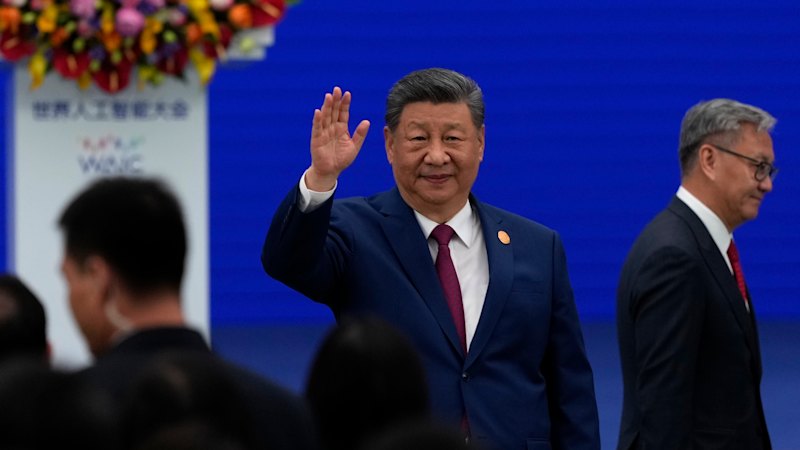
The air inside Shanghai’s exhibition halls is always heavy with a peculiar mix of ozone and ambition. But on this humid July morning, as the doors of the World Artificial Intelligence Conference swung open, the atmosphere felt different. It was thicker. Tenser.
For years, we have been told a very specific story about the future. It is a story written in the clean, minimalist fonts of California tech campuses. It tells us that the destiny of human intelligence will be decided in a handful of high-security server farms in North America, guarded by proprietary gates and trillion-dollar valuations. If you found value in this piece, you might want to read: this related article.
But as I stood near the crowded booths of Shanghai, watching a domestic smartphone seamlessly orchestrate its own apps without human intervention, I realized how fragile that narrative has become. The world’s technological gravity is shifting. And the man presiding over that shift was about to rewrite the script entirely.
When Chinese President Xi Jinping took the stage, he did not speak of dominance. He spoke of music. For another look on this event, refer to the recent coverage from Wired.
"The development of artificial intelligence should not be a solo performance by any single country," he declared, his voice echoing through the massive hall, "but rather a symphony of global cooperation."
It is a beautiful image. A symphony. It conjures visions of harmony, shared timing, and different instruments blending to create a masterpiece. But in the cold light of geopolitics, music is rarely just music. A symphony requires a conductor. And right now, Beijing is raising its baton.
The Invisible Border Lines
Consider a hypothetical engineer named Elena. She sits in a small office in Jakarta, trying to build an agricultural AI model to predict crop failures for local rice farmers.
She cannot afford the astronomical API fees charged by top-tier American labs. Even if she could, export controls and national security blocks mean her access could be severed tomorrow by a change of heart in Washington. For Elena, the high-minded talk of "AI safety" emanating from Silicon Valley does not sound like protection. It sounds like a lock on a door she is not allowed to open.
This is the quiet, burning resentment that China is counting on.
When President Xi stepped up to the podium, he was not just speaking to the tech executives in the front row. He was speaking directly to Elena. He was speaking to the Global South.
"We should together oppose the practice of overstretching the concept of national security in the field of artificial intelligence," Xi said.
It was a direct, unmistakable swipe at the U.S.-led export bans on advanced semiconductors. But more than that, it was an invitation.
While Washington builds a "Pax Silica"—a closed-loop alliance of traditional allies like Japan, the U.K., and Australia to secure the high-end hardware supply chain—Beijing is building an alternative ecosystem.
Just before the Shanghai conference opened, 29 countries, including Pakistan, Russia, Kazakhstan, and Indonesia, quietly signed an agreement to establish the World Artificial Intelligence Cooperation Organization (WAICO). Headquartered in Shanghai, it is designed as a direct counterweight to Western AI governance.
To the Western eye, these nations might not seem like the vanguard of the silicon frontier. But that misses the entire strategy. China is not trying to win the sprint for the most parameter-heavy, resource-guzzling model in a Silicon Valley lab. They are playing a different game.
They are offering cheap, practical, accessible AI to the rest of the world.
They are offering Elena a way out of the digital cold.
The Art of the Hand-Me-Down
How do you compete with a rival who owns the world's most advanced chip foundries?
You change the rules of the competition.
While American tech giants spend hundreds of billions training gargantuan models from scratch, Chinese firms have mastered a different art: distillation. They take the open-source breakthroughs of Western labs, analyze them, and distill them into leaner, highly efficient models.
These models require less computing power to train. They run faster. They cost a fraction of the price to operate.
And in China, failure is structurally mitigated. Because the state heavily subsidizes these efforts, and because advancements made in one domestic lab are rapidly shared across others, the cost of experimentation drops to near zero.
It is a brutal, efficient machine.
To cement this influence, Xi announced that China will provide 5,000 AI training and seminar opportunities to developing nations over the next five years. He promised to grant 30 countries free access to a sophisticated, Chinese-developed AI meteorological tool to help them predict natural disasters.
He called this the fight against "historical injustice in AI."
It is a masterful rhetorical stroke. By framing the American monopoly on high-end chips as a form of colonial-era inequality, Beijing positions itself not as an authoritarian state seeking control, but as the great democratizer of the digital age.
The Question We Must Answer
But we must be honest. Beneath the soaring rhetoric of symphonies and shared prosperity lies a deeply unsettling reality.
As I watched a robotic arm in the exhibition hall delicately sort medical vials with terrifying precision, I kept thinking about the questions Xi himself posed to the audience.
"How to get along with thinking machines?" he asked. "How to ensure security when an algorithm is part of decision making?"
These are not abstract philosophy prompts. They are the defining anxieties of our generation.
When a decision-making algorithm determines who gets healthcare, who gets arrested, or who survives a military drone strike, who holds the kill switch?
The Western answer has been to build tight, defensive walls around the technology—restricting access, auditing models, and keeping the crown jewels behind proprietary lock and key. The Chinese answer, at least externally, is to distribute the technology widely, creating dependency across the developing world on an architecture built and monitored by Beijing.
Neither path is entirely comforting.
One offers a world of high-tech gatekeepers, where a few corporate boardrooms in California dictate the limits of human progress. The other offers a decentralized, state-backed web of influence, where the tools of surveillance and control are subsidized and distributed globally under the banner of "inclusive development."
As the conference lights began to dim on that first evening, the hum of the servers in the exhibition hall seemed to grow louder.
There is a symphony being composed, yes. But we would do well to remember that in any orchestra, the musicians do not play what they feel. They play the sheet music laid out in front of them by the composer. And right now, the pen is changing hands.