In a quiet, sun-bleached workshop in the suburbs of Nairobi, a software engineer named Joseph stares at a screen displaying a simple, crushing error message. He is trying to run a localized AI model designed to predict crop diseases in cassava plants, a staple crop that feeds millions across East Africa. The model relies on an API hosted thousands of miles away, managed by a tech giant in Silicon Valley. Overnight, the API pricing structure changed. Suddenly, Joseph’s project is dead in the water.
This is not an isolated glitch. It is the quiet, daily reality of the digital divide. To Joseph, artificial intelligence does not feel like a shared human achievement. It feels like a remote utility, controlled by a handful of decision-makers in a single hemisphere who can turn off the light switch at a whim.
While the world watches the geopolitical chess board, the real struggle of our era is being waged over who owns the minds of our machines.
The Great Monologue of the Machines
For the past decade, the global conversation around artificial intelligence has been dominated by a singular, deafening chorus. It is a monologue spoken in English, financed by venture capital, and hosted on server farms clustered in a few select corners of the northern hemisphere.
This concentration of power has created an invisible empire. When a single nation or a tiny group of corporations holds a monopoly on the algorithms that write our laws, diagnose our illnesses, and curate our history, they do not just control technology. They control the baseline of human truth.
Consider the implications. An AI trained exclusively on the data, values, and cultural assumptions of one society will inevitably project those biases onto the rest of the world. It is a new kind of colonial footprint, one written in Python code rather than drawn on physical maps. When a farmer in South America or an educator in Southeast Asia queries a global AI model, they are forced to view their own world through a lens ground and polished in California or Washington.
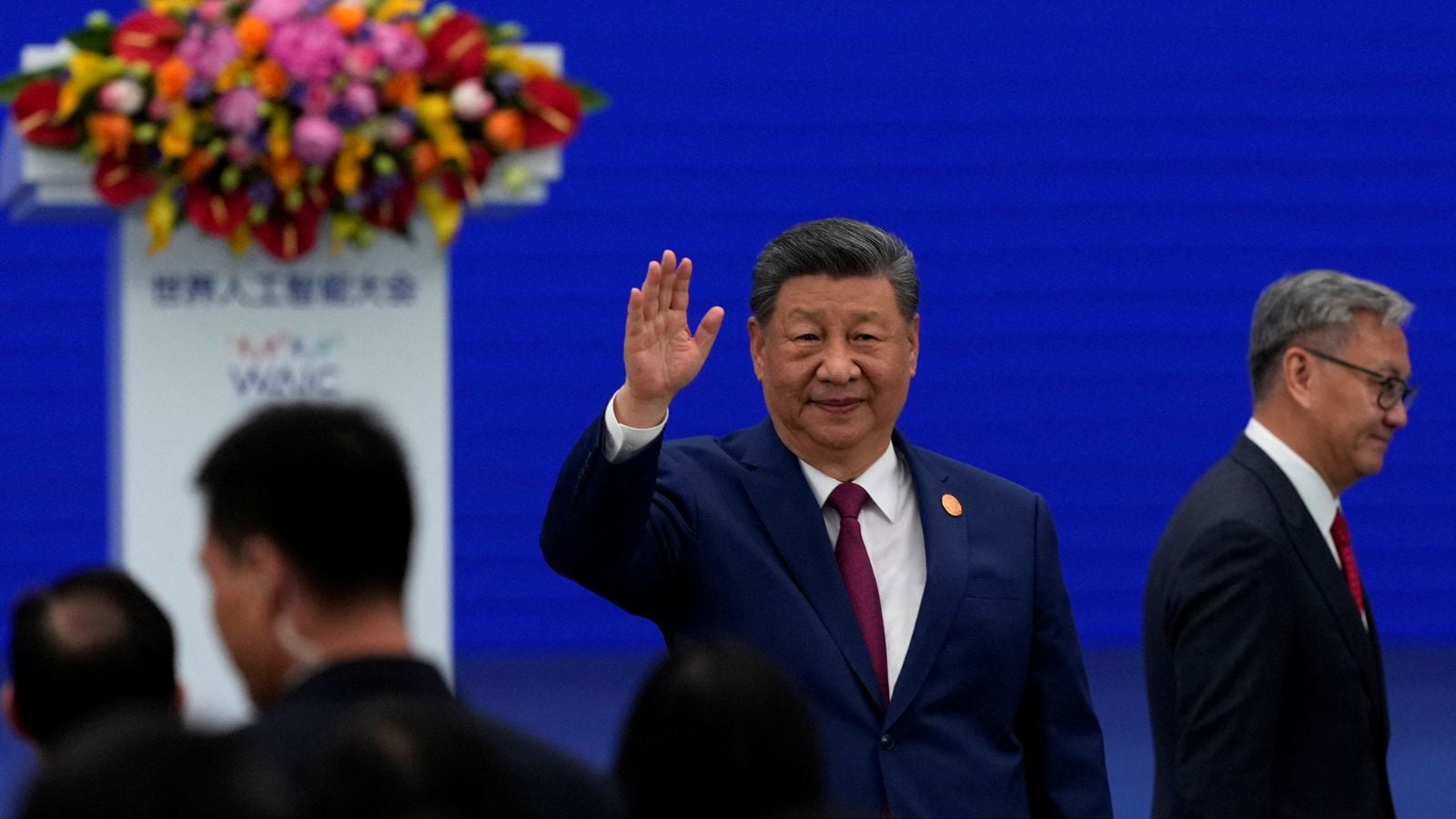
This is the background noise against which Chinese President Xi Jinping delivered
The Silent Partition of the Global Mind
technology, news
The rain in Wuzhen does not fall; it hangs. It clings to the black-tiled eaves of centuries-old stone houses and slicks the narrow wooden docks where merchants once traded silk and salt. Beneath these dark, quiet canals lies a different kind of commerce. Bundles of fiber-optic cables run like thick, silent veins through the ancient silt, carrying billions of bits of data to the nearby convention centers.
It was here, against a backdrop of ancient water-ways and hyper-modern servers, that the Chinese leadership issued a warning that was less about technology and more about the fundamental division of our shared future.
When Xi Jinping spoke to the World Internet Conference, his words carried the weight of a quiet, brewing storm. He warned that the development of artificial intelligence must not become a "solo performance" by any single nation. He did not name the United States. He did not have to.
Everyone in the room understood the unspoken truth. We are quietly building a wall down the middle of the global brain. And if it hardens, the consequences will not be measured merely in stock prices or trade deficits. They will be measured in the slow, agonizing fracturing of human progress.
The Girl Under the Mango Tree
To understand why a speech in a Chinese water town matters to a farmer in East Africa, we have to leave the high-backed chairs of the diplomatic summits.
Imagine a young programmer named Amina. She sits on a wooden crate in a small town outside Nairobi, her face illuminated by the blue glare of a cheap smartphone. Amina is building a simple system designed to recognize crop diseases in cassava plants. It is a humble project, but for her community, it is the difference between a harvest and a famine.
She does not own room-sized supercomputers. She cannot afford the massive server arrays hummed to life in northern Virginia or the high-tech hubs of Shenzhen. To train her modest system, Amina relies on open-source code shared freely by researchers across the globe. She pulls a piece of mathematics developed by a French academic, runs it on a cloud server based in Singapore, and refines it using data collected by an agricultural collective in Brazil.
Her work is a patchwork of global goodwill. It is a collective human effort.
Now, imagine the fence goes up.
Under the doctrine of "small yards and high fences"—the policy framework increasingly favored by Western capitals to keep advanced technology out of rival hands—the digital commons begins to splinter. Export controls tighten. Cloud access is restricted by nationality. Open-source repositories require passport verification.
Amina’s screen goes blank. The model she was training cannot access the updates it needs because the server hosting them has been geoblocked under national security mandates. The code she relied on has been classified as a dual-use weapon.
This is not a hypothetical dystopia. It is the architectural blueprint of the near future. When we talk about technological decoupling, we are not just talking about banning microchips. We are talking about segmenting the global collective intelligence. We are telling Amina that her crops must fail because she was born on the wrong side of a geopolitical fault line.
The High Cost of the High Fence
The argument for isolationism is always wrapped in the language of safety.
Washington asserts that restricting access to high-end semiconductors and advanced algorithms is a national security necessity. The goal is to prevent adversaries from weaponizing intelligence, designing novel biological agents, or automating cyber warfare. These are real, terrifying risks. No one denies them.
But the cure being prescribed may prove more lethal than the disease.
Consider the nature of scientific discovery. Throughout history, the moments of greatest human advancement have occurred when ideas were allowed to collide, mutate, and merge. The Renaissance was not born in a vacuum; it was sparked by the translation of Islamic texts brought along the Silk Road. The modern computer was not the product of a single isolated laboratory, but the result of decades of cross-pollination across continents.
By turning artificial intelligence into a proprietary state secret, we are arresting our own development.
[The Split Brain Scenario]

   WESTERN BLOC                       EASTERN BLOC
  ┌────────────────┐                 ┌────────────────┐
  │ Proprietary OS │                 │ Proprietary OS │
  │ Closed Data    │                 │ Closed Data    │
  │ US/EU Standards│     BARRIER     │ China Standards│
  └───────┬────────┘                 └───────┬────────┘
          │                                  │
          ▼                                  ▼
   Amina's Project                    Amina's Project
  (Access Denied)                    (Access Denied)
When a single country attempts to run a "solo performance," it forces the rest of the world to build its own, separate stage. The result is not a safer world, but a redundant and highly combustible one. We will have two distinct, incompatible versions of the future.
One half of the world will run on systems trained on Western values, Western biases, and Western data. The other half will run on systems trained under the watchful eye of Beijing, reflecting its own societal models and political priorities.
What happens when these two separate intelligences are forced to interact?
When automated air traffic control systems cannot talk to one another because their underlying code is mutually hostile? When autonomous supply chains grind to a halt at national borders because their data formats are classified? The friction will not just be economic. It will be systemic.
The Illusion of Containment
There is a deep, almost tragic irony in the attempt to contain this technology.
A physical weapon can be locked in a silo. A nuclear isotope can be tracked, weighed, and monitored by international inspectors. But an algorithm is not a physical object. It is a set of instructions. It is an idea.
You cannot fence in an idea.
To believe that a technological blockade can permanently keep a determined adversary behind a digital wall is to misunderstand the very nature of software. History shows us that blockades do not stop progress; they merely force the blockaded party to build their own tools.
China, faced with sweeping restrictions on advanced microchips, has not surrendered its digital ambitions. Instead, it has poured hundreds of billions of dollars into domestic semiconductor manufacturing, creating an domestic supply chain that operates entirely outside Western oversight.
By forcing a total separation, we lose the one thing that could actually keep us safe: visibility.
When we lock the doors and pull down the shades, we lose the ability to see what is happening on the other side. We lose the capacity to establish global safety standards. We lose the trust required to say, "We will not let our machines make the decision to launch a missile."
If we do not talk to each other, we cannot set the guardrails. We are left running a race in the dark, sprinting toward an abyss, terrified that the person next to us is slightly ahead.
The Empty Seat at the Table
In his address, the Chinese leader made another point that often gets lost in the noise of the superpower rivalry. He argued that the global South must have a greater voice in how these systems are governed.
This is where the true battle lies.
The vast majority of the world's population does not live in Silicon Valley or the technology parks of Hangzhou. They live in nations that are currently spectators in the greatest technological shift in human history. Yet, they will be the ones who feel its impact most acutely.
When we automate labor, it is the manufacturing hubs of Southeast Asia and the call centers of South Asia that will see millions of jobs vanish overnight. When we deploy predictive policing models, it is the marginalized communities of the global South that will be used as testing grounds for algorithmic control.
To shut these nations out of the conversation is to commit a grave historic error.
"Technology should not be a tool for hegemony,
 nor should it be used to divide the world into
 those who have the light and those who live in
 the shadow."
If the rules of artificial intelligence are written solely by the victors of the current tech war, those rules will inevitably serve the interests of power, not humanity. They will prioritize surveillance over healthcare, defense over education, and control over liberation.
The Thread That Binds Us
The sun eventually broke through the gray mist in Wuzhen, casting long shadows across the stone canals. The water continued to flow, indifferent to the high-stakes political theater playing out in the glass-and-steel conference halls nearby.
The water reminds us of a simple, undeniable truth: some things cannot be partitioned.
The atmosphere does not recognize national borders. The oceans do not stop at customs checkpoints. And the digital ecosystem we have spun around our planet is just as interconnected, just as fragile, and just as vital to our survival.
We are currently standing at a crossroads. We can continue down the path of partition, building our high fences higher, retreating into our digital fortresses, and hoping that our rival’s machine fails before ours does. Or we can recognize that the challenges posed by this new era—climate displacement, economic disruption, existential risk—are too vast for any single nation to solve alone.
The solo performance is a lonely, dangerous act. It leaves the performer exhausted and the audience in the dark.
As the cables beneath the Wuzhen canals hummed with the weight of a billion conversations, one could only hope that somewhere, in some quiet office in Washington, Beijing, or Nairobi, someone was listening to the silence between the notes. The future of human intelligence depends not on who wins the race, but on whether we choose to run it together.