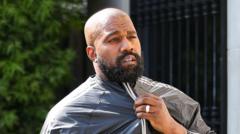
Politicians love a moral panic because it costs nothing and signals everything. Keir Starmer’s "deep concern" over Ye—formerly Kanye West—headlining Wireless Festival 2026 is the ultimate exercise in performative governance. By pearl-clutching over a three-night residency in Finsbury Park, the Prime Minister isn't protecting the public; he’s demonstrating a fundamental misunderstanding of how culture, commerce, and the "Great British Summer" actually function.
The lazy consensus suggests that allowing a controversial figure a platform is an endorsement of their every manic episode or hateful outburst. It isn't. It’s a business transaction in a struggling entertainment economy. When the PM weighs in on a festival lineup, he isn't just fighting antisemitism—which is a legitimate and urgent battle—he’s setting a precedent for the state-sponsored curation of art. That is a slope more slippery than the mud at Glastonbury.
The Economic Reality of the "Monster"
Let’s look at the cold, hard numbers. I have seen festival promoters sweat through their shirts trying to balance a spreadsheet in an era where touring costs have spiked by 30% since 2022. Wireless isn't just a party; it’s a massive employer.
- Security and Logistics: Thousands of local jobs are created for the weekend.
- Tourism: Fans fly in from across Europe, filling London hotels that are still clawing back from the post-pandemic slump.
- The Draw: Love him or hate him, Ye is one of the few remaining "event" artists who can sell out three consecutive nights.
By suggesting the booking should be "rethought," Starmer is essentially telling a private business to set fire to millions in revenue and thousands of man-hours of planning. In a country currently obsessed with "growth," kneecapping one of the few sectors where the UK still leads globally—live music—is a bizarre move for a leader.
The Myth of the "Safe" Festival
The argument usually goes: "We must ensure Britain is a place where everyone feels safe." This is a noble sentiment used as a blunt instrument. Music festivals have never been safe spaces for ideology; they are pressure cookers of counter-culture, excess, and raw expression.
If we apply the Starmer Standard—where a performer's external political views must align with the state’s current moral temperature—the UK festival circuit would vanish overnight.
- Do we ban every rock star with a history of predatory behavior?
- Do we de-platform rappers whose lyrics have been used to fuel gang violence in the very boroughs where Wireless is held?
- Do we scrub the history of every legacy act that took "problematic" stances in the 70s?
The answer is usually no, because those artists don't have a 24-hour news cycle dedicated to their every tweet. The logic is inconsistent and based on the noise level, not the principle.
The Case for Transgression
Art is not meant to be a comfort blanket. It is meant to be a provocation. I’ve seen the industry become sanitized to the point of irrelevance over the last decade. Every artist has a PR team that acts like a human firewall, scrubbing every thought for potential offense. This doesn't make culture "safer"; it makes it boring.
Ye is many things—unstable, offensive, and occasionally brilliant. But he is a reminder that we live in a world where not everyone is a "good person" in the way a politician defines it. By attempting to sanitise Wireless, Starmer is effectively trying to turn music into a civil service branch.
The Counter-Intuitive Truth: Why We Need the Mess
Here’s what the critics miss. The best way to deal with a controversial artist is not to ban them; it’s to let them play and see if anyone shows up.
Imagine a scenario where the public decides they’ve had enough of Ye’s rhetoric. The ticket sales slump, the festival loses money, and the market dictates his relevance. That is a organic, powerful, and democratic process.
When a Prime Minister intervenes, he creates a martyr and a "forbidden fruit" dynamic. He makes Ye’s return a political statement rather than a musical one. Starmer is unintentionally elevating a rapper into a figure of resistance against the state.
Why You’re Asking the Wrong Question
Instead of asking, "Should we let him play?", we should be asking, "Why is our political class so insecure that a musician’s setlist feels like a threat to national stability?"
If our social cohesion is so fragile that three nights of The College Dropout and Bully in North London can shatter it, the problem isn't the guy with the microphone. The problem is a political system that has failed to build any other form of cultural resilience.
Wireless is a business. It provides a platform for a 48-year-old artist who—despite a well-documented manic episode in early 2025—is still one of the most streamed musicians on the planet. To suggest the organizers are "irresponsible" is to suggest that the 50,000 people who will attend each night are incapable of separating a song from a headline.
The Harsh Reality of Cancel Culture in 2026
We’ve seen brands like Adidas cut ties and lose $150 million in the process. We’ve seen the Wall Street Journal ads and the "manic episode" explanations. The "crisis history toxicity" is real. But it hasn't stopped the demand.
As an insider who has sat in rooms with these promoters, I can tell you: They don't book Ye because they like his views. They book him because he is the only artist left who feels like an event. In an era of AI-generated pop and sterile streaming-friendly hits, the chaos of Ye is a commodity.
Keir Starmer should stick to the budget and the NHS. Let the promoters handle the lineups. Let the fans handle the tickets. And let the music, however loud or offensive, speak for itself in a field in London.
The moment we let the government decide who is "appropriate" to entertain us is the moment we stop being a culture and start being a simulation.
Stop trying to fix the festival circuit. Fix the country.