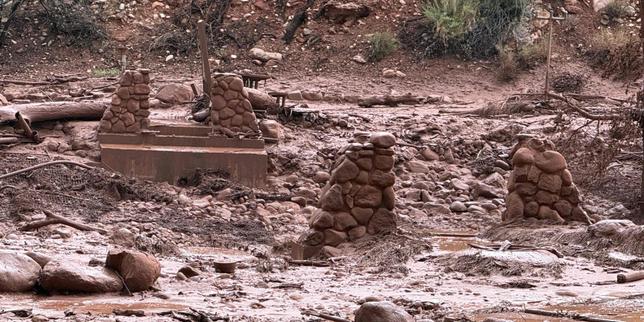
Every time a canyon flash flood claims a life, the media runs the exact same script. They publish the aerial shots of chocolate-brown torrents tearing through red rock, wheel out a breathless headline about a sudden wall of water, and quote park rangers warning tourists to respect the weather. It is safe, sanitized reporting. It places the blame squarely on the shoulders of mother nature, casting an ancient geological formation as a malicious actor ambushing innocent vacationers.
The lazy consensus is that flash floods are unpredictable acts of God. They are framed as random meteorological lightning bolts that strike without warning, leaving humans helpless against the raw fury of the elements.
That narrative is a comforting lie. It absolves tour operators, park management, and ill-prepared thrill-seekers of their actual accountability.
Flash floods in arid environments are not random. They are entirely predictable physical phenomena dictated by catchment geometry, extreme gradient slopes, and hydrophobic soil crusts. When a storm drops two inches of rain thirty miles away on the Kaibab Plateau, that water does not evaporate or soak into the soil. It funnels into narrow sandstone chutes, gathering speed, debris, and destructive kinetic energy long before it reaches the slot canyons where tourists are snapping photos.
I have spent two decades guiding expeditions through slot canyons across the Southwest, and I have watched the evolution of outdoor safety become dangerously watered down. We have traded rigorous wilderness risk education for brightly colored brochures and automated text alerts that people cannot read when they are deep underground with no cell service.
The Fallacy of the Safe Season
The mainstream tourism complex relies on a dangerous fiction: that seasonal safety windows exist. Brochures tell you when it is safe to visit, implying that outside those windows, the desert transforms into a death trap.
This binary thinking gets people killed.
Weather in the Grand Canyon watershed does not read a calendar. Monsoon season officially runs from July to September, but I have pulled stranded hikers off sandstone ledges in late October and watched dry washes turn into violent rapids in mid-May under a cloudless local sky. The storm that kills you is almost never happening where you are standing. It is happening fifty square miles upstream, invisible behind a distant ridge.
When mainstream outlets report on a tragedy like the recent deaths and missing persons in the park, they focus on the recovery efforts. They detail the search dogs, the chopper grids, and the emotional toll on the families. What they systematically omit is the systemic failure of risk communication. Visitors are told to check the weather, as if looking at a weather app in Flagstaff gives you any useful data about a localized microburst dropping an inch of rain over a remote tributary basin.
People do not need better weather apps. They need a fundamental reeducation in reading terrain.
How to Read a Watershed Before It Kills You
If you are standing in a slot canyon and relying on park signage to keep you alive, you are already playing a rigged game. Slot canyons are natural drainage pipes. They are hydraulic funnels designed by physics to move water from high points to low points as fast as possible.
To survive them, you have to stop looking at the sky and start looking at your boots.
First, examine the walls. Are there drift logs wedged twenty feet above your head? That is not rustic art. That is high-water mark evidence from a previous season. If debris is hanging from the ceiling, you are standing in a hydraulic choke point.
Second, check the drainage ratio. For every square foot of canyon floor you occupy, how many square miles of bare rock sit upstream? If that ratio is high, a brief summer thunderstorm twenty miles away translates to a ten-foot wall of water arriving at your location in twenty minutes with zero visual warning.
Third, understand soil mechanics. Arid soils develop a biological crust of cyanobacteria, lichens, and mosses. When dry, this crust is rock-hard and entirely non-porous. When it rains, it seals instantly. Runoff coefficient approaches one hundred percent. Every single drop of rain that hits the plateau becomes surface runoff instantly. It does not trickle. It charges.
The Regulatory Theater
National park services are trapped in an institutional bind. If they close backcountry access every time there is a thirty percent chance of convective thunderstorm activity in a regional watershed, the economic backlash from tourism outfitters and local economies is swift and brutal. So they compromise. They leave the gates open, post a generic warning sign at the trailhead, and rely on liability waivers to clear their conscience.
This creates a moral hazard. The average tourist sees an open trail and assumes authorization equals safety. They trust the infrastructure. They assume that if a canyon were genuinely dangerous today, someone in a uniform would have locked the gate.
That trust is lethal.
Park rangers are not babysitters, and the wilderness is not a theme park ride with safety rails. When you step below the rim, you assume one hundred percent of the liability. The moment you outsource your risk assessment to a government placard or a park service advisory board, you have surrendered your survival instincts to bureaucrats who are managing public relations as much as public safety.
The Contrarian Playbook for Canyon Country
If you want to explore deep geological chasms without becoming a statistic, you have to throw out conventional tourist advice and adopt an industrial-grade risk management framework.
- Ignore local skies: Check the radar for the entire upper drainage basin, not the coordinates of your destination. A clear blue sky above your head is entirely irrelevant if a massive storm cell is parked over the headwaters.
- Identify escape routes before entering: Never descend into a narrow gorge without identifying vertical scramble routes every hundred yards. If a canyon walls out and offers no escape climbing points, turn around immediately. No photograph or view is worth your life.
- Treat every dry wash as an active river: Never set up camp, eat lunch, or linger in the bottom of a water-carved channel. Treat the center of a wash like active railway tracks. You cross it with purpose; you do not loiter.
- Abandon the checklist mentality: Real outdoor competence is dynamic. If the upstream telemetry looks ambiguous, cancel the trip. Ego kills more hikers than water ever will.
The next time a flash flood hits the headlines, look past the tragic human element and examine the systemic incompetence that allowed tourists to walk blind into a hydraulic death trap. Nature is not being malicious. It is simply obeying the laws of physics. It is time we started doing the same.