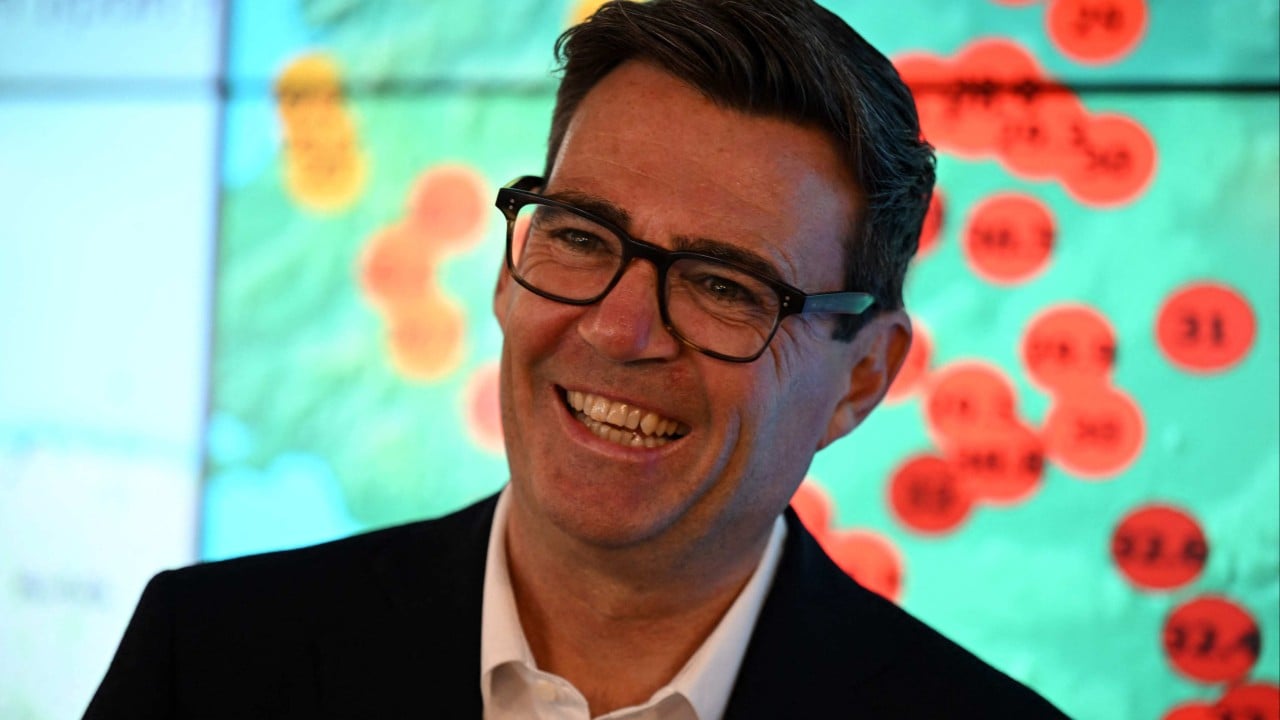
The political class is currently suffering from a collective delusion. Watching Prime Minister Andy Burnham juggle mortarboards and builder’s hats on social media, the establishment press is rushing to applaud his “modern” communication style. They call it digital savvy. They call it meeting voters where they are.
It is, in reality, a desperate and dangerous retreat into the shallowest reaches of the attention economy. You might also find this related article interesting: Strategic Asymmetry in Modern Long Range Strike Campaigns.
The prevailing narrative—that Burnham’s pivot to vertical video and influencer cameos is a masterstroke of political outreach—is built on the lazy consensus that engagement equals impact. It does not. Engagement is the junk food of the digital age: it offers a momentary spike in endorphins, satisfies the algorithm’s craving for noise, and leaves the body politic malnourished and increasingly cynical.
I have spent years watching organizations confuse vanity metrics with actual influence. When you treat the Prime Minister’s office like a brand account vying for viral reach, you are not “democratizing” information. You are infantilizing the electorate. As discussed in recent coverage by The Guardian, the results are widespread.
Imagine a scenario where the head of government is judged solely by their ability to keep a teenager watching for seven seconds. That is the world we have built. When you focus on the “hook,” the “selfie angle,” and the “relatable” personality, you necessarily prune the complexity of actual governance. Real policy—the kind that moves the needle on energy grids, trade deficits, or housing stock—is boring, granular, and rarely fits into a 30-second loop. By forcing these issues into the TikTok format, Burnham isn’t making politics accessible. He is scrubbing it of the very details required to understand it.
The defense for this strategy is always the same: “Young people don’t watch the news anymore.”
This is a failure of imagination, not a technological inevitability. If the only way to reach a demographic is to act like a content creator, you aren’t a leader; you’re an entertainer. And entertainers are held to a different standard. When the joke falls flat, or when the “everyday fixes” fail to offset the structural rot, the audience will move on to the next shiny object. By tying his legitimacy to the algorithm, Burnham has essentially outsourced his authority to the platform’s whims.
The danger here is not that he is “cringe.” It is that he is normalizing the idea that the state is just another content stream.
Consider the hiring spree in Number 10. They are recruiting a squad of social media professionals at high salaries to “feed the algorithm.” This is not a communication strategy; it is an allocation of resources toward optics at the expense of substance. The professionalization of the “relatable” persona is a calculated effort to mask the lack of institutional control. When you hire people to simulate spontaneity, you lose the ability to have an honest conversation.
The disconnect between the slick, edited video of the PM pouring a beer and the reality of a country struggling with deep-seated economic instability is not just a PR mismatch. It is a fundamental breach of trust. If you treat the voter like a consumer, don’t be surprised when they demand a refund the moment the product underperforms.
We are currently witnessing a race to the bottom of the attention span. Every effort spent on securing a cameo with a popular influencer is an effort not spent on engaging in the messy, high-friction work of parliamentary debate or long-form civic education.
Politicians are obsessed with “reaching” people. They should be obsessed with respecting them. If you want to rebuild trust, you don’t need better editing software. You need to stop assuming that the electorate is too distracted to handle complexity. The moment you start treating voters like toddlers, you guarantee they will remain in a state of political adolescence.
The long-term cost of this strategy is the erosion of the office itself. When the Prime Minister becomes a TikTok personality, the institution is diminished to the level of an app. And when the apps change, as they always do, the authority goes with them.
Stop asking if the content is viral. Start asking if it actually builds the social capital necessary to govern. The answer, as the view count climbs and the substance evaporates, is increasingly clear.
The algorithm does not care about your success. It cares about your screen time. If you choose to play that game, you have already conceded the fight.


