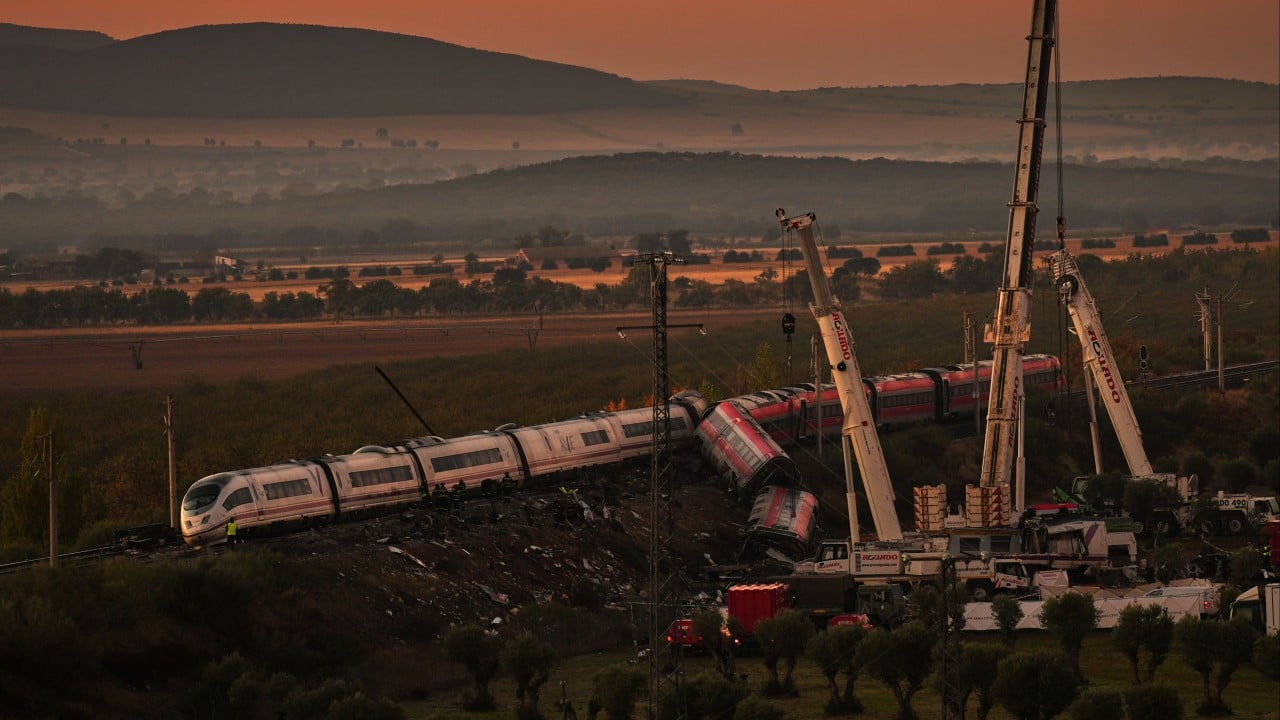
Spain has officially entered three days of national mourning following a catastrophic high-speed train disaster, and the immediate shockwaves go far beyond the lowered flags in Madrid. When a country widely celebrated for operating the second-longest high-speed rail network on the planet suffers a major rail tragedy, people naturally start asking uncomfortable questions.
If you've ever ridden an AVE train from Madrid to Barcelona or Seville, you know the reputation. They're sleek, fast, and usually punctual to the minute. Most travelers treat Spanish high-speed rail as the gold standard of European transit. Yet, as emergency crews work through the wreckage and investigators begin piecing together what went wrong, we're forced to confront a harsh reality about modern transportation systems. Even the most advanced networks aren't immune to catastrophic failure. Recently making news recently: Why Hegseth's New US-ASEAN Defence Pitch Faces Deep Skepticism.
Understanding the Official Mourning Period
In Spain, a three-day official mourning period—known as luto oficial—isn't just a symbolic gesture for the evening news. It's a formal state protocol reserved for national tragedies of massive scale.
During these seventy-two hours, flags on all public buildings and military vessels fly at half-mast. Government officials cancel public celebrations, major sporting events often begin with a minute of silence, and regional authorities coordinate victim support services alongside the central government in Madrid. The Royal Family and the Prime Minister's office typically adjust their schedules to visit the crash site and meet with families at local hospitals. Additional insights regarding the matter are explored by The Washington Post.
Honestly, the public response in Spain during moments like this is remarkable. You don't just see state-mandated silence; you see immediate community mobilization. Local residents near rail corridors often show up with water, blankets, and vehicles before emergency perimeters are even fully established. It's a stark contrast to the cold, bureaucratic tone that usually dominates transport policy discussions.
The Shadow of Santiago de Compostela
You can't talk about a high-speed train disaster in Spain without thinking back to July 24, 2013. That was the day an Alvia train derailed near Santiago de Compostela in Galicia, killing 79 people and injuring more than 140 others.
I still remember the footage from that curve at Angrois. It changed how Spain—and honestly, most of Europe—thought about rail safety. Before 2013, there was an assumption that modern signaling systems and strict operating protocols made high-speed derailments virtually impossible. Then came the investigation, which revealed a devastating mix of excessive speed and a sudden transition from automated track-side speed control to manual driver control right before a sharp bend.
That disaster led to massive regulatory overhauls across the Spanish rail network, managed largely by Adif (Administrador de Infraestructuras Ferroviarias) and operated by Renfe alongside newer private competitors. Engineers upgraded trackside beacons, rewrote braking curves, and expanded the rollout of the European Rail Traffic Management System (ERTMS).
So when another major incident hits the headlines, the immediate question from anyone who follows European infrastructure isn't just about human error. It's about whether those post-2013 safeguards held up, or if a new vulnerability emerged in a system that has grown rapidly over the last decade.
Why Spain’s Rail Network Is So Complex
To understand what goes into keeping high-speed trains safe in Spain, you have to look at the geography and the engineering behind it. Spain isn't flat. Building rail lines across the Iberian Peninsula means cutting through mountain ranges, spanning deep gorges, and dealing with extreme temperature swings between the scorching central plateau and the humid northern coast.
Spain boasts roughly 4,000 kilometers of high-speed track, trailing only China globally. That's an astonishing achievement for a country of around 48 million people.
Here's where things get tricky from an operational standpoint:
- Mixed-gauge engineering: Spain historically used a wider Iberian track gauge than the rest of continental Europe. Modern high-speed lines use the standard international gauge, which means trains that transition between old and new networks have to pass through specialized gauge-changing facilities.
- Rapid liberalization: Over the past few years, Spain opened its high-speed tracks to competition. Alongside state-backed Renfe, you now have Ouigo (backed by France's SNCF) and Iryo (backed by Italy's Trenitalia and Air Nostrum) running dozens of daily services on the exact same corridors.
- Aging versus new infrastructure: While the Madrid-Barcelona or Madrid-Valencia lines feature modern, dedicated corridors, other routes rely on upgraded conventional tracks where signaling standards vary from one stretch to the next.
More trains on the tracks mean lower ticket prices and better options for passengers. That's great for travelers. At the same time, higher traffic density puts immense pressure on maintenance windows. Track crews have fewer hours at night to inspect rails, test overhead catenary wires, and verify signaling electronics.
How Rail Investigations Actually Work
When a disaster occurs, social media immediately fills up with armchair engineers blaming the driver, the weather, or the train manufacturer. Ignore almost all of it. Real rail investigations take months, and the early hours are focused entirely on rescue, recovery, and preserving physical evidence.
In Spain, the independent body responsible for investigating rail accidents is the CIAF (Comisión de Investigación de Accidentes Ferroviarios). Their process follows strict international protocols, similar to aviation crash investigations.
First, investigators secure the train's event recorders—essentially the "black boxes" located in the driving cabs. These devices log everything: throttle position, brake pressure, horn activation, cab signaling alerts, and exact speed down to the second.
Second, they examine the infrastructure itself. Was there a broken rail? Did a switch fail to lock properly? Did a landslide or foreign object obstruct the right-of-way? In regions prone to heavy rain or seismic activity, track bed stability is always one of the first things engineers check.
Third, they look at human factors and communications. Investigators pull audio recordings between the train driver and the centralized traffic control center (CTC). They check shift schedules to see if fatigue played a role, and they review whether any temporary speed restrictions were properly communicated and programmed into the onboard computer systems.
What Most People Get Wrong About High-Speed Rail Safety
There's a common misconception that high-speed trains are inherently more dangerous than conventional trains because they travel at 300 kilometers per hour. The data actually shows the exact opposite.
Dedicated high-speed lines are built without level crossings—meaning cars and trucks can't accidentally drive onto the tracks. They're fenced off along their entire length to keep wildlife and trespassers out, and they rely on continuous cab signaling rather than traditional trackside traffic lights that a driver might miss in heavy fog or rain.
Statistically, high-speed rail remains one of the safest ways to move large numbers of people across land. Think about the hundreds of millions of passengers who ride high-speed trains every year across Spain, France, Germany, and Japan without incident.
The danger usually doesn't come from the speed itself. It comes from transitions.
When a train moves from a high-speed line onto a conventional line, or enters a complex station throat with dozens of switches, or operates during degraded signaling conditions where maintenance work is underway, the margin for error shrinks dramatically. That's where automation hands control back to human operators, and that's historically where European rail systems have experienced their worst failures.
The Human Toll Behind the Infrastructure Debate
It's easy to get lost in talk about ERTMS beacons, axle counters, and maintenance budgets, especially when you're trying to make sense of how a modern train system can fail so catastrophically. We shouldn't forget why Spain has lowered its flags.
Behind every emergency dispatch and official press conference are commuters heading to work, students traveling home for the weekend, and families taking a routine trip across the country. High-speed rail in Spain isn't a luxury service for business executives anymore; thanks to competition and affordable fares, it's everyday public transit. That makes a disaster like this hit even closer to home for ordinary people.
Emergency responders—firefighters, civil guard officers, medical teams, and Red Cross volunteers—often work under horrific conditions in the first 24 hours, cutting through twisted aluminum and steel while trying to keep trapped passengers calm. Their work is grueling, and the psychological toll on small towns near crash sites lingers long after the international news cameras pack up and leave.
Practical Steps for Travelers and Rail Observers
If you're traveling in Spain during the official mourning period or in the weeks immediately following a major rail incident, expect disruptions and approach your itinerary with a bit of patience.
- Check operator alerts directly before heading to the station. Don't rely solely on third-party booking apps. Check Renfe, Iryo, or Ouigo's official channels, as investigators frequently close affected corridors for days or weeks, forcing operators to reroute trains or set up alternative bus bridges.
- Expect heightened security and slower speeds. Following major incidents, infrastructure managers often impose precautionary speed restrictions across similar track sections or train classes while engineers run emergency inspections. Your three-hour journey might suddenly take four and a half.
- Follow verified official sources rather than viral clips. During the first 48 hours of any disaster, misinformation spreads rapidly online—from misidentified casualty numbers to fake technical explanations. Stick to updates from Spain's Ministry of Transport, Adif, and established national outlets like RTVE or El País.
- Understand your passenger rights under EU law. Under European Union rail passenger regulations, if a delay exceeds 60 minutes, you're entitled to partial ticket refunds, meals, and refreshments—and in severe disruptions, alternative transport or hotel accommodation—even when the root cause is under investigation.
Over the coming weeks, Spain's focus will shift from mourning to accountability. Families will demand clear answers from the Ministry of Transport, rail unions will scrutinize maintenance staffing levels, and engineers across Europe will study the preliminary findings from the CIAF. Trust in public infrastructure takes decades to build and only seconds to shake, and earning it back requires complete transparency about what went wrong on those tracks.