The morning air in Lusaka carries the scent of charcoal smoke and crushed earth. It is a dry heat that clings to the skin, thick with the quiet anxiety of a nation holding its breath. Before the sun has fully burned away the mist over the sprawling compounds, the queues begin to form. They do not march. They wait.
They stand shoulder-to-shoulder under the sprawling acacia trees, wrapped in colorful chitenge wrappers, clutching worn voter cards like fragile heirlooms. (Note: The characters described here are fictional composites drawn from standard observations of urban polling queues in the region, designed to illustrate the lived reality of these elections.)
Consider Joseph, a thirty-four-year-old bus driver whose calloused hands grip the steering wheel of his minibus every day through choking traffic. For Joseph, this Tuesday is not a routine civic obligation. It is a reckoning. The cost of fuel has crept upward like a slow poison, eating away at the margins of his daily bread. A loaf of bread, a bag of mealie meal, the school fees for his two youngest children—every transaction feels heavier this year.
He stands in line now, silent, shifting his weight from one foot to the other. Ahead of him, an elderly woman leans heavily on a wooden cane, her eyes fixed firmly on the cardboard voting booth ahead.
Democracy here is not an abstract theory found in political science textbooks. It is physical. It requires endurance.
Across the country, millions of Zambians are casting their ballots as President Hakainde Hichilema bids for a second term. The stakes are immense, wrapped in the delicate balance of economic reform and the heavy expectations of a population desperate for relief. When Hichilema swept into office years ago, he did so on a massive wave of popular discontent, promising to resurrect a bruised economy, crack down on systemic corruption, and restore fiscal discipline to a nation suffocating under external debt.
The promise was intoxicating. The reality has been a grind.
Economics is often taught as a series of cold equations, curves on a whiteboard, and sterile percentages released in quarterly central bank reports. But real economics is felt in the stomach. It is the sound of a mother calculating whether she can afford medicine or dinner.
To understand Zambia today, you have to look at the copper mines. Copper is the lifeblood of this country, the red metal that pumps through the veins of its national budget. For decades, fluctuating global prices and mismanaged contracts meant that the wealth generated deep underground rarely trickled down to the dusty streets of compounds like Kanyama or Misisi.
When the current administration took the reins, they inherited a mountain of debt that had brought the treasury to its knees. Default loomed like a shadow. Restructuring that debt required bitter medicine—slashing subsidies, tightening public spending, and navigating a labyrinth of international creditors.
Medicine is supposed to heal. But first, it makes you sick.
The fiscal austerity measures instituted over the past five years bought international credibility. They stabilized the currency at times and kept the lights on. Yet, on the ground, ordinary families felt the pinch long before they saw the promise. Prices rose. The cost of living became a daily trial of endurance.
This is the central paradox of the ballot box today. Voters are not simply choosing between candidates or parties. They are passing judgment on a painful transitional phase.
Listen to the murmurs in the queue.
"Things are hard," a young woman murmurs, adjusting a baby strapped tightly to her back with a bright blue cloth. Her voice is devoid of anger, worn down to a flat, exhausted acceptance. "Everyone says the debt is fixed. But the maize meal is still expensive."
Beside her, an older man nods slowly. He remembers past regimes, past promises that vanished like morning dew. "Change takes time," he counters, his voice steady. "If we tear down the house while it is being rebuilt, we will sleep in the dirt."
This internal debate plays out in millions of minds across the ten provinces. It is a national dialogue whispered in minibuses, argued over steaming plates of nsima in local eateries, and deliberated quietly behind the cardboard screen of the polling booth.
The incumbent enters this election carrying the heavy armor of incumbency alongside the heavy scars of reform. His campaign has hammered home the message of institutional renewal, fighting corruption, and laying the groundwork for long-term growth. The narrative is clear: we survived the worst, and now the foundation is set.
Yet, opposition challengers smell blood in the water. They move through the dense crowds with promises of immediate relief, pointing directly at the empty pockets of the working class. They argue that fiscal discipline means nothing if the people starve while waiting for the macro-economy to catch up.
It is a classic political dilemma. How do you ask a hungry population to be patient?
The sun climbs higher, baking the asphalt outside the polling station. Election monitors in high-visibility vests pace back and forth, ensuring peace. Police officers stand at a respectful distance, their rifles slung casually, their faces masked by the universal exhaustion of a long shift.
Tension hums in the air, but it is an orderly tension. Zambians have a long, proud democratic tradition of peaceful transitions. Since the return to multiparty democracy, power has shifted between political parties multiple times without fracturing the peace of the state. That peaceful heritage is a national treasure, guarded jealously by ordinary citizens who know too well what lies on the other side of civil unrest.
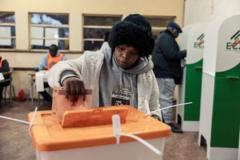
Inside the small, private enclosure of the booth, Joseph finally steps forward.
The ambient noise of the crowd fades, muffled by the cardboard walls. Before him lies the ballot paper—a large sheet crowded with symbols, photographs, and names.
He holds the black marker.
This is the quietest moment of the entire process. No speeches. No cameras. No grand economic theories. Just a citizen, a pen, and a choice that will ripple outward through schools, hospitals, mines, and markets for the next five years.
He makes his mark.
Folding the paper with deliberate care, he slides it into the locked plastic ballot box. The slot makes a soft, definitive thud.
Outside, the queue remains endless. Thousands more are waiting under the fading glare of the afternoon sun, inching forward one slow step at a time, carrying their hopes, their frustrations, and their votes toward the inevitable dawn of a new day.