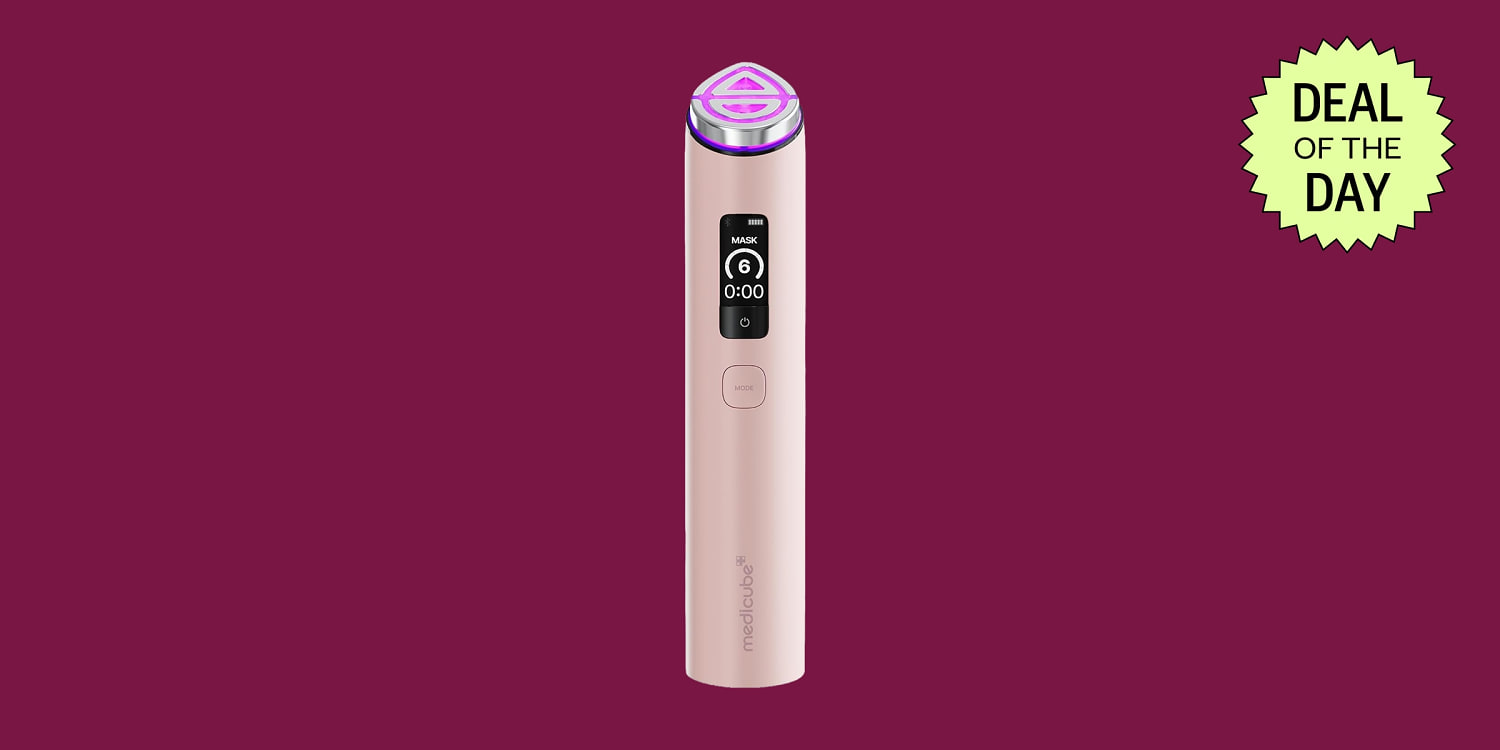
The beauty industry wants you to believe that professional-grade dermatology can be shrunk down, battery-powered, and delivered to your nightstand for a few hundred dollars. When major online retailers slash prices on hot new releases, the internet reacts with a buying frenzy.
The latest example is the Medicube Booster Pro X2, an upgraded multi-mode skincare wand that entered the market with massive hype, only to see its price slashed by over 25% on Amazon shortly after its retail debut.
To the casual shopper, this markdown looks like a classic consumer win—a chance to secure "glass skin" technology at a steep discount. But to anyone tracking the rapid cycle of beauty tech, the sudden discount reveals a much larger truth about the home-device economy. Behind the flash sales lies a fierce battle for market share, high manufacturing margins, and a looming consumer realization: buying the device is only the first step in an expensive, long-term habit.
The Economics of the Rapid Markdown
The Booster Pro X2 boasts upgraded features, including seven treatment modes and six intensity levels designed to enhance product absorption, smooth pores, and lift facial muscles. It is the successor to an already popular predecessor, the original Booster Pro, which dominated social media feeds.
Yet, despite its fresh arrival on digital shelves, the device is already experiencing deep discounts.
This aggressive pricing strategy is not a sign of poor sales. It is a calculated business play. Beauty-tech devices carry exceptionally high markup margins. Unlike traditional electronics, where hardware components drive the cost, beauty devices are sold on the emotional promise of aesthetic transformation. Once the initial research, development, and injection molds are paid off, the physical cost to manufacture a plastic wand with LED lights and circuit boards is remarkably low.
This margin gives brands massive flexibility. By launching at a premium price point, they capture early adopters willing to pay full price for the latest novelty.
Once that initial wave of demand cools, the price is lowered. The "sale" price becomes the actual target retail price, designed to capture the broader, more price-sensitive demographic.
The Razor and Blade Strategy of Modern Beauty
There is another, more lucrative reason brands are eager to get these devices into your hands at a discount: the "razor and blade" business model.
At-home skincare devices do not work in a vacuum. To glide smoothly over the skin and conduct electrical currents safely, they require topical products. While the Booster Pro X2 is marketed as working with your existing serums, the brand simultaneously pushes its own high-margin consumables. These include:
- PDRN Pink Peptide Serums designed to work alongside the device's absorption modes.
- Collagen Jelly Creams formulated to optimize the microcurrent and EMS functions.
- Zero Pore Pads to prep the skin before utilizing the device’s "Air Shot" mode.
A consumer might purchase a device once every few years, but they will repurchase serums, toners, and specialized conductive gels every single month. By discounting the hardware, beauty brands secure a recurring subscription-style revenue stream from skincare consumables. The wand is merely the vehicle; the liquids are the true profit engine.
Decoupling the Science from the Marketing
The marketing behind these devices relies heavily on clinical-sounding terminology: electroporation, electrical muscle stimulation (EMS), and microcurrent. While these technologies are indeed rooted in legitimate dermatological science, the home-use versions are fundamentally limited by safety regulations.
Electroporation versus Tap Water
In a clinical setting, electroporation uses high-voltage pulses to temporarily open pathways in the cell membrane, allowing deep active ingredients to penetrate. Home devices use incredibly low-voltage pulses. While this does help push serums past the outermost layer of dead skin cells better than manual rubbing, it is a far cry from the medical-grade systems used in a dermatologist's office.
EMS and the Illusion of Lifting
EMS works by emitting electrical currents that force facial muscles to contract. When you use the "Derma Shot" mode, you will feel your jaw or cheek muscles twitch. This creates an immediate, temporary tightening effect by increasing blood flow and muscle tone.
However, this is a transient change. Within a few hours, the muscles relax, and the skin returns to its baseline state. To maintain any semblance of a "lifted" look, you must use the device daily.
The Commitment Trap
The ultimate hurdle for home beauty tech is not the technology itself, but human behavior.
Most people buy these devices with grand intentions. They envision a relaxing, spa-like nightly ritual. The reality is far more tedious.
Using a device like the Booster Pro X2 effectively requires multiple steps. You must wash your face, dry it completely to use the "Air Shot" mode, apply a serum, switch the device to "Booster" mode, glide it across your face, apply a heavier cream, and switch to the "MC" or "Derma Shot" modes. This turns a quick five-minute evening routine into a fifteen-to-twenty-minute chore.
Within a month, the novelty fades. The expensive wand gets relegated to a drawer, joining the graveyard of discarded hair stylers and facial rollers.
Before clicking "Add to Cart" on a discounted skincare device, ask yourself if you are truly buying a solution to a skin concern, or if you are simply buying the temporary excitement of a retail sale. If you do not have the patience to sit in front of a mirror and slowly glide a vibrating plastic wand over your face for fifteen minutes every single night, even a 50% discount is money wasted.