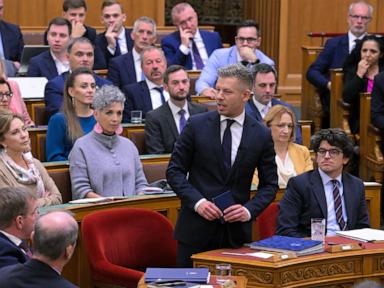
Hungarian politics operates on a knife edge. On a Monday morning in late September, the National Assembly in Budapest delivered a vote that fundamentally altered the country's legal and political trajectory. Lawmakers voted 139 to zero to suspend the parliamentary immunity of Prime Minister Péter Magyar, alongside two prominent figures from the previous political era, Balázs Hankó and Miklós Seszták. This extraordinary session cleared the legal path for state prosecutors to proceed with active criminal investigations into allegations ranging from petty theft to massive public fund misuse.
Immunities are shields. They are designed to protect elected officials from politically motivated judicial harassment. Yet they frequently morph into iron curtains that obstruct accountability. What happened in the Hungarian parliament was not a standard bureaucratic clearance. It was a calculated political maneuver designed by a newly installed administration to rewrite the rules of impunity.
To understand why this vote matters, look past the procedural technicalities. Look at the individuals involved and the specific cases that prosecutors have spent months trying to unseal.
The Anatomy of a Calculated Gamble
Péter Magyar did something unexpected for a sitting head of government. He demanded his own protection be stripped away.
When the Chief Public Prosecutor's Office requested the suspension of immunity for Magyar and two opposition lawmakers from the Fidesz and Christian Democratic camps, conventional political survival instinct suggested a fight. Rallies, legal delays, procedural stalls. Instead, Magyar took to social media and public platforms to urge his own majority in parliament to vote in favor of lifting the shield.
Why would a prime minister invite criminal investigation? Control.
By championing the removal of his own immunity, Magyar neutralized the opposition's primary narrative weapon. He seized the high ground of absolute legal equality. If he had fought to keep his protection, critics would have immediately drawn direct parallels to the culture of untouchability that defined the long reign of Viktor Orbán. By welcoming the scrutiny, Magyar flipped the script. He transformed a defensive legal vulnerability into an aggressive offensive weapon against the old guard.
The case against Magyar stems from a strange incident at a Budapest nightclub in June 2024. Long before he ascended to the premiership, during the turbulent fallout of the European Parliament elections, an altercation at the Ötkert venue resulted in accusations of theft involving a mobile phone. Witnesses, rival politicians, and social media videos swirled in a chaotic mix of tabloid drama and political mudslinging. At the time, Magyar's protection as an MEP blocked prosecutors from moving forward. The European Parliament refused previous requests to lift that shield.
Now, sitting in the prime minister's office, Magyar faces the music. Or rather, he orchestrates the orchestra playing it. The move strips away the parliamentary obstacle, but it leaves the evidentiary burden squarely on the authorities. Whether the scattered accounts from a crowded nightclub hold up under rigorous judicial examination remains an entirely separate question.
Millions in Misused Culture and Transport Contracts
While the media spotlight naturally gravitates toward the prime minister, the investigations targeting the two Orbán-era figures carry far heavier financial and systemic weight.
Balázs Hankó, who previously served as the minister responsible for culture and innovation under the Orbán administration and now sits as a Fidesz lawmaker, faces serious allegations concerning the National Cultural Fund. State prosecutors allege that approximately 17.3 billion forints, roughly equivalent to forty-four million euros, were systematically misapplied across more than one thousand individual cases. The core accusation claims that funds designated for public cultural enrichment were steered through opaque criteria to benefit political objectives, including campaign funding for Fidesz ahead of prior electoral cycles.
Hankó has rejected every element of the accusation. He frames the proceedings as a partisan witch hunt orchestrated by the current administration to discredit its predecessors.
Parallel to the cultural fund inquiry stands the case of Miklós Seszták. Seszták, a former national development minister and current Christian Democratic lawmaker, finds himself under scrutiny for alleged bribery and kickbacks exceeding twelve billion forints, roughly thirty-one million euros. Investigators are focusing on public procurement deals tied to vehicle acquisitions by Volánbusz, the state-owned bus company, alongside large-scale public construction projects managed during his ministerial tenure between 2014 and 2018.
The mechanics of these alleged schemes follow familiar patterns across Central European public finance. Complex sub-contracting webs, inflated valuations for second-hand infrastructure, and political patronage networks intersecting with commercial tenders. Proving these allegations in a court of law requires tracing paper trails that were often meticulously obfuscated by administrative design.
The Strategy of Absence
When the parliamentary bell rang for the extraordinary session, half the chamber was conspicuously empty.
Lawmakers from Fidesz and the Christian Democratic People's Party boycotted the vote entirely. Their absence was not an accident of scheduling. It was a deliberate boycott designed to delegitimize the proceedings. By refusing to participate, the former ruling camp registered its formal position that the entire judicial inquiry amounts to political persecution disguised as institutional reform.
This tactic isolates the opposition while giving the governing majority a clean, unanimous tally of 139 votes. Fidesz strategists calculate that participating in the vote would legitimize a process they view as an existential threat to their political network. By staying away, they maintain ideological purity among their base, portraying Magyar's administration as authoritarian actors weaponizing the state apparatus against political rivals.
Yet this approach carries inherent risks. Abandoning the parliamentary floor leaves the political narrative entirely in the hands of the government. When opposition benches sit empty during critical votes on accountability, voters often interpret the absence not as principled resistance, but as cowardice or quiet admission.
Institutional Realities and the European Dimension
Hungary does not exist in a geopolitical vacuum. For years, Brussels locked horns with Budapest over rule-of-law deficiencies, judicial independence, and the allocation of billions in European Union funds.
The recent shift in government has initiated a cautious thaw between the European Commission and the Hungarian treasury. Unlocking withheld financial aid depends heavily on demonstrable proof that the Hungarian state is dismantling systemic corruption channels and restoring judicial integrity.
Lifting immunity for both the current prime minister and senior figures from the previous regime serves as powerful theater for European capitals. It signals to Brussels that the sacred cows of political immunity no longer roam unchecked across the Hungarian political plains. European officials watching from afar see an unprecedented willingness to submit political actors to ordinary criminal procedure.
Yet deep structural challenges remain. The Chief Public Prosecutor's Office operates within a legal framework largely shaped during the decades of Fidesz dominance. While the faces at the top change, the institutional machinery retains deep-seated loyalties and procedural inertia. A prosecutor's zeal depends as much on institutional culture as it does on legislative permission slips.
The Mechanics of Legal Accountability
Lifting immunity does not equal a guilty verdict. This distinction gets lost in the noisy daily churn of political commentary.
Immunities merely remove the procedural wall that prevents investigators from conducting searches, interrogations, and indictments. For Magyar, the phone case moves from a political talking point into the hands of investigators who must now establish whether a crime actually occurred during that nightclub altercation. For Hankó and Seszták, the massive financial audits of cultural funds and transport contracts must transition from investigative dossiers into ironclad courtroom evidence capable of surviving aggressive defense teams.
Hungarian courts face immense scrutiny. Every ruling handed down in these upcoming months will be dissected by international observers, domestic partisans, and legal scholars looking for signs of bias. If the judiciary acts with clinical impartiality, it establishes a vital precedent for future administrations. If the processes bog down in political theater or appear overly selective, public cynicism will only deepen.
The immunity vote in Budapest marks a definitive break with past political conventions, but it is merely the opening chapter of a much longer, more complicated legal reckoning. The shield has dropped, and the real test of institutional resilience begins now.