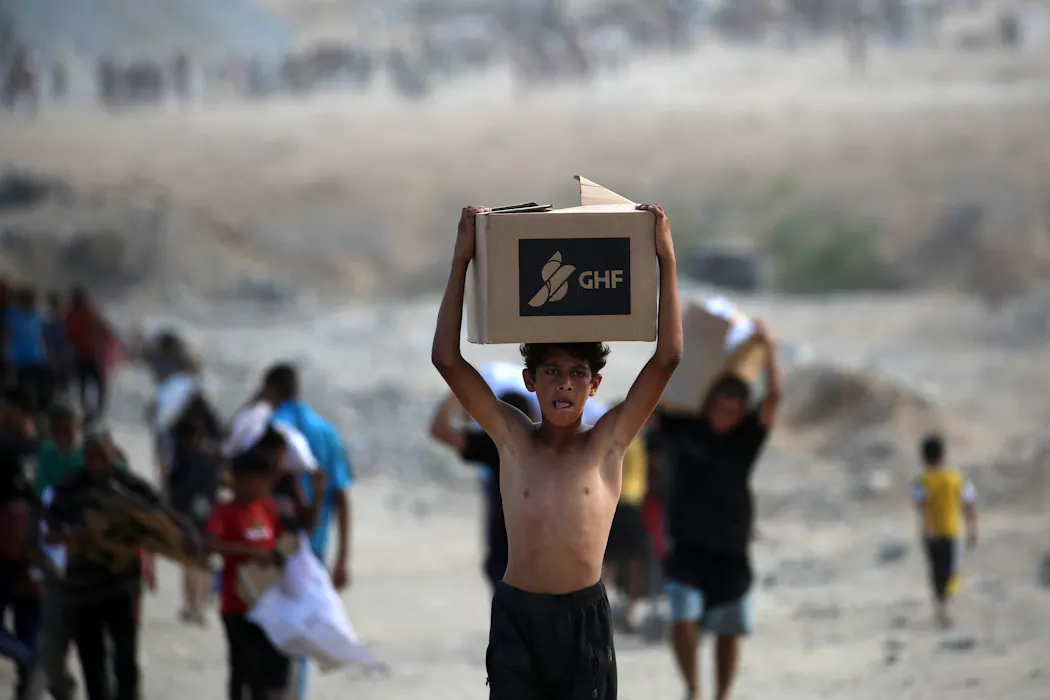
The humanitarian establishment loves a villain, and nothing fits the casting call quite like the private sector. When reports surface of chaotic distribution lines, soaring local prices, and armed looting in conflict zones, the reflex among commentators is immediate and predictable. They point the finger at commercial contractors, profit motives, and supply-chain outsourcing. Privatised aid failed the people of Gaza, the chorus declares. The world must learn never to repeat it.
It is a comforting narrative. It casts humanitarian crisis as a moral struggle between selfless institutional bureaucrats and predatory capitalists. It allows international agencies to wash their hands of systemic failure by blaming external market forces.
It is also entirely backwards.
Privatisation did not fail Gaza because commerce is inherently toxic to humanitarian relief. It failed because it was deployed into a totalitarian vacuum of zero competition, crony-ridden monopolies, and physical blockades, then judged by standards that traditional state-run aid agencies have failed to meet for decades. By focusing our outrage on the fact that some actors made a profit on a bag of flour, we ignore the much darker truth: the legacy institutions of international relief have institutionalized dependency, choked agility, and failed the exact populations they were chartered to protect.
If we want to fix aid delivery in hyper-complex conflict zones, we have to stop treating state-administered charity as a sacred cow and start looking at logistics with cold, empirical realism.
The Myth of the Benevolent Monopoly
To understand why the critique of privatised aid collapses under scrutiny, one must first dismantle the mythology surrounding traditional humanitarian operations. The prevailing consensus assumes that when the United Nations or state-funded non-governmental organizations handle aid, every dollar is spent with ascetic purity and every kilo of rice reaches the most vulnerable without friction.
I have spent years analyzing supply chains in fractured states, and I have seen what happens when monopolies control relief. Traditional aid agencies operate under an immunity shield that protects them from market discipline. When a private logistics firm fails to deliver, it goes bankrupt, loses its contract, or replaces its management. When a massive multilateral agency fails to deliver, it commissions a three-year evaluation report, blames external geopolitical factors, and asks donor governments for a fifty percent budget increase.
The traditional aid model is built on slow-moving bureaucratic layers. Cargo sits on tarmacs for weeks while committees debate customs clearance, local permissions, and inter-agency coordination protocols. In a rapid-onset crisis or an active siege, administrative delay is a death sentence.
When commercial actors were brought into Gaza, they were not introduced as participants in a functioning, competitive market. They were dropped into a high-risk security nightmare where state actors had flattened infrastructure, restricted fuel imports, and turned border crossings into choke points. To blame "the market" for failing under those conditions is like blaming a race car driver for losing a race after you have removed all four tires.
Anatomy of a Logistical Bottleneck
Let us look at how the supply chain actually functioned, strip away the moralizing rhetoric, and examine the mechanics.
When aid enters a war zone, it faces two distinct challenges: macro-logistics (getting goods across borders and ports) and micro-logistics (distributing goods to households). Traditional humanitarian agencies excel at the former when borders are open and political will is high, but they stall completely at the latter. Why? Because they lack the last-mile flexibility of local merchant networks.
International organizations rely on massive, centralized warehouses and rigid convoy schedules. In a dense urban environment under heavy bombardment, a centralized convoy is a slow-moving target. It attracts crowds, invites looting, and creates massive security vulnerabilities. Furthermore, because traditional aid is distributed free of charge, it immediately distorts local pricing and triggers a secondary black market where armed factions can seize supplies and resell them at inflated rates.
Commercial supply chains, by contrast, rely on distributed networks of small merchants, independent truckers, and local traders who know every alleyway, bypass road, and informal storage depot. When private actors were utilized in Gaza, the core failure was not that they used commercial channels; it was that the operating environment was so restricted that only a handful of politically connected middlemen could operate. That is not free-market capitalism. That is cartelized cronyism born of state failure and military blockade.
When you restrict supply down to a trickle through bureaucratic bottlenecks, any private actor who manages to get goods through will charge high prices. Basic economics dictates that when supply is constrained to one percent of demand, prices skyrocket. The critics look at those high prices and scream about predatory capitalism, while ignoring the fact that the artificial supply restriction was caused by political blockades and bureaucratic gatekeeping in the first place.
The Cronyism Trap Versus True Markets
We must be entirely honest about the downsides of our own preferred alternatives. A pure market approach in an active war zone carries severe moral hazards. Without oversight, unscrupulous operators will exploit desperation. Price gouging on basic caloric necessities is morally repugnant, and no serious analyst defends it.
However, pretending that state-administered or NGO-administered distribution avoids corruption is willful blindness. Across multiple conflict zones over the past thirty years, massive quantities of international aid have been systematically diverted, taxed, or weaponized by local authorities and militias. In many cases, traditional aid agencies knowingly tolerate high diversion rates as the "cost of doing business" just to maintain their presence on the ground, quietly sweeping the losses into administrative write-offs.
The difference is accountability. In a transparent commercial system, transactions leave paper trails. You can track inventory, verify delivery, and audit pricing. In a bureaucratic relief monopoly, accountability often vanishes behind diplomatic vetoes and operational secrecy.
Imagine a scenario where aid delivery is treated not as a charitable handout managed by distant committees, but as a heavily subsidized, open-access commercial utility. In this model, international donors do not buy and ship physical goods across borders with a fleet of rented trucks. Instead, they issue purchasing power tokens or digital vouchers directly to families, while simultaneously subsidizing private importers to flood the market with bulk food items.
When the market is flooded with abundant supply, prices drop naturally. Local merchants compete for business, delivery times shrink to hours instead of weeks, and the need for armed escorts for massive, vulnerable truck convoys disappears because goods move in small, discrete, commercially indistinguishable shipments.
That is not a utopian fantasy; it is how modern economies feed billions of people every day, even during severe economic shocks. Yet the humanitarian establishment resists it because it strips them of their institutional gatekeeping power. If local merchants can feed the population, what do we need the agency executives for?
Accountability Without Bureaucracy
The defenders of the status quo will argue that commercial networks cannot reach the poorest of the poor—those who have no cash, no savings, and no access to digital wallets. This is a valid operational critique, and it points to where humanitarian intervention actually belongs.
The proper role of international aid is not to act as a global grocery wholesaler or a trucking conglomerate. That is a task for supply chain professionals and private logistics firms. The proper role of humanitarian agencies is safety-net targeting: identifying the destitute, managing protection risks, and providing direct financial or nutritional supplements to those whom the market misses.
By trying to manage every link of the supply chain from procurement in distant countries to hand-to-mouth distribution in a war zone, international agencies take on a scope of work that they are structurally incompetent to execute. They become bloated logistics operations with a humanitarian mission statement, performing poorly at both.
Let us define terms precisely. Humanitarian logistics requires three attributes: speed, resilience, and adaptability.
- Speed is achieved by utilizing existing commercial inventory within regional proximity rather than shipping goods from thousands of miles away.
- Resilience is achieved by decentralizing the supply network so that the destruction of a single warehouse or road does not halt the entire operation.
- Adaptability is achieved by letting local economic actors price risk and solve micro-logistics problems using local knowledge.
Traditional state-run aid models fail on all three counts. They are slow, centralized, and brittle.
The Uncomfortable Truth About Distribution
We are left with a stark choice. We can continue the cycle of moral outrage, blaming private contractors every time a centralized aid distribution collapses under the weight of geopolitical siege, or we can fundamentally redesign how relief reaches populations in extremis.
Stopping the repetition of past mistakes requires abandoning the comforting illusion that bureaucracy equals virtue and that commerce equals vice. The people of Gaza do not need another symposium on the ethics of supply-chain management. They need food, medicine, and building materials entering their territory through every available channel—public, private, formal, and informal—in quantities so massive that price gouging becomes mathematically impossible.
When supply is infinite, profiteering dies. When distribution is decentralized, bottlenecks vanish. And when aid agencies stop trying to run trucking companies and start focusing on protecting human lives, logistics actually works.
Stop protecting broken institutions. Flood the zone with goods through every market mechanism available. Let commerce do what bureaucracy never could.