The velvet of seat B-14 is worn thin, smoothed down by a century of nervous palms and shifting weight. If you sit there just as the houselights begin to velvety-sink into blackness, you can feel the precise vibration of London subterranean transit deep in your heels. It is a quiet, rhythmic thrum. It is the heartbeat of a West End theater that has survived two world wars, a dozen monarchs, and the relentless, unforgiving march of modern real estate.
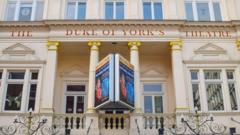
For 134 years, the building on St. Martin’s Lane has worn the title of the Duke of York’s Theatre. It is a name that evokes a specific kind of British institutional permanence. It sounds like heavy oak doors, starched collars, and aristocratic dust. But names are fragile things. They are leased from history, and eventually, the lease expires.
Soon, the brass lettering above the canopy will change. The Duke is stepping down. In his place, a playwright is moving in.
The venue is being officially renamed the Tom Stoppard Theatre. On the surface, it is a standard piece of theatrical news, the kind of press release that populates industry trade columns and gets filed away under administrative updates. Ambassador Theatre Group decides to honor Britain’s greatest living dramatist. The boards are scrubbed. The stationery is reprinted. Business moves on.
But look closer at the limestone facade. Look at what it actually means to strip a royal title off a monument of culture and replace it with the name of an immigrant boy who fled the Nazis, arrived in England with nothing but a borrowed surname, and proceeded to rewrite the English language.
This is not a corporate rebranding. It is a quiet revolution in how we decide who belongs in the cultural landscape.
The Weight of the Limestone
To understand the stakes, you have to understand the sheer inertia of the West End. Theater districts do not like change. They tolerate the occasional paint job, but the geography of British drama is meant to feel ancient, almost geological. The Duke of York’s opened its doors in 1892, originally called the Trafalgar Square Theatre, before settling into its ducal identity three years later.
Consider what these walls have absorbed. This is where Arthur Wing Pinero’s comedies scandalized late-Victorian sensibilities. This is the room where J.M. Barrie first introduced a boy who wouldn't grow up. On December 27, 1904, a crowd of children and adults sat in these exact stalls, looked up at the proscenium arch, and watched Peter Pan fly into the night sky for the very first time.
That kind of history creates a ghost. Not a literal phantom with a bedsheet, but a heavy, atmospheric pressure. When an actor steps onto that stage, they are competing with every line of dialogue that has ever vibrated through the plasterwork.
For over a century, that pressure was mediated through the name of royalty. The theater belonged to the Crown’s lineage, a symbolic nod to the idea that art exists under the patronage of the state. It was a top-down arrangement. The building was a palace of entertainment, and audiences entered as guests of an absent duke.
When you change that name to Stoppard, the entire architecture shifts.
Suddenly, the house belongs to the maker. It belongs to the craftsman who sat in the back row during tech rehearsals, chewing his fingernails down to the quick while a lighting designer tried to fix a stubborn spotlight. It honors the sweat, the frantic rewrites on the back of cigarette packets, and the terrifying vulnerability of putting words into a stranger’s mouth.
The Boy from Zlín
There is an inherent irony in naming a massive piece of prime London heritage after Sir Tom Stoppard, a man whose entire literary career has been an interrogation of identity, displacement, and the instability of truth.
He was not born to the manor. He was born Tomáš Straüssler in Zlín, Czechoslovakia, in 1937. His family fled the Nazi occupation, moving to Singapore, then to India, fleeing just ahead of the fires of the mid-century collapse. His father died at sea. By the time a young Tom settled in Derbyshire in 1946 with his mother and his new English stepfather, he was a human mosaic of different cultures, languages, and traumas.
He became more English than the English. He fell in love with the specific, elastic brilliance of the language because he had to learn its contours from the outside.
Think about his breakout masterpiece, Rosencrantz and Guildenstern Are Dead. The play takes two minor, forgotten nobodies from the margins of Hamlet and places them center stage. They are confused. They are trapped in a world where the rules keep changing, flipping coins that always land on heads, waiting for an identity that never quite arrives. They are the ultimate immigrants, trying to figure out the script of a play they didn't know they were cast in.
How poetic, then, that the man who wrote the definitive comedy about two outsiders wandering the corridors of a royal castle is now displacing a Duke from his own theater.
The decision by the Ambassador Theatre Group isn't just an act of reverence; it is a rare moment of historical symmetry. Stoppard’s history with the Duke of York's is deep and bloody. It is the space where his recent, monumental work Leopoldstadt found its life. That play, an epic narrative tracking a Jewish family through the horrors of the twentieth century, was intensely autobiographical. It was Stoppard looking into the mirror of his own forgotten past, reckoning with the relatives he lost to the concentration camps.
To watch Leopoldstadt inside the Duke of York's was an exercise in cognitive dissonance. You were sitting in a Victorian playhouse named after British royalty, watching a story about the fragile, obliterated culture of Central European Jewry. The building and the text were at war, in the best possible way.
By renaming the venue, the West End is admitting that the stories told inside the room have finally broken through the skin of the building itself.
The Invisible Economy of Prestige
Let’s be cold-eyed for a moment. The theater industry is not a charity. It is an ecosystem of brutal margins, shifting tourist demographics, and astronomical production costs. Every square inch of the West End must justify its existence in ticket sales and bar revenue. Why would a corporate entity give up a name that has carried reliable, premium brand recognition for over a century?
Because the nature of prestige has changed.
A royal title doesn't sell a ticket to a twenty-two-year-old student looking for something that speaks to the chaos of their modern life. A duke is an anachronism; a great writer is an anchor. In an era dominated by screen-based entertainment, where digital content can be summoned with a thumb-swipe, live theater has to double down on its unique selling proposition: human presence.
By branding a theater with a playwright's name, the venue becomes a temple to the act of creation. It tells the audience that what happens inside this room is bespoke, intellectual, and intensely human. It turns the building from a mere real estate asset into a literary destination.
It is a strategy that has worked before. When the Comedy Theatre was renamed the Harold Pinter Theatre in 2011, it didn't just change the sign; it changed the programming DNA. It became a home for precise, taut, menacing drama. The Novello Theatre, named after Ivor Novello, carries the DNA of musical spectacle. The Gielgud and the Sondheim stand as monuments to performance and composition.
The Tom Stoppard Theatre will carry its own specific mandate. You cannot easily program a brainless, superficial farce in a building that bears the name of the man who wrote Arcadia. The name demands wit. It demands intellectual ambition. It demands that the audience show up ready to think, to argue, and to have their assumptions cracked open.
The View from the Circle
Imagine an aspiring writer sitting in the upper circle of the renamed theater five years from now. They are young, perhaps they feel out of place in the glittering, expensive heart of London. They look down at the stage, feeling the immense distance between their own messy, unformed thoughts and the polished perfection of a West End production.
Then they look at the program. They read the name on the front of the building.
They don't see the title of a nobleman who inherited his position through the accident of birth. They see the name of a kid from Zlín who liked words, who worked as a journalist in Bristol, who failed and stumbled and kept writing until he found a way to make the English language dance to his own rhythm.
The distance between the gallery and the stage shrinks. The building becomes a promise rather than a fortress.
This is the real work of cultural renaming. It isn't about setting Sir Tom's legacy in stone—his scripts have already taken care of that. It is about changing the signals the building sends out to the street. It is about telling the passerby that the highest honor the theatrical community can bestow doesn't belong to the rulers, but to the storytellers.
The next time you walk down St. Martin’s Lane, stop outside the theater. Ignore the traffic, the glare of the digital billboards, and the rush of commuters heading toward Leicester Square. Look up at the space where the old letters used to be.
The Duke has left the building. The writer remains.