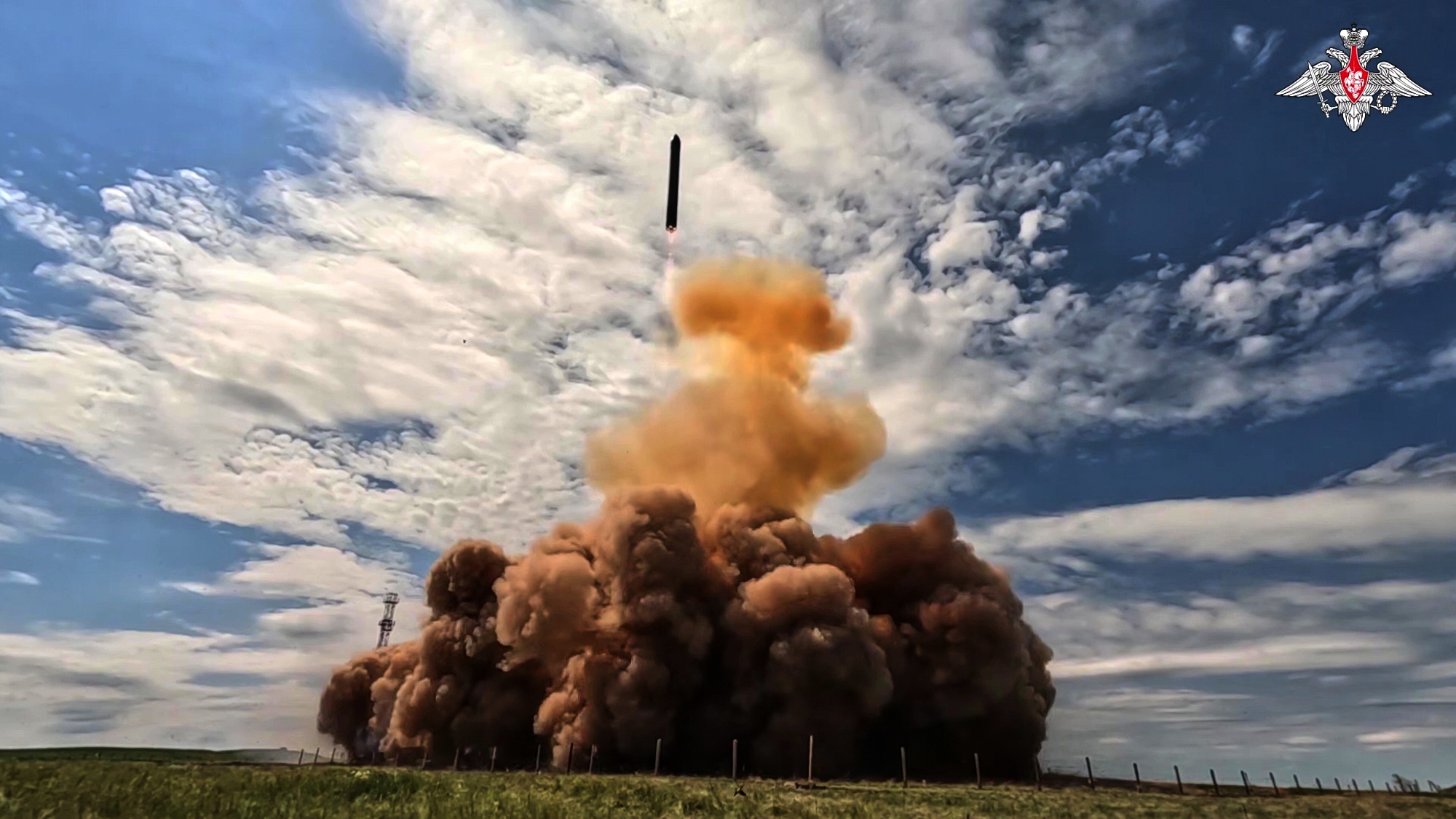
The deployment of the Oreshnik missile system represents a structural shift in intermediate-range strike capabilities, moving beyond traditional subsonic cruise missiles toward high-velocity kinetic effects. This shift is not merely a quantitative increase in speed but a qualitative change in the interception calculus for modern air defense systems. By utilizing a multi-warhead ballistic trajectory that reaches terminal velocities in the hypersonic range, the system exploits a specific vulnerability in existing kinetic interceptor envelopes. The primary objective of this deployment is the establishment of a "protection gap" where the cost and probability of successful interception become prohibitively high for the defender.
The Mechanics of Kinetic Superiority
To understand why the Oreshnik occupies a unique position in contemporary ballistics, one must examine the physics of its terminal phase. Unlike standard cruise missiles that rely on aerodynamic lift and air-breathing engines, the Oreshnik follows a ballistic arc that terminates in a near-vertical descent. This trajectory maximizes gravitational acceleration, ensuring the reentry vehicles maintain high kinetic energy.
The system utilizes Multiple Independently Targetable Reentry Vehicles (MIRVs). This design serves three distinct strategic functions:
- Saturation of Processing Logic: Aegis and Patriot systems must track, categorize, and assign interceptors to multiple incoming threats simultaneously. The sheer number of reentry vehicles can exceed the number of ready-to-launch interceptors at a single battery site.
- Probability of Kill (Pk) Reduction: By splitting a single missile into multiple sub-munitions, the attacker forces the defender to achieve a 100% success rate across all targets to prevent damage. A single missed intercept results in a successful strike.
- Kinetic Hardening: Reentry vehicles traveling at Mach 10 or higher generate a plasma sheath. This sheath can interfere with radar signatures, complicating the precision tracking required for "hit-to-kill" interceptors like the PAC-3.
Interception Dynamics and the Response Window
The primary bottleneck for any missile defense system is the "decision-to-impact" timeline. Subsonic missiles allow for minutes of reaction time; the Oreshnik reduces this to seconds. When a ballistic missile enters its terminal phase, the window for engagement is defined by the sensor's horizon and the interceptor's fly-out speed.
Current Western defense architectures, such as the Terminal High Altitude Area Defense (THAAD) and the Patriot (MIM-104), operate within specific altitude gates. The Oreshnik’s velocity places it at the extreme edge of these gates. As velocity increases, the required maneuverability of the interceptor grows exponentially. At hypersonic speeds, the G-loads required for an interceptor to adjust its path for a direct collision often exceed the structural integrity of the interceptor’s airframe.
The cost-exchange ratio also shifts heavily in favor of the attacker. While the Oreshnik is an expensive asset, the requirement to fire two or three interceptors at every single sub-munition—to ensure a high probability of kill—drains the defender’s inventory at a rate that cannot be sustained during a prolonged theater conflict.
Strategic Signaling and the INF Vacuum
The emergence of the Oreshnik is a direct technical consequence of the dissolution of the Intermediate-Range Nuclear Forces (INF) Treaty. Without the constraints of that framework, the development of ground-launched missiles with ranges between 500 and 5,500 kilometers has resumed.
This creates a new "Theater Escalation Ladder." Previously, the gap between short-range tactical missiles and long-range intercontinental ballistic missiles (ICBMs) was populated largely by air-launched or sea-launched assets. A ground-mobile ballistic system like the Oreshnik introduces a permanent, hard-to-track threat that can be launched with minimal preparation time.
The system’s "non-nuclear" testing in a combat environment serves as a demonstration of conventional strategic deterrence. It communicates that high-value infrastructure can be neutralized without resorting to nuclear payloads, thereby lowering the threshold for the use of strategic-grade delivery systems. This is the "Dual-Use Dilemma": a defender cannot know if an incoming Oreshnik carries a conventional or nuclear payload until impact, forcing the defender to treat every launch as a potential existential threat.
Logistics of Mobility and Survivability
Fixed missile silos are vulnerable to preemptive strikes. The Oreshnik system utilizes a Transporter-Erector-Launcher (TEL) vehicle, which provides a high degree of "shoot-and-scoot" capability. The survivability of these units depends on:
- Road Mobility: The ability to utilize existing civilian and military road networks to vanish into forested or urban environments after launch.
- Rapid Emplacement: The time required to transition from a traveling configuration to a launch-ready state.
- Camouflage and Deception: Utilizing thermal masking and physical decoys to defeat satellite and UAV reconnaissance.
By maintaining a mobile battery, the attacker ensures that the "First Strike" capability of an opponent remains incomplete. Even if fixed sites are destroyed, the mobile Oreshnik units remain an active threat, fulfilling the fundamental requirement of second-strike deterrence.
Global Proliferation and the Technical Baseline
The test launch of the Oreshnik is not an isolated event but part of a broader global trend toward the "hypersonic-ballistic" hybrid. Other nations are pursuing similar technology to bypass the Aegis Ashore and other regional missile shields. The Oreshnik serves as a technical baseline for what is now possible with solid-fuel boosters and advanced heat-shielding materials.
The limitations of this technology reside in guidance and targeting. At terminal velocities, traditional GPS or GLONASS signals can be blocked by the plasma layer. Therefore, the Oreshnik likely relies on high-precision Inertial Navigation Systems (INS) supplemented by optical or radar terrain mapping in the final seconds of flight. The accuracy of these systems (Circular Error Probable, or CEP) determines whether the missile is a precise "sniper" weapon or a "blunt force" tool intended for large industrial targets.
The Shift in Defense Procurement
Western military planners are now forced to accelerate the development of Glide Phase Interceptors (GPI) and directed-energy weapons. Since kinetic interceptors are reaching their physical limits, the next phase of defense will likely focus on:
- Space-Based Tracking: Low Earth Orbit (LEO) satellite constellations designed to track high-speed dim targets from launch to impact.
- Directed Energy: High-power lasers or microwaves that can damage the sensitive electronics or control surfaces of a reentry vehicle without needing a direct physical collision.
- Electronic Warfare: Attempting to spoof the internal navigation of the missile before it enters the terminal phase.
The Oreshnik has effectively forced a "re-tooling" phase in global defense spending. Nations can no longer rely on the legacy systems designed for the slower, more predictable threats of the early 2000s.
The deployment of the Oreshnik signals that the era of uncontested air defense in theater-level conflicts has ended. Strategy must now account for a "leaky" defense environment where some percentage of high-velocity munitions will inevitably reach their targets. The priority for regional actors must move toward hardening physical infrastructure and decentralizing command-and-control nodes. If an incoming strike cannot be reliably intercepted, its strategic value must be diminished through redundancy and rapid recovery capabilities. The goal is no longer the perfect shield, but the resilient network.


/https://blastathletics.s3.amazonaws.com/uploads/cover_photo/file/31947/OC_Buc.jpg)