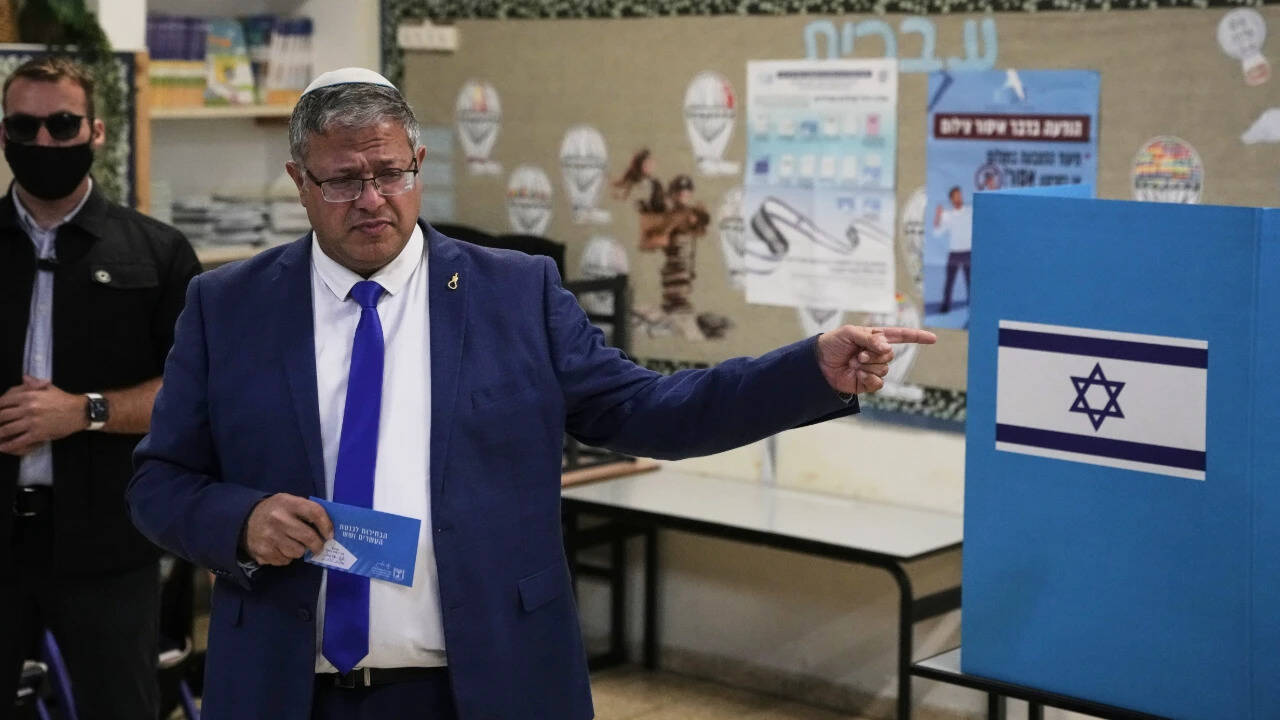
When Israeli National Security Minister Itamar Ben Gvir calls for the arrest of Arab party leaders over alleged election theft, standard news coverage treats the statement either as an unprecedented institutional crisis or as literal law enforcement policy. Both readings miss the structural reality of Israeli coalition politics and the mechanics of electoral mobilization.
According to public statements reported in Israeli media, Ben Gvir, leader of the ultranationalist Otzma Yehudit party, accused Arab political factions of undermining the democratic process and urged law enforcement to detain their leadership. Critics, including opposition lawmakers and civil rights organizations like Adalah, immediately condemned the remarks as an authoritarian attack on the voting rights of Palestinian citizens of Israel, who make up roughly 21% of the population. Meanwhile, supporters of Ben Gvir argue that his rhetoric reflects legitimate concerns over voter turnout irregularities and political incitement.
To understand what is actually happening, observers need to look past the surface-level shock and examine the electoral incentives driving both sides of the Knesset.
The Mechanics of Political Mobilization in a Fragmented System
Israel’s proportional representation system rewards sharp polarization. With an electoral threshold set at 3.25% of the total valid vote, smaller parties survive not by appealing to the political center, but by consolidating their core base and suppressing or fracturing the opposition's turnout.
In recent election cycles, Arab voter turnout has been one of the single most decisive variables in determining whether a right-wing bloc led by Benjamin Netanyahu or an anti-Netanyahu coalition secures a 61-seat majority. For instance, in the March 2020 election, the Joint List—an alliance of predominantly Arab parties—achieved a historic 64.8% turnout among Arab citizens, winning 15 seats and blocking a right-wing majority. By contrast, when turnout dropped to 44.6% in March 2021, Arab representation fell to 10 seats across two separate factions, Ra'am and the Joint List.
When Ben Gvir attacks Arab party leaders—such as Ayman Odeh of Hadash-Ta'al or Mansour Abbas of Ra'am—he is not issuing an operational directive to the Israel Police. Under Israeli law, the National Security Minister sets general policy for the police, but does not have the legal authority to order individual arrests or direct criminal investigations, which remain under the purview of the Attorney General and the State Prosecutor's Office.
Instead, the rhetoric serves two distinct political functions:
- Base Consolidation: It reinforces Ben Gvir’s brand among right-wing voters who view Arab nationalist parties as inherently hostile to the state’s Jewish character.
- Narrative Framing: By characterizing high Arab turnout or political organizing as "stealing elections," it delegitimizes any governing coalition that relies on Arab parties for parliamentary support, a tactic previously used against the 2021–2022 Bennett-Lapid government, which included Mansour Abbas's Ra'am party.
Institutional Guardrails vs. Political Theater
A common analytical error is conflating incendiary ministerial rhetoric with actual institutional collapse. Israel’s electoral administration is managed by the Central Elections Committee (CEC), an independent body headed by a Supreme Court justice and composed of representatives from all parliamentary factions.
The CEC oversees polling stations, ballot counting, and the certification of results. While accusations of fraud have surfaced in multiple Israeli elections—including past controversies involving hidden cameras placed in Arab polling stations by Likud activists in 2019—the CEC and the Supreme Court have consistently maintained procedural control over election certification.
Furthermore, Israel’s Basic Law: The Knesset (Section 7A) explicitly outlines the legal mechanism for disqualifying a party or candidate from running in elections. Disqualification is permitted only if a party's goals or actions negate the existence of the State of Israel as a Jewish and democratic state, incite racism, or support armed struggle against the state. Even when the CEC votes to disqualify an Arab party or candidate—which happens frequently during election cycles—the Israeli Supreme Court has historically overturned almost all such disqualifications on appeal, citing the fundamental right to vote and be elected.
The Two-Front Reaction
The debate surrounding Ben Gvir’s statements highlights a fundamental divide in how Israeli democracy is defined by its participants.
The Civil Rights and Opposition Perspective
Legal scholars at the Israel Democracy Institute (IDI) and representatives from Arab civil society argue that rhetoric calling for the arrest of elected representatives crosses a dangerous line, even if no arrests occur. Their concern is not merely legal, but sociological:
- Chilling Effect: Aggressive rhetoric from the minister overseeing the police can intimidate voters in Arab municipalities, depressing turnout on election day.
- Delegitimization of Citizenship: Framing the participation of 20% of the electorate as illegitimate erodes the baseline consensus required for a functioning multi-ethnic democracy.
- Institutional Erosion: Repeated public clashes between the National Security Minister and the Attorney General (currently Gali Baharav-Miara) weaken public trust in the neutrality of law enforcement.
The Nationalist Right Perspective
Conversely, Ben Gvir and his allies argue that their stance is a defensive measure aimed at preserving the integrity of the state. From their viewpoint:
- Security Concerns: Right-wing lawmakers frequently point to statements by certain Arab Knesset members expressing solidarity with Palestinians in the West Bank and Gaza as evidence of disloyalty during wartime.
- Electoral Integrity: Supporters contend that oversight in certain municipalities has historically been lax, and that strict enforcement is necessary to prevent ballot stuffing or identity fraud.
- Sovereignty: For Otzma Yehudit voters, the core issue is demographic and political sovereignty—the belief that fateful decisions regarding Israel's borders and security should be decided by a Jewish majority, not by parties that oppose Zionism.
Why Conventional Media Coverage Misses the Mark
Standard reporting often treats every provocative statement from a cabinet minister as a standalone breaking news event, detached from the legislative and judicial reality on the ground. This creates a distorted picture for international readers.
First, it ignores the sharp distinction between parliamentary immunity and ministerial power. Knesset members enjoy substantive immunity under the Knesset Members Immunity, Rights and Duties Law, meaning they cannot be arrested or prosecuted for actions or statements made in the course of fulfilling their parliamentary duties unless the Knesset House Committee votes to strip that immunity—a high bar that requires legal justification reviewed by the Attorney General.
Second, it overlooks the strategic agency of Arab political leaders themselves. Figures like Mansour Abbas have actively reshaped the political calculus by demonstrating that Arab parties can leverage their swing-vote status to secure billions of shekels in state funding for Arab municipalities—such as the five-year economic development plan passed in 2021—rather than remaining in permanent opposition. Conversely, leaders like Ayman Odeh and Ahmad Tibi argue that true equality cannot be bought through budget allocations while systemic discrimination and the occupation persist.
Assessing the Real Impact
Evaluating the significance of Ben Gvir’s rhetoric requires separating immediate legal reality from long-term political trends.
In the immediate term, the likelihood of police arresting heads of Arab political parties over election disputes without concrete, prosecutable evidence approved by the Attorney General is virtually zero. The institutional friction between the Ministry of National Security and the Ministry of Justice acts as a built-in brake on unilateral executive action.
However, in the longer term, the normalization of such rhetoric alters the boundaries of acceptable political discourse. When accusations of "election theft" become a standard tool of political competition, the losing side in any close election—regardless of ideological alignment—faces heightened pressure to reject the legitimacy of the outcome. For voters and analysts alike, the critical metric to watch is not the volume of ministerial statements, but the actual turnout figures in Arab communities and the rulings of the Supreme Court when the next election cycle begins.