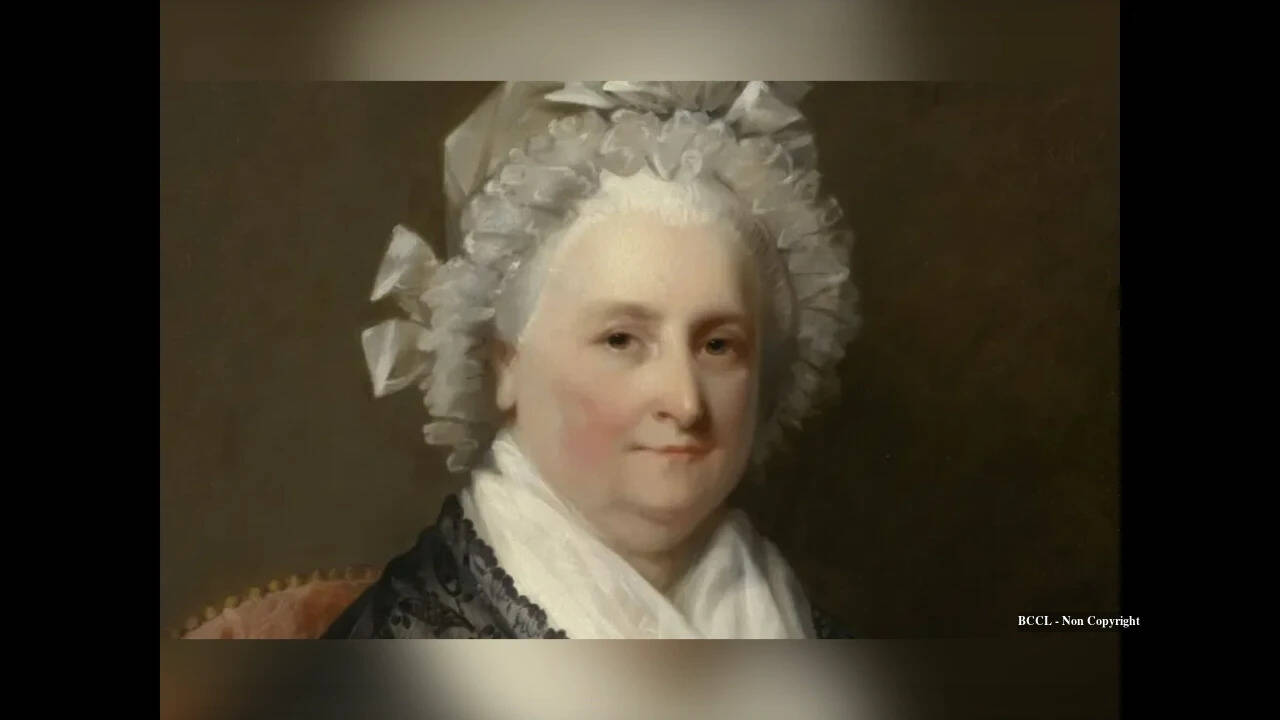
A two-page letter written by Martha Washington in August 1760 recently fetched $47,500 at auction and is now headed to the Library of Congress, filling a massive void in the nation's historical record. Penned from Mount Vernon to her sister, Anna Maria Bassett, the document details the acute illnesses of her young children, Patsy and Jacky Custis, alongside the quiet domestic realities of early colonial Virginia. Its high price reflects an extreme market scarcity. After George Washington died in 1799, Martha burned nearly all of their personal correspondence, leaving fewer than a dozen surviving letters written in her own hand during her lifetime.
Most collectors expect Founding Era documents to be dense with political strategy, military logistics, or constitutional theory. Those items trade hands regularly at major auction houses in New York and London. What rarely surfaces is the unvarnished, domestic vulnerability of the people who built the early republic. When a piece of paper bridges that gap—and carries the signature of the nation's first First Lady—institutional buyers and private collectors collide.
The mechanics of this specific sale reveal much about how historical artifacts are valued, authenticated, and ultimately absorbed into public collections. It is not merely a story about an old piece of paper changing hands. It is a look inside the ruthless economics of historical preservation, the deliberate erasure of women's voices from the 18th-century archive, and the quiet bidding wars that determine whether the public ever gets to read primary sources.
The Deliberate Destruction of an Archive
To understand why a single sheet of laid paper commands nearly fifty thousand dollars, you have to understand what happened in the upper bedroom at Mount Vernon shortly after December 14, 1799. George Washington was dead. Martha, grieving and fiercely protective of their shared privacy, gathered forty-four years of letters exchanged between them and threw them into the hearth.
She spared only two. One was written in June 1775, right after George accepted command of the Continental Army. The other was penned days later, just before he left Philadelphia for Cambridge. Everything else—thousands of pages chronicling their courtship, the Revolutionary War, the presidency, and their private anxieties—turned to ash.
Historians have spent two centuries lamenting that fire. By destroying her marital correspondence, Martha Washington inadvertently created one of the steepest supply-and-demand curves in the autograph and manuscript market. While thousands of George Washington letters survive in archives and private vaults across the globe, authentic letters written entirely by Martha Washington are unicorn artifacts.
Furthermore, surviving examples from her early years at Mount Vernon are practically nonexistent. She married George in January 1759, bringing her two surviving children from her first marriage to Daniel Parke Custis—John Parke Custis (Jacky) and Martha Parke Custis (Patsy)—to the Potomac estate. The August 1760 letter captures her just nineteen months into that marriage, adjusting to a new household while navigating the terrifying medical realities of 18th-century parenting.
Inside the August 1760 Manuscript
The letter itself is a masterclass in 18th-century domestic endurance. Addressed to her younger sister, Anna Maria Dandridge Bassett, who lived at Eltham plantation in New Kent County, the text strips away the marble-statue mythology surrounding the Washingtons.
In the summer of 1760, Mount Vernon was sick. Martha writes plainly about the physical toll on her children. Little Patsy, then around four years old, was suffering from severe fevers and convulsions—early manifestations of the epilepsy that would plague her until her sudden death at age seventeen. Jacky, roughly six, was also battling persistent illness.
In colonial Virginia, a childhood fever was not a minor inconvenience treated with over-the-counter syrups. It was a potential death sentence. Families routinely lost half their children before adulthood to dysentery, smallpox, malaria, and mysterious "bilious fevers." Martha’s writing conveys the exhausting vigilance required of a colonial mother, detailing the remedies tried, the anxious nights, and her yearning for her sister's company.
There is no mention of British taxation. There are no grand pronouncements about liberty. Instead, there is a mother asking for family news, commenting on the Virginia weather, and managing the sprawling logistical network of a plantation household while her husband was frequently away tending to his estates or sitting in the House of Burgesses in Williamsburg.
For social historians, this mundane detail is gold. Political history tells us what men decided in legislative chambers; domestic correspondence tells us what life actually felt like on the ground.
The Anatomy of a High-Stakes Auction
When a document of this caliber hits the market, the pricing structure operates differently than standard collectibles. A typical signed document by a minor Revolutionary figure might sell for a few hundred dollars. A routine military endorsement signed by George Washington during the war might bring $15,000 to $25,000, depending on content and condition.
Martha Washington breaks those rules. Because the supply is fixed at near zero, pricing is driven by three primary factors:
- Holograph Status: In the rare book and manuscript trade, an ALS (Autograph Letter Signed)—meaning the entire body of the letter as well as the signature is in the author's hand—is vastly more valuable than an LS (Letter Signed), which was dictated to a secretary. Martha Washington frequently used secretaries, including George himself, later in life during her presidency years when her eyesight and hand weakened. An early, entirely handwritten letter is exponentially rarer.
- Date and Provenance: Letters written during the Mount Vernon years prior to the Revolution offer a window into her life before she became a public symbol. Clear provenance—tracing the letter from the Bassett family descendants through private collections—eliminates doubts about authenticity.
- Content Depth: Collectors pay premiums for narrative substance. A brief social invitation is worth far less than a two-page letter detailing family health, emotional state, and daily life at Mount Vernon.
The $47,500 hammer price (including buyer's premium) reflects a fierce calculation. At that figure, the buyer is not just acquiring ink on rag paper; they are acquiring a permanent piece of American primary source material that almost certainly will never appear on the open market again.
How the Library of Congress Acquires History
Public institutions rarely compete on equal footing with billionaire collectors. The Library of Congress operates under strict budget constraints, relying heavily on congressionally appropriated funds, dedicated endowments, and private philanthropic gifts to acquire major historical manuscripts.
When an item like the 1760 Martha Washington letter surfaces at auction, curators in the Library’s Manuscript Division have to move quickly. They cannot simply show up on auction day with an unlimited paddle. The acquisition process requires rapid internal vetting:
- Curatorial Justification: Specialists must prove the document fills a specific, documented gap in the existing national collection. Because the Library of Congress already holds the largest collection of George Washington papers in the world—roughly 65,000 items—acquiring a rare early letter from Martha directly strengthens the contextual depth of their core holdings.
- Condition and Authenticity Forensics: Before bidding a dime, conservators and manuscript experts verify the paper's watermark, the iron-gall ink composition, and the specific orthographic quirks of Martha Washington’s handwriting. Martha was notoriously phonetic in her spelling—a standard trait among even wealthy 18th-century women who received minimal formal schooling—and her distinctive penmanship is difficult for forgers to replicate convincingly across two full pages.
- Funding Alignment: Because tax dollars for acquisitions are limited, the Library often coordinates with dedicated trust funds, such as the James Madison Council, or private benefactors who purchase items on the institution's behalf or fund the bid directly.
Securing the letter for $47,500 is widely viewed by archival professionals as a major victory for public access. Had the manuscript gone into a private vault, it might have disappeared for another fifty years, unseen by researchers, biographers, or everyday citizens.
The Invisible Labor of Colonial Women
The intense interest in this specific sale also highlights a broader shift in how museums, libraries, and collectors value historical documents. For decades, the manuscript market was overwhelmingly male-dominated—both in the subjects collected and the buyers writing the checks. Letters by generals, presidents, and industrialists commanded top dollar, while correspondence by their wives, sisters, and daughters was treated as secondary ephemera.
That valuation model is rapidly eroding. Institutions have realized that their archives are structurally lopsided. You cannot accurately tell the story of Mount Vernon—an estate sustained by the forced labor of hundreds of enslaved people and managed day-to-day by Martha Washington while George was away for years at a time—using only George’s account books and military dispatches.
Martha Washington was not a passive ornament in the background of the American Revolution. She spent every winter of the eight-year war in camp with George, from Valley Forge to Morristown, organizing relief efforts, managing military hospitality, and serving as an unofficial morale officer for the Continental Army. Later, as the nation's first First Lady, she invented the social protocols of the executive branch from scratch, balancing republican simplicity with the dignity required of a new sovereign nation.
Yet her voice remains muffled because so little of her writing survived. Every time a letter like the August 1760 manuscript is recovered, digitized, and placed in the public domain, historians gain another data point to reconstruct her actual personality—not the sanitized, grandmotherly caricature painted by 19th-century mythmakers, but the sharp, resilient, deeply family-oriented Virginia planter's wife who actually lived the history.
What Happens to the Letter Next
Entering the Library of Congress does not mean the letter is immediately thrown into a glass display case on Capitol Hill. In fact, public exhibition is usually the final step in a long conservation pipeline.
First, the manuscript undergoes environmental stabilization. Eighteenth-century rag paper made from linen and cotton fibers is remarkably durable—far superior to modern wood-pulp paper, which turns acidic and brittle within decades. However, iron-gall ink, the standard writing fluid of the colonial era, can slowly eat through paper if exposed to high humidity over centuries. Conservators check for ink corrosion, surface dirt, and fragile fold lines where the paper was originally creased and sealed with wax.
Next comes high-resolution multispectral imaging. Technicians photograph the front and back of the sheets under specialized lighting to capture every faint pencil annotation, postal mark, and watermark. These digital files are then transcribed, indexed, and uploaded to the Library’s online portal, allowing a student in Oregon or a historian in London to examine the exact brushstrokes of Martha Washington’s quill without touching the physical artifact.
Finally, the physical sheets are housed in custom-fitted, acid-free folders and stored in climate-controlled vaults beneath Washington, D.C., maintained at precise temperature and humidity levels designed to preserve the paper for the next five hundred years.
The Cost of Historical Memory
Some taxpayers inevitably balk when they read headlines about a single two-page letter selling for nearly the median annual household income in the United States. On the surface, $47,500 seems like an extravagant sum for an update on two sick children written over two hundred and sixty years ago.
That reaction misses the reality of the global antiquities and manuscript market. In an era where rare sports trading cards routinely sell for millions of dollars and digital NFTs have traded for tens of millions, $47,500 for a primary-source document written by the first First Lady of the United States is arguably an undervaluation.
Private collectors know this. Had a major institutional buyer not stepped in to secure the piece, the price could easily have climbed higher in future decades as the remaining pool of privately held Founding Era manuscripts shrinks even further. Once a document enters the Library of Congress, it is permanently removed from commerce. It will never be resold, never split up, and never locked behind a private collector's gate.
When Martha Washington fed her letters into the Mount Vernon fireplace in 1799, she believed she was protecting her privacy. She had no way of knowing that her act of grief would turn the few surviving scraps of her handwriting into some of the most sought-after artifacts in American history—or that more than two centuries later, the nation would pay nearly fifty thousand dollars just to hear her speak plainly about a sick child on a hot Virginia afternoon.


