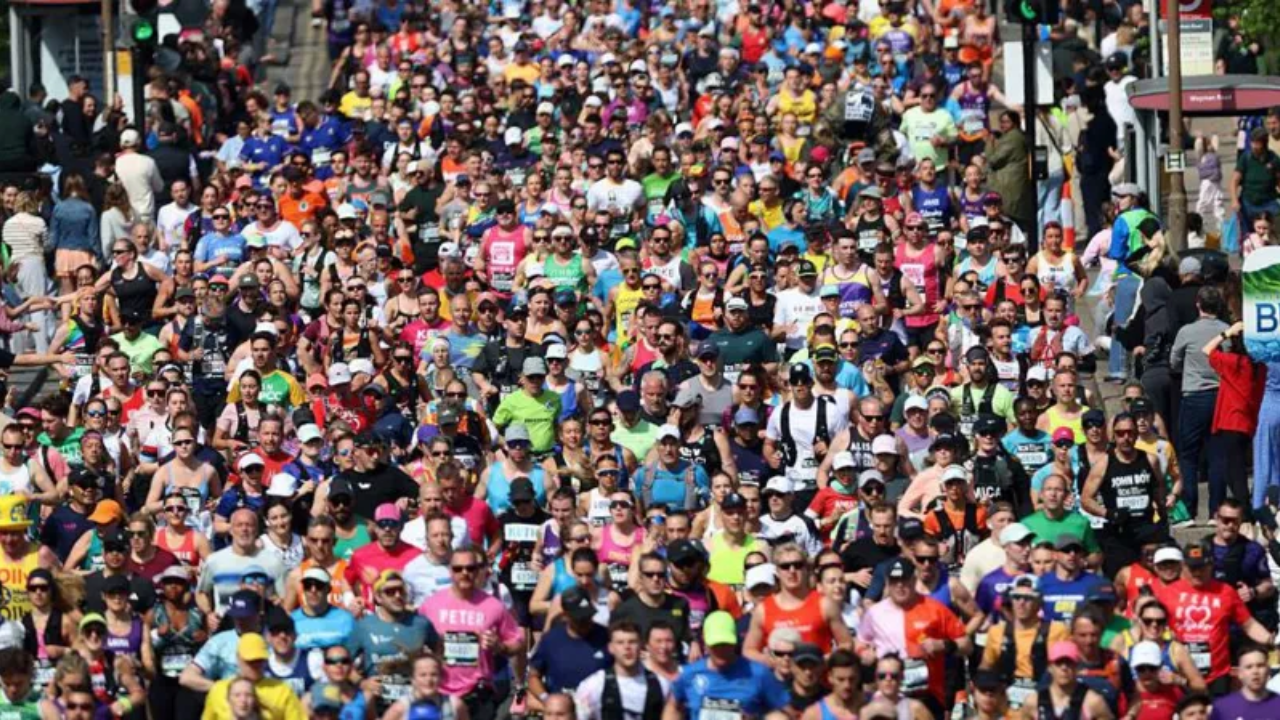
The tarmac on the Mall shouldn't feel soft. It is high-grade asphalt, engineered to withstand the weight of royal processions and the relentless grind of London traffic. But when you are thirty-five thousand steps into a journey that started in Blackheath and your glycogen stores have been empty since Canary Wharf, the ground begins to hallucinate. It ripples. It breathes. To the forty thousand runners crossing the finish line of the 2026 London Marathon, that stretch of road felt less like a street and more like a sanctuary.
We often talk about these events in the language of logistics. We discuss road closures, chip times, and hydration stations. We look at the sweeping overhead shots of a river of neon polyester flowing over Tower Bridge and see a spectacle. But the spectacle is a mask. Behind it lies a staggering, record-breaking engine of human desperation and hope that, this year, translated into a number that defies standard athletic logic.
£87.5 million.
That is the new world record for a single-day annual fundraising event, officially tallied as the final donations trickled in from the 2026 race. It eclipses every previous high-water mark in the history of the sport. Yet, to understand how a group of sweating, limping strangers managed to pull nearly ninety million pounds out of the ether, you have to look past the spreadsheets. You have to look at the blistered feet and the names written in Sharpie on sweaty vests.
The Anatomy of a Mile
Consider Sarah. She is a hypothetical runner, but she represents thousands who stood in the starting pens this April. Sarah isn’t an elite athlete. She doesn't have a shoe contract or a specialized diet. She has a knee that clicks when it rains and a job that requires her to sit at a desk for nine hours a day.
Why was she there?
She was there because three years ago, a specific type of cancer with a long, unpronounceable name took her father. She was there because the hospice that made his final weeks bearable relies on the very funds she spent six months begging from her cynical coworkers and distant cousins. When Sarah hit "the wall" at mile 22—that physiological point where the body decides it is actually dying and tries to shut down—she didn't keep going because of "willpower." She kept going because she had £3,400 pledged to a cause that felt more real than the pain in her quads.
This is the invisible infrastructure of the London Marathon. The race isn't powered by Gatorade; it’s powered by debt. Not the kind of debt you owe a bank, but the kind of debt you owe to the people who aren't here anymore, or the people who might still be saved.
The Economics of Empathy
The sheer scale of £87.5 million is difficult to visualize. If you laid those pound coins edge-to-edge, they would stretch from London to the edge of the Sahara Desert. In a year where the global economy has felt brittle and the cost of living remains a persistent shadow over every household budget, this windfall seems counterintuitive. One might expect charitable giving to shrink when the price of bread rises.
Instead, the opposite happened.
The 2026 race saw a 12% increase in individual donation amounts compared to the previous year. We are seeing a shift in how the public views these mass-participation events. They are no longer just "races." They have become the primary delivery system for social welfare in sectors where government funding has retreated. From mental health hotlines to rare disease research, the finish line in front of Buckingham Palace has become one of the most vital financial hubs in the country.
The "world record" isn't just a trophy for the organizers. It is a lifeline for approximately 2,400 different charities. It represents millions of hours of nursing, thousands of liters of clean water in distant villages, and countless sessions of therapy.
The Friction of the Road
The beauty of the marathon lies in its inherent unfairness. The wind doesn't care if you're running for a children’s hospital or if you’re just trying to beat your personal best. The cobblestones at the Tower of London trip the saint and the sinner alike. This year’s race was particularly brutal, with a humidity that turned the air into a thick, breathable soup by noon.
You could see the toll in the "recovery" area. Men and women draped in foil blankets, looking like a discarded collection of baked potatoes, shivering despite the heat. There is a specific sound to the end of a marathon: the rhythmic clack-clack of medals hitting one another, punctuated by the occasional sob of pure, unadulterated exhaustion.
It is a strange irony. We live in a world that is increasingly obsessed with "frictionless" experiences. We want our food delivered without speaking to a human. We want our movies streamed instantly. We want our lives to be smooth. Yet, we flock to an event that is defined by friction. We pay for the privilege of suffering.
Perhaps that is why the fundraising totals keep climbing. In an era of digital detachment, the physical agony of the marathon provides a sense of "proof." When a friend asks you for twenty pounds because they are running 26.2 miles, you aren't just buying a tax receipt. You are paying for the honesty of their effort. You are witnessing someone trade their physical comfort for a stranger’s well-being.
The Ghost Runners
For every person crossing the finish line, there is a ghost. There are the people who couldn't run because of the very illnesses being funded. There are the volunteers who stood for ten hours handing out water, their own backs aching, just to be a part of the machinery of hope.
The record-breaking £87.5 million is a staggering sum, but it is also a heavy one. It carries the weight of every story told on a "JustGiving" page. It carries the grief of the bereaved and the desperate optimism of the newly diagnosed.
The 2026 London Marathon didn't just break a record; it validated a certain view of humanity. It suggested that even when things are difficult, even when the news is grim and the "landscape" of our society feels fractured, we are still capable of collective greatness. We can still decide, en masse, that a Sunday morning is better spent in pain for the sake of others than in the quiet comfort of our own beds.
As the sun set over London on that record-breaking Sunday, the crews began the long process of sweeping up the discarded plastic bottles and the stray bits of foil. The city returned to its normal, hurried self. The "soft" tarmac of the Mall hardened back into ordinary road.
But in the bank accounts of thousands of charities, the pulse of those forty thousand hearts continues to beat. The money will be spent. The research will continue. The beds will be funded. And somewhere, a woman named Sarah is finally sitting down, her medal clinking against a cup of tea, knowing that for one day, her sore legs were the most powerful thing in the world.
The race is over. The work it paid for has only just begun.