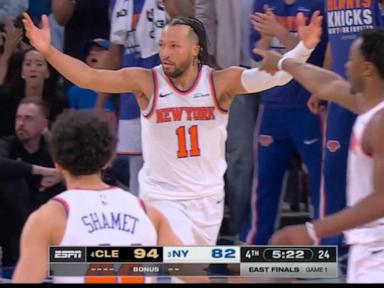
Basketball games are won in the margins, but playoff series are defined by systemic collapse. When the New York Knicks engineered a historic 22-point fourth-quarter comeback to secure a 115-104 overtime victory against the Cleveland Cavaliers in Game 1 of the Eastern Conference Finals, casual observers saw a miracle. They witnessed Jalen Brunson catch fire for 38 points, scoring 17 of them in the final frame and overtime, turning Madison Square Garden into an absolute asylum.
The real story of Game 1 is not a mystical triumph of New York grit. It is a cold, clinical demonstration of how tactical stubbornness and defensive hunting can dismantle a championship-level roster in less than eight minutes of game time.
Historically, NBA teams entering the fourth quarter down by 22 or more points in the postseason possessed a 1-594 record since play-by-play tracking began in 1997. The Cavaliers did not just lose a basketball game; they defied mathematical probability through a sequence of critical structural failures.
The Hunting of James Harden
Every NBA playoff series eventually transforms into a brutal exercise in hunting. Teams identify the weakest defensive link on the floor, drag them into the action via high pick-and-rolls, and exploit them until the head coach is forced to make a painful adjustment. In the fourth quarter of Game 1, the target was James Harden.
Brunson and the Knicks coaching staff recognized a fundamental truth. Cleveland was attempting to hide Harden on weaker perimeter threats, but New York forced the switch with merciless repetition. Once Brunson got the matchup he wanted, the result was academic.
- Footwork Disparity: Brunson used his low center of gravity and sudden stop-and-start hesitations to leave Harden stranded in space. Harden simply lacks the lateral quickness at this stage of his career to stay in front of an elite, downhill slasher.
- The Help Defense Dilemma: Because Harden was beaten so cleanly at the point of attack, Cleveland’s backline defenders, including Dean Wade and Evan Mobley, were forced to leave their assignments to contest Brunson near the rim. This opened up the offensive glass for Josh Hart and kick-out lanes for Mikal Bridges.
Brunson was not just hitting tough shots; he was operating with complete comfort because he knew exactly how his defender would react to every crossover. By the time Cleveland realized their perimeter containment was non-existent, the momentum had entirely shifted.
The Timeout Tragedy and Tactical Inertia
When a home team starts stringing together buckets in the postseason, the building becomes an active participant. The noise cascades down from the rafters, adrenaline surges, and the opposing team begins to play with a palpable sense of panic. The standard antidote is a tactical timeout to reset the defense and calm the nerves.
Cleveland coach Kenny Atkinson chose a different path.
As the Knicks mounted an astonishing 18-1 run late in the fourth quarter, the Cavaliers bench remained completely passive. Atkinson did not signal for a timeout until the lead had already evaporated to a mere five points. By then, the psychological damage was done.
Defenders were visibly winded, offensive possessions had devolved into isolation panic, and the Knicks were playing with the house money of a team that knew they had already broken their opponent’s spirit.
Leaving an aging star like Harden on an island against the most dangerous isolation scorer in the Eastern Conference without offering schematic help or a breather is an indefensible strategy. When Sam Merrill finally came over to double-team Brunson in overtime, it was far too little, far too late. The Knicks closed the contest on a staggering 44-11 run over the final 12 minutes of regulation and overtime.
The Disappearance of Donovan Mitchell
While Harden was being exploited on defense, Donovan Mitchell was frozen out on the other end of the floor. Mitchell was brilliant for the first three quarters, pacing Cleveland with 29 points and looking every bit like the best player on the court.
Then came the closing stretch. Mitchell attempted just five shots combined across the entire fourth quarter and overtime.
"We let them deny the ball too easily, and we didn't execute the sets designed to get our best scorer cleanly into his spots when the pressure amplified."
Some credit must go to the defensive length of OG Anunoby and Mikal Bridges, who bracketed Mitchell and denied him clean entries. However, the Cavaliers offense facilitated this erasure by standing still. Instead of running Mitchell through baseline screens or utilizing him as a screener to force mismatches, the offense degenerated into stagnant perimeter passing.
Harden shot a dismal 5-of-16 from the field overall, yet he continued to dictate the tempo late in the game while Mitchell was relegated to a decoy in the corner. If Cleveland intends to bounce back in Game 2, the hierarchy of the late-game offense must be explicitly clear. Mitchell needs the ball in his hands, regardless of how aggressively the defense denies him.
Looking Past the Miraculous Finish
The temptation for New York is to view this victory as a validation of their entire game plan. That would be a catastrophic mistake heading deeper into the Eastern Conference Finals.
For the first 36 minutes, the Knicks were thoroughly outplayed. They shot a miserable 31% from beyond the arc for the night, and before their furious fourth-quarter rally, they were sitting at a wretched 4-of-22 from three-point territory. Karl-Anthony Towns had an incredibly sloppy outing, registering 13 points and coughing up 7 costly turnovers.
New York survived because they dominated the offensive glass and generated 11 first-half turnovers out of Cleveland, keeping themselves within shouting distance before the historic meltdown occurred. They cannot rely on a historic 1-in-500 statistical anomaly to win three more games against this team. Cleveland blew a golden opportunity, but they provided a blueprint on how to stifle New York's half-court offense for three full quarters. Game 1 was a masterclass in psychological collapse, but the schematic war is only just beginning.