The maritime equilibrium in West Asia has shifted from a state of managed friction to an active war of attrition. The operational reality of the current conflict is defined by an ongoing United States naval blockade of Iranian ports, initiated on April 13, alternating with a fragile ceasefire brokered by Pakistan on April 8 that is currently collapsing. Rather than a standard diplomatic impasse, the current crisis represents a structural collision between two distinct strategic mechanisms: the American economic-strangulation model and Iran’s asymmetric-denial doctrine.
A granular analysis of the situation reveals that neither Washington’s naval containment nor Tehran’s diplomatic maneuvering via Islamabad can achieve its stated objectives under current parameters. The strategic friction points reveal the precise structural limits of both military coercion and intermediary diplomacy.
The Strategic Cost Function of the Blockade
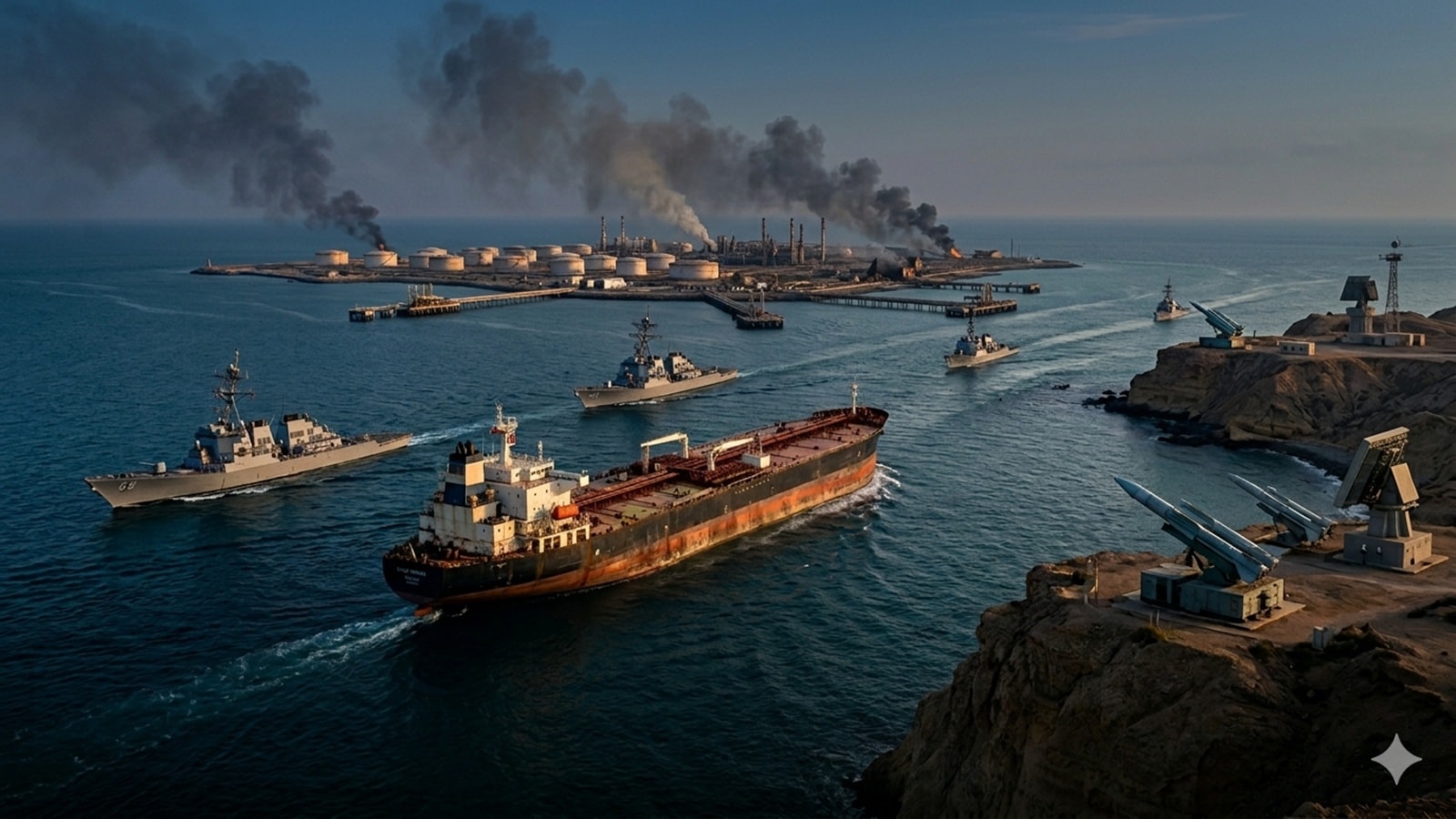
The US naval blockade operating in the Gulf of Oman is designed to enforce a zero-export mandate on Iranian maritime trade. However, a naval blockade is governed by a punishing cost-benefit equation that alters global economic metrics the longer it persists.
The primary cost variable is the systemic economic friction imposed on third-party states. The Strait of Hormuz and the adjacent Sea of Oman serve as the transit corridor for approximately 20% of global liquefied natural gas (LNG) and petroleum supplies. By restricting maritime traffic, the blockade forces commercial shipping entities to absorb escalating insurance premiums, war-risk surcharges, and prolonged transit times. This operational friction induces a long-term economic penalty on major importing nations, particularly within the Eurozone and the Asia-Pacific region.
The secondary variable is the escalatory feedback loop. Under international legal frameworks, a state under a total naval blockade treats the enforcement mechanism as an explicit act of war. This legitimizes a shift from defensive posturing to offensive asymmetric retaliation under domestic doctrine. The statement by Expediency Council member Mohsen Rezaei—warning that the Sea of Oman will become a "graveyard" for American vessels—is not empty rhetoric; it is a public articulation of Iran's anti-access/area-denial (A2/AD) operational framework.
Iran’s Asymmetric Counter-Containment Framework
Iran’s military strategy does not rely on matching the conventional blue-water naval capabilities of the United States. Instead, Tehran employs an asymmetric framework designed to exploit the geographic vulnerabilities of the Sea of Oman and the Strait of Hormuz. This doctrine operates across three distinct operational axes:
- Choke-Point Saturation: The use of low-cost, high-volume kinetic vectors—specifically loitering munitions, anti-ship cruise missiles (ASCMs), and fast-attack craft—to overwhelm the Aegis Combat Systems and close-in weapon systems (CIWS) of escorting naval vessels.
- Sub-Surface Denial: Deploying midget submarines (such as the Ghadir class) and smart naval mines in the shallow, acoustically complex waters of the Persian Gulf and the Gulf of Oman, nullifying traditional Western superiority in anti-submarine warfare.
- Sequential Escalation: A dual-track strategy where the Strait of Hormuz is kept nominally open to non-aligned commercial shipping, while targeted operations are prepared against military assets and infrastructure belonging to states supporting the blockade.
This asymmetric posture functions as a leverage multiplier. By threatening to transform a localized blockade into a wider regional shipping crisis, Tehran seeks to force global markets to pressure Washington for a de-escalation.
The Pakistani Mediation Bottleneck
The diplomatic track administered by Islamabad suffers from a fundamental misalignment of strategic objectives. Pakistan’s role as an intermediary is structurally limited because both primary actors view the negotiation process through incompatible frameworks.
[Iran's Phased Proposal] ---> De-escalate First (Lift Blockade / Unfreeze Assets) ---> Defer Nuclear / Regional Proxies
                                                                                               ^
                                                                                               | (Structural Mismatch)
                                                                                               v
[US Stated Objectives]   <--- Dismantle First (Nuclear Infrastructure / Stop Proxies) <--- Enforce Total Compliance
The revised peace proposal delivered by Pakistan to Washington highlights this tactical divergence. Iran’s diplomatic playbook attempts to decouple immediate economic relief from long-term strategic concessions. The Iranian proposal prioritizes three immediate operational steps:
- The immediate termination of the US naval blockade on Iranian ports.
- The lifting of maritime sanctions to allow the resumption of standard commercial shipping.
- The comprehensive release of tens of billions of dollars in frozen assets held in foreign banking institutions.
Under this proposed framework, contentious issues—such as the total dismantlement of uranium enrichment infrastructure and restrictions on regional non-state allies—are systematically deferred to subsequent, unspecified rounds of negotiations.
The structural breakdown occurs because the United States administration operates on an inverse sequence. Washington views the naval blockade not as a variable to be negotiated away early, but as the primary source of leverage required to compel total compliance. The American position demands front-loaded, verifiable concessions regarding Iran’s nuclear program and the immediate cessation of proxy operations in Lebanon and the broader Levant before any economic architecture is dismantled.
This creates a dynamic where both sides continuously alter specific terms—what Pakistani mediation sources describe as "changing the goalposts"—while the underlying structural demands remain entirely rigid.
The Failure of Transactional De-escalation
The limits of this diplomatic impasse are exacerbated by the internal political constraints of the participating states. The ceasefire reached in April is highly unstable because it lacks an institutional framework to monitor compliance or penalize violations.
The American posture is heavily influenced by domestic executive policy, which favors maximum-pressure mandates over incremental diplomatic bargains. The rejection of previous Iranian drafts as unacceptable indicates that Washington will not accept a phased deal that leaves Iran's enrichment capabilities intact. While minor concessions have been floated—such as potential waivers on specific oil shipments or the partial release of a fraction of frozen funds—these targeted measures fail to address Iran's core systemic requirement: total economic normalization.
Concurrently, external geopolitical pressures fail to offer an alternative path to stability. Recent bilateral discussions between the United States and major global energy importers, including China, have yielded no cooperative mechanisms to defuse the maritime standoff. Because major importing powers are unwilling or unable to guarantee alternative security architectures in the region, the burden of containment remains entirely on US naval deployments, increasing the probability of a tactical miscalculation at sea.
Regional Spillover and Strategic Alignment
The confrontation cannot be viewed in geographic isolation. The naval blockade in the Sea of Oman is directly linked to the broader kinetic environment of West Asia.
Iran's defensive calculus integrates its regional alliances as an extended deterrence network. The ongoing combat operations involving Israel and Hezbollah in Lebanon form an explicit variable in the peace negotiations. Tehran’s insistence on a comprehensive halt to fighting on all fronts demonstrates that it views its proxy architecture as indivisible from its state security.
Conversely, regional alignments are shifting in response to the maritime pressure. The strategic orientation of the United Arab Emirates and other Gulf Cooperation Council (GCC) states is a critical vector. Iranian warnings to regional states against participating in or endorsing Western-led maritime containment structures underscore the risk of horizontal escalation. If local littoral states are perceived as facilitating the US blockade, the theater of conflict will expand from the blue waters of the Gulf of Oman to the critical energy infrastructure of the Arabian Peninsula.
Strategic Action and Tactical Projection
The current posture is unsustainable. The tactical reality indicates that the confrontation will break along one of two definitive lines before the current quarter concludes.
The United States must either expand the operational scope of the blockade to include aggressive interdiction of non-aligned vessels—a move that risks direct diplomatic conflict with major global economies—or accept that a blockade alone cannot force a structural revision of Iran's nuclear policy.
Because Washington is unlikely to abandon its leverage voluntarily, and Tehran cannot absorb an indefinite economic siege, the most probable outcome is a localized kinetic breakout in the Sea of Oman. Iran will likely execute a controlled, asymmetric demonstration of force—utilizing smart sea mines or coordinated drone swarms against a secondary target—to alter the risk-calculus of international insurance markets. This actions-based escalation will be designed to bypass the deadlocked Pakistani diplomatic channel, forcing global energy consumers to intervene and compel a mutual pullback.
Command structures in the region must prepare for immediate maritime disruption, as the period for structured diplomatic resolution has effectively expired.