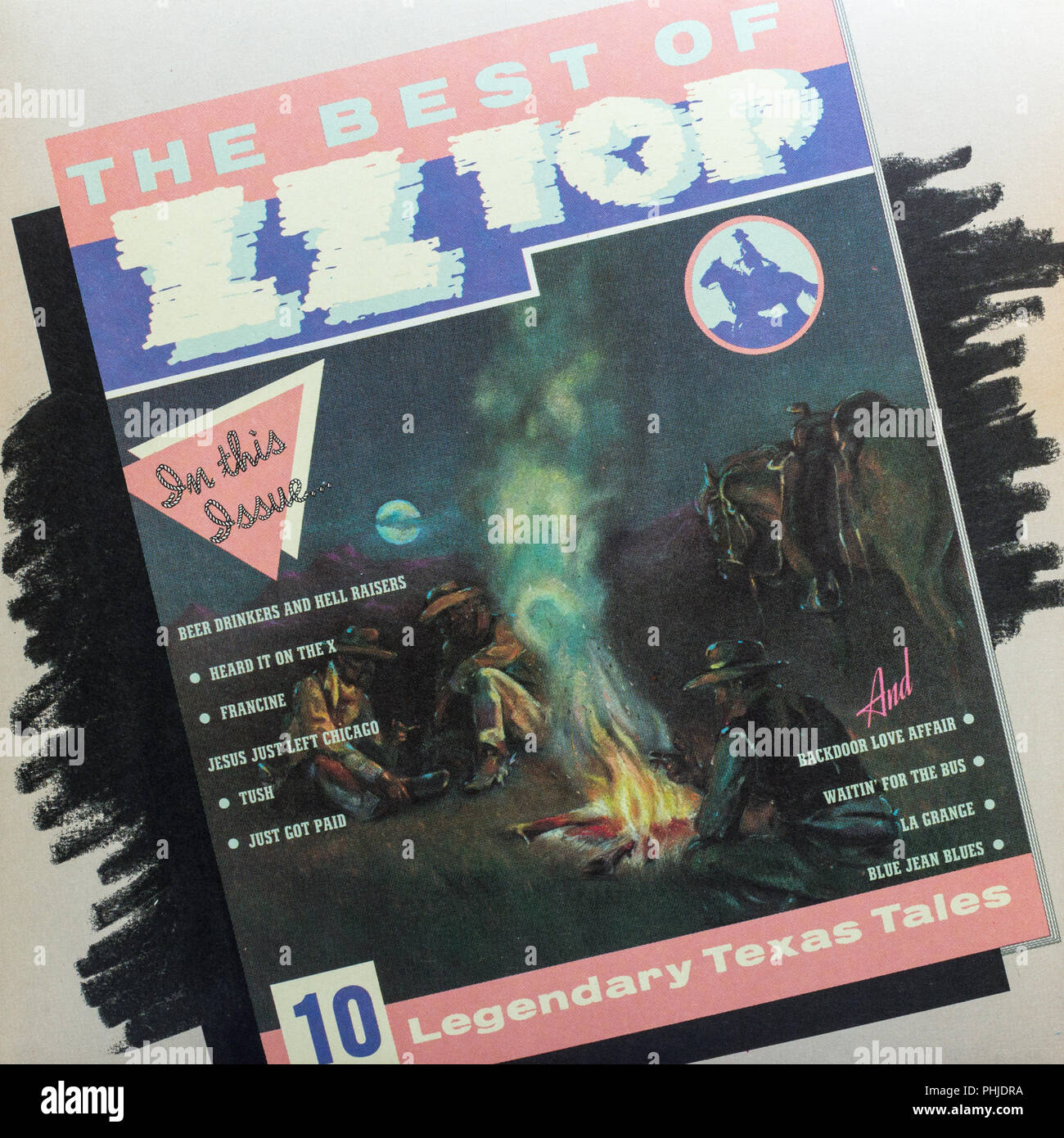
Honestly, if you look at a ZZ Top album cover, you aren't just looking at a sleeve for a piece of vinyl. You’re looking at the visual evolution of "cool" in America. From the greasy, late-night Tex-Mex diners of the early seventies to the neon-soaked, space-faring synth-rock of the mid-eighties, this band understood branding way before it was a corporate buzzword.
Most people just remember the beards and the car. But if you look closer, there is a weird, gritty, and sometimes hilarious story tucked into the ink of those jackets.
The Most Famous Meal in Rock History: Tres Hombres
Ask any die-hard fan about the Tres Hombres album cover and they won't talk about the front. They'll talk about the inside.
The gatefold of that 1973 record is legendary. It’s a massive, gut-busting spread of Tex-Mex food that looks so good you can almost smell the cumin. It wasn't some Hollywood prop, either. Billy Gibbons and the guys had the meal prepared by Leo’s Mexican Restaurant, a local Houston staple on South Shepherd.
Leo's is gone now, but that photo lives forever.
They shot the spread at Galen Scott’s photo studio. To get the vibe right, they tuned an antique radio to XERF, a high-powered border radio station that used to blast out of Mexico. They even had a calendar with an "Adelita"—one of the famous female revolutionaries—hanging in the background. It was authentic. It was Texas. It was basically a love letter to a $2.99 dinner special that changed their lives.
The Name on Everyone’s Lips: Eliminator
In 1983, everything changed. ZZ Top stopped being just a "Texas band" and became global icons. A huge part of that was the car.
The Eliminator album cover features a painting of Billy Gibbons’ customized 1933 Ford 3-window coupe. This wasn't just some stock photo. Billy spent roughly $250,000 having Dan Thelan’s Buffalo Motor Cars shop build it. It was chopped three inches, lowered, and painted that specific, scorching red.
Tom Hunnicutt did the painting for the cover.
Think about that for a second. The band didn't even put their faces on the front. They put a car. It was a bold move that paid off because that car became the star of MTV. It was a "magical fantasy object" that appeared in the videos for "Gimme All Your Lovin'" and "Sharp Dressed Man," usually saving some downtrodden kid from a boring life.
When Things Got Weird: Degüello and Beyond
If the seventies were about food and the eighties were about cars, the transition period was just... dark. And awesome.
Take Degüello (1979). The word basically means "no quarter" or "slashing of the throat." It refers to the bugle call used by the Mexican Army at the Alamo.
The cover art, designed by Bill Narum, is minimalist but fierce. A tattered battle flag, arrows, and flames. It felt like a warning. This was the first album where Gibbons and Dusty Hill showed up with the full-grown beards they’d cultivated during their three-year hiatus.
Then you have Afterburner (1985).
The manager, Bill Ham, wanted to show the world that ZZ Top was now an international force. So, they hired artist Barry Jackson. The concept? The Eliminator car orbiting the Earth like a space shuttle. Jackson actually painted a version that was six feet long.
Interestingly, the space theme wasn't just for the cover. The stage design for that tour—complete with a massive longhorn skull that snorted smoke—was originally pitched to the band Loverboy. They passed. ZZ Top saw it and said, "Yeah, we'll take that."
The Men Behind the Brush
We usually credit the musicians, but the visual identity of ZZ Top was a team effort.
- Bill Ham: The manager who acted as the "image-maker" until 2006. He was the one who pushed for the car and the space themes.
- Bill Narum: The artist who captured the gritty, psychedelic Texan spirit of the early albums.
- Barry Jackson: The man who brought the "high-tech" eighties vibe to life on Afterburner and Recycler.
Why It Still Matters Today
We live in a world of digital thumbnails. You see a tiny square on Spotify and you move on. But ZZ Top’s covers were built for the physical world. They were meant to be held, opened, and studied.
When you look at the Rio Grande Mud cover, you’re looking at a band trying to find their footing. When you look at Recycler, where the guys are depicted as shadowy, metallic figures, you’re looking at a band that had fully embraced their status as "rock-and-roll outlaws."
Actionable Insights for Collectors and Fans:
- Check the Gatefold: If you're buying Tres Hombres on vinyl, make sure the inner spread is clean. That food photo is the centerpiece of the whole experience.
- Original Mixes: If you're a purist, look for the 2013 box set The Complete Studio Albums (1970-1990). Many of the early CDs had "modernized" drum sounds added in the 80s that ruined the original vibe. The box set restored the original, gritty mixes.
- Identify the Artist: Look for the "Narum" signature on the 70s covers. It's a hallmark of the band's golden era.
ZZ Top understood that an album cover isn't just a lid for a box. It's the first note of the song. It sets the stage before the needle even touches the wax.