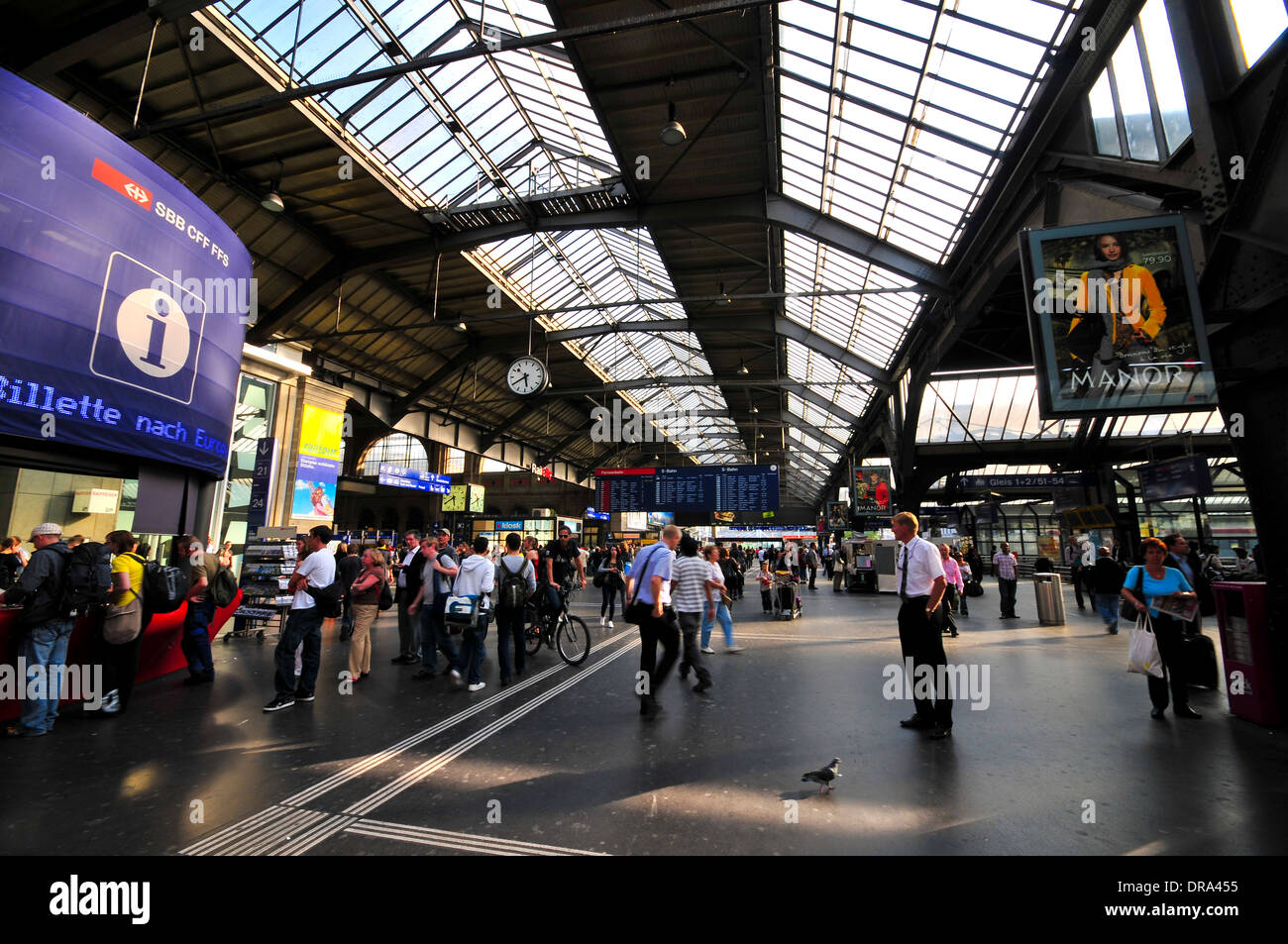
You step off the train and immediately feel it. That hum. It isn't just the sound of SBB engines or the screech of brakes; it’s the vibration of 450,000 people moving through a single limestone monument every single day. Most travelers treat the Zurich main train station—locally known as the Zürich Hauptbahnhof or just HB—as a place to escape as quickly as possible. They grab a lukewarm coffee, stare frantically at the blue "Generalanzeiger" departure board, and sprint toward a platform. Honestly? They’re missing the best part of the city.
The HB is basically a city within a city. It’s a subterranean labyrinth, a historical landmark, and the largest shopping mall in Switzerland all rolled into one. If you’ve ever found yourself lost in the ShopVille section downstairs on a Sunday when every other store in Zurich is legally required to be closed, you know exactly what I’m talking about. It's the only place where the rigid Swiss rules of "Ruhetag" (rest day) don't seem to apply, making it the frantic, beating heart of Swiss commerce. In other developments, we also covered: The Invisible Pipeline (And the Summer We Almost Grounded).
The Architecture of Zurich Main Train Station Is a Lie
When you look at the sandstone facade designed by Jakob Friedrich Wanner back in 1871, you see Neo-Renaissance grandeur. It looks like a temple to the industrial age. It's beautiful. Triumphant. But that grand hall? The Haupthalle? It's mostly empty. This is one of the weirdest things about the Zurich main train station. In any other global city, that prime real estate would be filled with ticket booths or waiting benches. Here, it’s a massive, open indoor plaza.
Why? Because Zurich uses it as a cultural flex. Lonely Planet has provided coverage on this important issue in extensive detail.
One week it’s an indoor beach volleyball tournament. The next, it’s the Christkindlimarkt, featuring a 50-foot Christmas tree dripping in Swarovski crystals. In the summer, you might find an open-air cinema or a massive "Züri Fäscht" installation. The most permanent resident is "L'Ange Protecteur," a massive, colorful floating angel sculpture by Niki de Saint Phalle. She weighs 1.2 tons. She’s bright, voluptuous, and hangs from the ceiling like she’s watching over the commuters, which, in a very literal sense, she is.
If you just stay on the surface, you’re only seeing the 19th-century shell. The real engineering genius is hidden. Underneath your feet, there are layers of tracks. Most people don’t realize the station actually has multiple "stations" inside it. You’ve got the terminal tracks (3–18) where the big EuroCity and Railjet trains pull in and stop. But then you have the low-level tracks like the Museumstrasse (41–44) and the Löwenstrasse (31–34). These aren't just extra platforms. They are through-stations that allow trains to pass under the city without reversing, a feat of civil engineering that cost billions of Swiss Francs to perfect.
Surviving ShopVille: More Than Just Swiss Chocolate
Let’s talk about the shopping. If you’re hungry, don't just settle for a generic sandwich. The Zurich main train station houses over 200 businesses. Most locals will tell you to head to Sprüngli. Yes, it’s a "chain" in the sense that they are everywhere in Zurich, but their "Luxemburgerli" (tiny macarons) are legendary for a reason.
- The "Secret" Migros: There is a Migros grocery store downstairs that is perpetually packed. It is arguably one of the highest-grossing grocery stores per square meter in the world.
- The Food Court Reality: You can find everything from high-end sushi to the ubiquitous "Dürüm" kebab.
- Sundays are Chaos: Because Swiss federal law is strict about Sunday trading, the HB is one of the few places where you can buy a pair of jeans, a new phone charger, or fresh groceries on a Sunday. Consequently, the entire population of the Canton of Zurich seems to descend into the station on the weekend. It's crowded. It's loud. But it's alive.
One nuance travelers often miss is the Landesmuseum (Swiss National Museum). It’s located literally 30 seconds from the northern exit of the station. The building looks like a fairytale castle. If you have a two-hour layover, don't sit on your suitcase. Drop your bags in the lockers (they take cards and coins, located near track 18) and walk into the museum. It’s the single best way to understand how Switzerland became, well, Switzerland.
Logistics: The Stuff Nobody Tells You
Navigating the Zurich main train station can be a nightmare if you don't understand the layout. It isn't a circle; it's a sprawling, multi-level grid.
The main hall is Level 0. ShopVille is Level -1. The deeper tracks (31-34 and 41-44) are Level -2. If you are catching an S-Bahn (local train) to the airport, you are almost certainly heading to the lower levels. Look for the "Flughafen" icon—a little airplane.
The Ticket Situation
Don't wait in line at the SBB Travel Center unless you have a really complex problem. The red ticket machines are multilingual and incredibly intuitive. Even better? Download the SBB Mobile app. It is widely considered one of the best transit apps in the world. You just "swipe" to start your journey and "swipe" to end it. The GPS tracks you. It calculates the cheapest fare automatically. It’s almost spooky how well it works.
Meeting Points
If you are meeting a friend, tell them "The Meeting Point." There is a massive clock in the main hall specifically designated as the "Treffpunkt." Thousands of reunions happen under that clock every day. If you want to be more specific (and less crowded), meet at the "Angel" (the Niki de Saint Phalle sculpture).
What Most People Get Wrong About the Trains
There’s a myth that Swiss trains are never late. As someone who has lived here, I can tell you: they are occasionally late. But "late" in Switzerland means three minutes. If your connection is four minutes, the SBB expects you to make it. They have timed the escalators and walking distances to the second.
The Zurich main train station is the primary hub for the Zürich S-Bahn, the InterCity (IC), and international lines like the TGV Lyria (to Paris), ICE (to Germany), and Nightjet (the sleeper trains). If you’re heading to Italy, the train will likely head south toward the Gotthard Base Tunnel—the longest railway tunnel in the world.
One weird fact? The station is actually a dead-end for many trains. This is why the lower-level "cross-city" tunnels were such a big deal. Before they existed, every train had to pull in, the driver had to walk to the other end, and the train had to pull back out. It was a logistical bottleneck that nearly crippled Swiss rail in the 90s. The "Löwenstrasse" project fixed that, but it required digging under the Sihl river. They literally had to freeze the ground to stop the river from collapsing into the construction site.
Actionable Tips for Your Next Visit
If you want to experience the Zurich main train station like a local and not a confused tourist, follow this checklist.
- Validate your hunger: Skip the fast food and go to Au Premier if you want a sit-down meal with a view of the hustle, or hit the Hiltl buffet (the world’s oldest vegetarian restaurant has a branch here) for a quick, high-quality takeaway.
- Use the lockers: They are located on the mezzanine level and near the tracks. They come in various sizes. Don't drag your 50lb suitcase through the cobblestone streets of the Altstadt.
- The "Züri-WC": The public bathrooms are paid (usually 2 CHF). They are spotlessly clean. Don't be "that person" trying to sneak into a cafe just to use the restroom; just pay the two francs. It’s worth it.
- Watch the "Generaldirektion": If you have a few minutes, stand in the main hall and watch the massive mechanical flip-board (the few that remain are being replaced by digital, but HB still keeps its iconic look). There’s a specific rhythm to the clicking sound that defines the atmosphere of the station.
- Look for the "Sihlquai" Exit: If you’re looking for the bus station (where the FlixBus and long-distance coaches arrive), you need the northern exit called Sihlquai. It’s often confused with the main entrance.
The Zurich main train station is a microcosm of Switzerland itself. It’s expensive, it’s efficient, it’s remarkably clean, and it functions with a level of precision that feels almost robotic until you see a choir singing in the main hall or a group of teenagers practicing breakdancing near the lockers.
Next time you’re there, don't just look at your watch. Look up at the ceiling. Look down at the levels of history beneath you. Grab a "Gipfeli" (croissant) from a bakery, find a spot near the limestone pillars, and just watch the world go by. You’ll realize that the station isn't just a way to get to Zurich—it is Zurich.
Next Steps for Your Trip: Download the SBB Mobile app before you arrive to avoid the ticket machine lines. If you have more than three hours, book a locker and walk the five minutes to the Bahnhofstrasse, one of the world's most expensive shopping streets, which starts right at the station’s front door. For those with a half-day, take the S10 train from the lower platforms (track 21/22) up to Uetliberg, Zurich’s local mountain, for a view that puts the entire station—and the lake—into perspective.