Time is messy. Honestly, if you've ever worked in aviation, the military, or managed a global server network, you know that "standard" time is anything but standard. You're sitting there at a desk in New York or D.C., looking at a log entry that says 14:00Z, and your brain just freezes. You need to convert zulu to eastern time before the meeting starts, but the math feels way harder than it should be.
It isn't just you. Even seasoned pilots and sysadmins sometimes double-check their fingers because of that one pesky variable: Daylight Saving Time.
What the Heck is Zulu Time Anyway?
Basically, Zulu time is the military and aviation name for Coordinated Universal Time (UTC). They’re the same thing. People use the "Z" suffix—hence "Zulu" from the phonetic alphabet—to show that a time isn't tied to a specific local timezone's quirks. It is the "prime meridian" of time, centered at 0° longitude in Greenwich, England.
It never changes.
While we’re over here springing forward and falling back like a confused gymnast, Zulu time stays exactly where it is. That's why it's the gold standard for anything that crosses borders. If a weather report says a storm hits at 1800Z, every pilot on the planet knows exactly when that is, regardless of whether they’re sitting in a cockpit in Dubai or a hangar in Atlanta.
The Math Behind Zulu to Eastern Time
Converting zulu to eastern time usually comes down to a simple subtraction rule. But here’s where everyone gets tripped up. You have to know what part of the year it is.
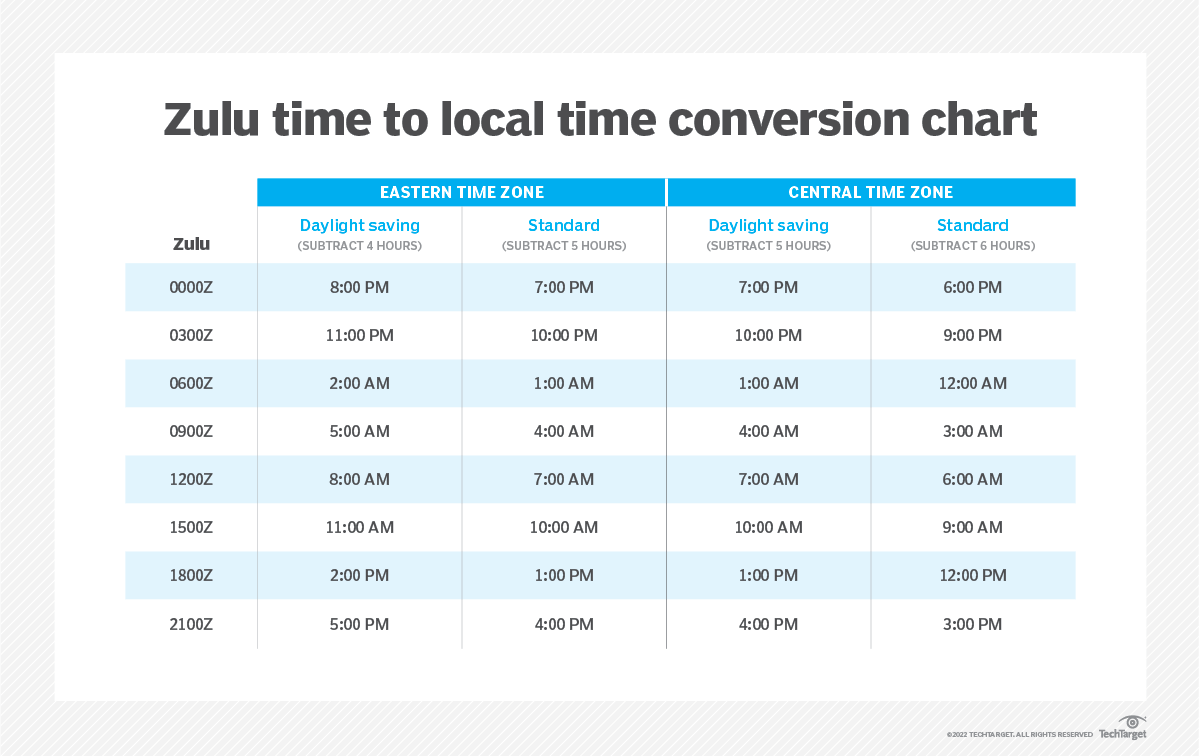
During the winter months, when we are on Eastern Standard Time (EST), you subtract 5 hours from Zulu. During the summer months, when we switch to Eastern Daylight Time (EDT), you subtract 4 hours.
Wait. Let’s look at that again.
If it’s 1500Z in January, it’s 10:00 AM in New York ($15 - 5 = 10$). If it’s 1500Z in July, it’s 11:00 AM in New York ($15 - 4 = 11$).
Most people mess this up because they forget that "springing forward" means the gap between us and the Prime Meridian actually shrinks. It feels counterintuitive. You’d think moving "forward" would mean a bigger number, but because Zulu is the fixed point, we are moving closer to it.
Why Do We Use "Zulu"?
The name comes from the nautical world. Back in the day, the globe was sliced into 24 time zones, each 15 degrees of longitude wide. Each zone got a letter. The zero-longitude zone (Greenwich) was assigned "Z." In the NATO phonetic alphabet, Z is Zulu.
It stuck.
Now, if you’re looking at a NASA launch schedule or an FAA NOTAM (Notice to Air Missions), you’ll see that Z everywhere. It keeps things from blowing up or crashing. Imagine a controller in London telling a pilot from Miami to land at "two o'clock." Which two o'clock? The pilot's watch? The tower's clock? Without a universal reference, it's chaos.
When the 24-Hour Clock Ruins Your Day
Let’s talk about the midnight problem. This is where zulu to eastern time conversions get genuinely dangerous for logistics.
Suppose a server backup is scheduled for 0300Z on Tuesday. If you are in New York during the winter (EST), that is 10:00 PM on Monday night ($3 - 5 = -2$, which wraps around to $24 - 2 = 22$, or 10 PM).
You’ve just crossed a date line.
I’ve seen entire dev teams miss critical deadlines because they thought a 0200Z Wednesday deadline meant they had until Wednesday morning. Nope. It was Tuesday night. You've got to be hyper-vigilant about that date rollover. If the Zulu time is low (0000 through 0400 or 0500), there is a very high chance the local Eastern time is actually the previous day.
Real-World Stakes: Not Just for Nerds
In the world of amateur radio, operators keep "logbooks" in Zulu time. They do this so that a contact made between a guy in Ohio and a woman in Tokyo can be recorded as happening at the exact same moment without doing time-zone gymnastics.
The National Weather Service (NWS) does the same thing. If you’re tracking a hurricane on the East Coast, the data points are almost always in UTC/Zulu. If you see a "12Z Model Run," and it's currently October, you need to know that’s 8:00 AM Eastern. If you're waiting for the "00Z run" to see if you need to board up your windows, you’re looking for data that drops at 8:00 PM local time.
Daylight Saving Time: The Great Annoyance
Most of the world hates Daylight Saving Time (DST). In the US, the Energy Policy Act of 2005 set the current rules, which have us in DST for about eight months of the year.
- EDT (UTC-4): Second Sunday in March to the first Sunday in November.
- EST (UTC-5): The rest of the year.
If you’re doing zulu to eastern time conversions regularly, just memorize the dates. Or, do what I do: keep a sticky note on your monitor. Because the moment you think you’ve got the 5-hour offset memorized, March rolls around and ruins your schedule.
How to Quick-Convert Without a Calculator
If you aren't a math whiz, try the "Index Finger Rule."
Look at your watch or a clock. If you need to subtract 4 hours (Summer), just move your eyes four hours counter-clockwise. If it's 12:00 (Noon) Zulu, your finger goes 11, 10, 9, 8. It's 8:00 AM.
It sounds stupidly simple, but in a high-stress environment—like a hospital or a flight deck—simple is what saves you.
A Quick Cheat Sheet for Common Zulu Conversions
Don't overcomplicate it. Here is how the most common timestamps usually shake out for the Eastern Time Zone.
During Standard Time (Winter): 1200Z is 7:00 AM. 1700Z is 12:00 PM (Noon). 2200Z is 5:00 PM. 0000Z is 7:00 PM.
During Daylight Time (Summer): 1200Z is 8:00 AM. 1700Z is 1:00 PM. 2200Z is 6:00 PM. 0000Z is 8:00 PM.
Notice how 0000Z—the start of the "new day" in Zulu—is actually early evening for the East Coast. That’s why your "Daily Login Bonus" in a lot of video games usually resets around 7 or 8 PM if the game's servers are based on UTC.
Why "Eastern Time" is a Moving Target
We often say "Eastern Time" as a catch-all, but that's technically lazy. We are either in EST or EDT.
The Caribbean is a great example of where this gets weird. Places like Jamaica or the Cayman Islands stay on EST all year. They don't do the "Daylight" dance. So, while New York is 4 hours behind Zulu in July, Jamaica stays 5 hours behind. If you're coordinating a cruise or a business call between New York and Kingston in the summer, you're actually in different time zones, even though you’re on the same longitude.
The Complexity of Global Software
Software developers have it the worst. If you’re writing code to handle zulu to eastern time transitions, you can't just hardcode "-5". You have to use a library like pytz in Python or Luxon in JavaScript that accounts for the historical changes in DST rules.
Why? Because the government changes the rules. In the 70s, during the energy crisis, the US stayed on Daylight Saving Time for a whole year. If your software is analyzing historical data from 1974, a simple "minus 5" rule will give you the wrong answer.
Practical Steps for Staying On Time
If you find yourself constantly needing to bridge the gap between zulu to eastern time, there are a few things you should do right now to make your life easier.
- Change your phone’s secondary clock. Most smartphones allow you to add a "World Clock" widget. Add "London" or search specifically for "UTC" or "Zulu." It’s much faster than doing mental subtraction.
- Use military time. If you’re dealing with Zulu, stop using AM and PM locally. It’s too easy to mix up 1200 and 0000. Switch your laptop and watch to the 24-hour format. It removes one layer of mental translation.
- The "Day-Before" Check. Whenever you see a Zulu time between 0000 and 0500, immediately highlight it. Remind yourself that this is likely "yesterday" in Eastern time.
- Automate your calendar. If someone sends you an invite in UTC, don’t manually enter it. Use a converter tool or let Google Calendar handle the offset. It knows the DST rules better than you do.
Time zones are a relic of a world that moved at the speed of a train. In a world that moves at the speed of a fiber-optic cable, they’re a headache. But as long as the sun hits Greenwich before it hits New York, we’re stuck with the math. Just remember: Subtract 5 in the snow, subtract 4 in the glow.
Actionable Takeaway for Immediate Use
To ensure you never miss a deadline again, verify your current offset right now by checking if "Daylight Saving Time" is active. If it is, use the 4-hour rule. If you are in the winter months, stick to the 5-hour rule. For any mission-critical task, always document the time in both Zulu and local Eastern time to provide a "paper trail" that prevents timezone-related errors.