Ever wonder why a pilot says they’re landing at 1400 Zulu when your watch says it’s 9:00 AM in New York? It’s not just some secret military code meant to confuse us civilians.
Zulu time is basically the heartbeat of global coordination. If you've ever looked at a weather map or watched a rocket launch, you've seen it. It’s the zero point. The anchor. Without it, the world's logistics would probably melt into a chaotic puddle of missed connections and mid-air scares.
Honestly, our concept of "local time" is a total mess for anything involving long distances. If I’m flying from London to Tokyo, "noon" doesn't mean anything. Whose noon? Mine? Yours? The guy's at the refueling stop in Dubai? To fix this, the world agreed on a single, unchanging clock that ignores borders, daylight savings, and politics. That is Zulu time.
The Zero Meridian and the Letter Z
Let’s get the "Zulu" part out of the way. It’s not named after the Zulu people of South Africa, though that’s a common guess. It comes from the phonetic alphabet used by the military and aviation industries. In that system, the letter Z is called "Zulu."
Why Z? Because it stands for Zero.
Back in the late 1800s, at the International Meridian Conference, everyone decided that the Prime Meridian—the line of 0° longitude—would pass right through the Royal Observatory in Greenwich, England. Since this is the starting point for all time zones on Earth, it was labeled the Zero Zone. In the world of nautical and military timekeeping, each time zone has a letter assigned to it. Since Greenwich is at zero longitude, it got the letter Z. Hence, Zulu time.
Most people use UTC (Coordinated Universal Time) and Zulu interchangeably. For 99% of us, they are identical. Technically, UTC is the high-precision atomic time standard, while Greenwich Mean Time (GMT) is a bit more "old school" and based on the Earth's rotation. But when a dispatcher tells a cargo ship to arrive at 1800Z, they’re talking about the exact same moment.
Why We Can't Just Use Local Time
Think about the International Space Station. It orbits the Earth every 90 minutes. It sees 16 sunrises and sunsets every single day. If the astronauts tried to keep "local time," they’d be changing their watches every six minutes. It would be a nightmare. Instead, they use Zulu time because it provides a constant, unwavering reference point.
The same logic applies to the internet. When you send an email or a server logs a transaction, it needs a timestamp that doesn't change just because a programmer in California moved their clock back an hour for November.
- Aviation safety depends on it.
- Weather forecasting is impossible without it.
- Global finance and stock exchanges rely on it to sync trades.
- Military operations need it so that "Attack at 0500" means the same thing to a submarine in the Pacific and a jet in Germany.
Imagine a pilot flying from San Francisco to Paris. They cross multiple time zones. If they had to constantly adjust their ETA based on the local time of whatever city they were flying over at that moment, the risk of a mid-air collision would skyrocket. By using Zulu time, every pilot in the sky is on the exact same page, no matter where their wheels are.
The Math Behind the Magic
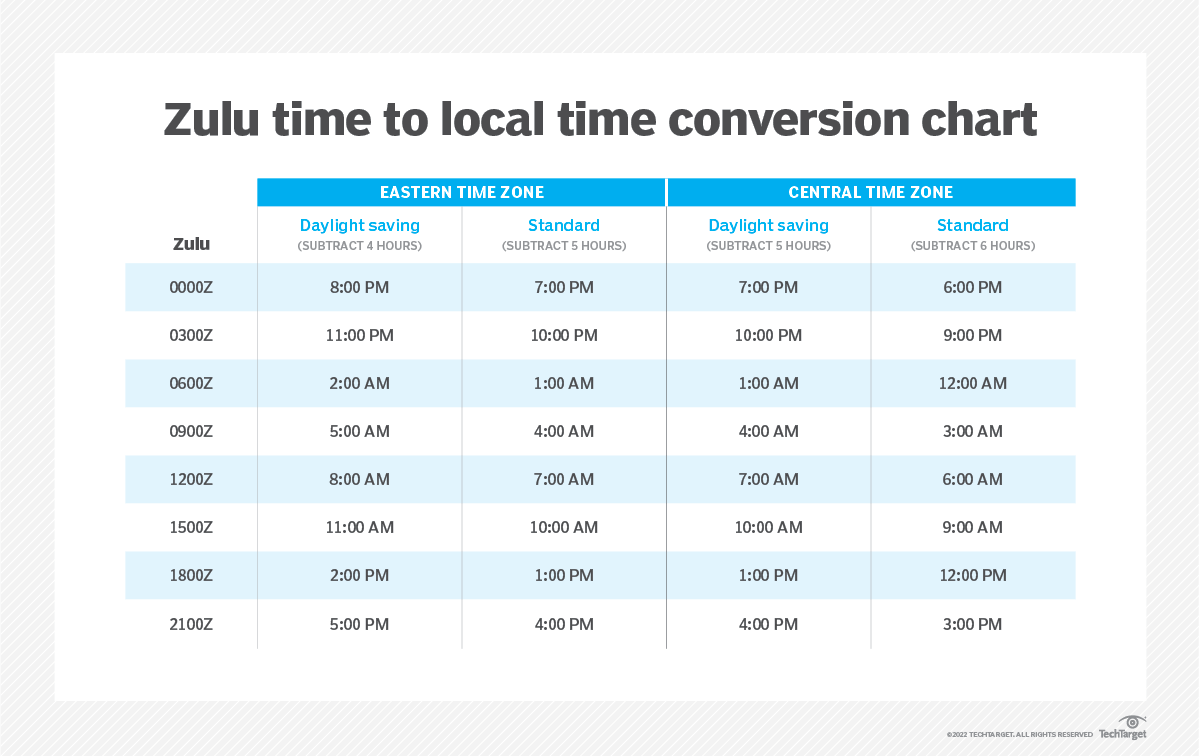
Converting your local time to Zulu time isn't actually that hard, but it does require you to know your "offset." Most of the world is either "plus" or "minus" a certain number of hours from the Prime Meridian.
For example, if you're on the East Coast of the United States (Eastern Standard Time), you are usually 5 hours behind London. So, if it's 10:00 AM EST, you add 5 hours to get 1500 Zulu.
But wait. It gets annoying.
Daylight Savings Time (DST) ruins everything. Zulu time never changes for DST. It stays put. So, while your local clock jumps forward or back, the gap between you and Zulu fluctuates. In the summer (Eastern Daylight Time), New York is only 4 hours behind Zulu. This is why pilots and meteorologists generally hate Daylight Savings—it adds an extra layer of mental math to an already complex job.
The History of "The Time of the World"
Before the 1880s, time was a local disaster. Every town had its own "sun time." If the sun was directly overhead, it was noon. If you traveled twenty miles over to the next town, their noon might be four minutes different from yours.
Then came the railroads.
Trains moved too fast for "town time." If two trains were on the same track and their conductors had slightly different ideas of what "12:15" meant, you ended up with a massive heap of twisted metal and steam. In 1884, representatives from 26 nations met in Washington, D.C., to figure out a prime meridian.
Greenwich won. France actually abstained from the vote for a while because they wanted the meridian to pass through Paris. Eventually, they gave in for the sake of global sanity. Since then, the 0° line has been the benchmark.
Spotting Zulu Time in the Wild
You don't have to be a Navy SEAL to see Zulu time in action. Just look at a National Weather Service (NWS) radar map. You’ll see a string of numbers like "12Z" or "18Z." That tells you exactly when the data was captured.
Meteorologists use this because weather systems move across states and countries. If a meteorologist in Kansas says a storm hit at 2:00 PM and a meteorologist in Illinois says it hit at 3:00 PM, are they talking about the same storm moving? Or two different storms? If they both use Zulu time, there is zero ambiguity.
You also see it in:
- Amateur Radio (Ham radio operators log all their contacts in Zulu to keep a standard global record).
- Cybersecurity logs (detecting hacks that happen across different global servers).
- Satellite communications.
- GPS technology (your phone uses atomic clocks synced to a variation of Zulu time).
Common Misconceptions
People often ask if Zulu time is the same as military time. Not exactly.
Military time is just a 24-hour clock format (0000 to 2359). You can use military time for your local zone—like saying 1300 instead of 1:00 PM. Zulu time specifically refers to that 24-hour clock at the 0° meridian. So, you can have "local military time" or "Zulu military time." They use the same format, but the actual hour is different.
Another myth is that it's "British Time." While it’s based on Greenwich, the UK actually uses British Summer Time (BST) in the warmer months, which is one hour ahead of Zulu. So for half the year, even the people living at the Prime Meridian aren't actually on Zulu time.
How to Start Using It
If you’re a tech nerd, a pilot-in-training, or just someone who works with people in five different countries, learning to think in Zulu time is a game-changer.
- Step 1: Find your offset. Check a site like TimeAndDate to see how many hours you are from UTC.
- Step 2: Forget AM/PM. Start thinking in a 24-hour scale.
- Step 3: Account for DST. Remember that your offset changes twice a year unless you live in a place like Arizona or Hawaii.
Most digital watches and smartphones allow you to add a second clock to your home screen. Set that second clock to London (without the DST adjustment) or UTC. Now, whenever you see a news report about a rocket launch or a global event, you won’t have to do the mental gymnastics to figure out when it's actually happening.
Actionable Insights for Daily Use
Understanding Zulu time is more than a trivia fact; it's a tool for high-stakes coordination. If you work in a global environment, stop inviting people to "9:00 AM CST" meetings without also providing the Zulu/UTC equivalent. It eliminates the "wait, did you mean my 9:00 or your 9:00?" confusion.
To master this:
- Set one of your device clocks to UTC permanently.
- Memorize your local "Z" offset for both winter and summer months.
- When booking international travel, always cross-reference the arrival "Z" time on your flight itinerary to ensure your hotel bookings match the actual day you land.
- If you are a developer, always store your database timestamps in UTC (Zulu) and only convert to local time on the "front end" for the user. This prevents massive data corruption issues when users move between time zones.
Zulu time is the only truly "global" language we have that isn't made of words. It’s a mathematical agreement that keeps the modern world from colliding with itself. Using it makes you more efficient, less prone to scheduling errors, and a little more connected to the way the world actually works.