Ever looked at a weather map or a flight plan and seen a time that made absolutely no sense? It’s usually followed by a "Z." That’s Zulu time. If you’re living on the East Coast, trying to sync Zulu time Eastern time is basically a rite of passage for pilots, ham radio operators, and anyone who’s ever tried to track a NASA launch from their couch in Florida.
It’s confusing.
The first thing to realize is that Zulu time isn't actually a "place." It’s a standard. Specifically, it’s Coordinated Universal Time (UTC). We call it "Zulu" because the military and aviation world uses the phonetic alphabet, and "Z" stands for Zero meridian. Since the Prime Meridian in Greenwich, England, is the starting point for the world’s clocks, it gets the "Z" designation.
So, when you're sitting in a coffee shop in Brooklyn or an office in Atlanta, you are living several hours behind that zero point.
The Math Behind Zulu Time Eastern Time
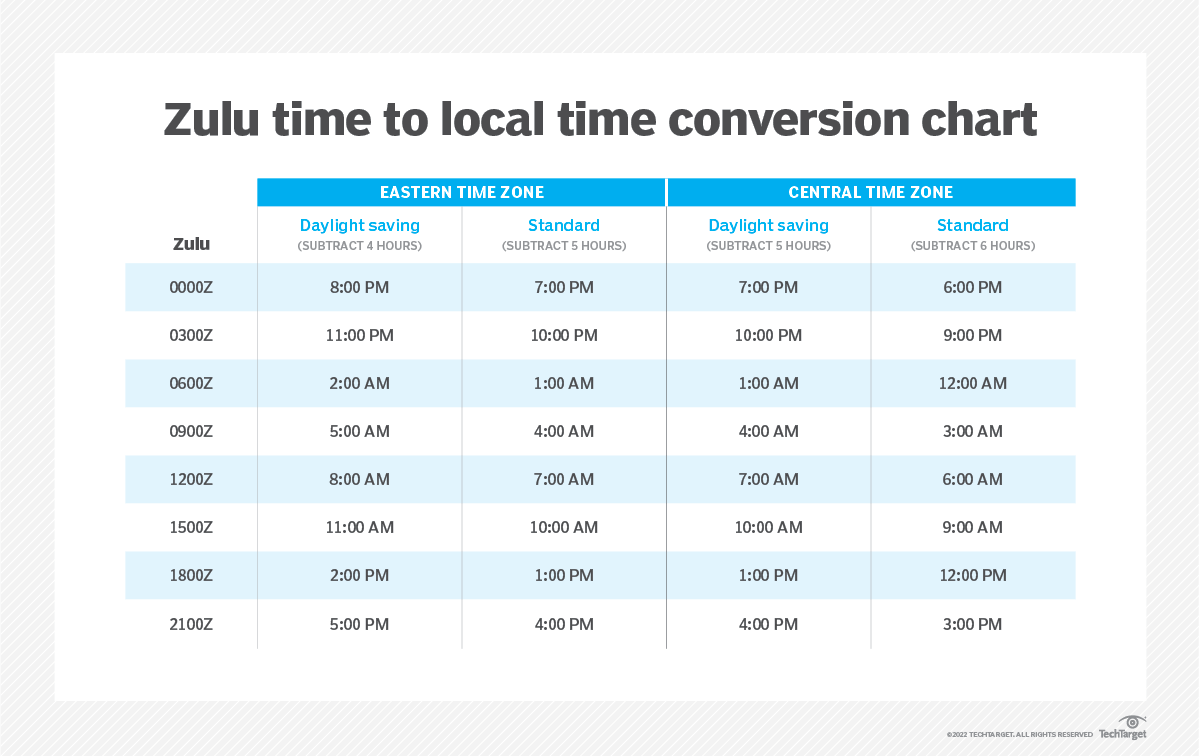
Here is the part where people usually trip up. The offset isn't permanent. Because the United States is one of the few places that still clings to the ritual of changing our clocks twice a year, the gap between Zulu time Eastern time shifts.
During the winter months, when we are on Eastern Standard Time (EST), we are exactly five hours behind Zulu. If the clock says 17:00Z, it is 12:00 PM in New York. Simple enough.
But then March hits.
When we spring forward into Eastern Daylight Time (EDT), the gap shrinks. We move an hour closer to the sun, figuratively speaking, and the offset becomes four hours. So that same 17:00Z suddenly becomes 1:00 PM. This is exactly how people miss international meetings or fail to see a satellite pass overhead. They forget that Zulu time never, ever changes for Daylight Saving. It is the steady heartbeat of the planet’s timeline.
Why We Even Use This System
You might wonder why we don't just use local time for everything. Imagine you’re a pilot flying from New York to London. If you tell air traffic control you’ll arrive at "5:00," which 5:00 are you talking about? New York time? London time? The time over the middle of the Atlantic?
It would be a disaster. Mid-air collisions and logistical nightmares would be the norm.
By using one universal clock, everyone stays on the same page. The National Hurricane Center (NHC) uses it for every single update. If you look at a hurricane tracking map, the timestamps are always in Zulu. This ensures that a meteorologist in Miami and a ship captain in the middle of the Caribbean are looking at the exact same data point without doing mental gymnastics about time zones.
Honestly, it’s the only way global infrastructure works. From the servers that power your banking apps to the GPS satellites orbiting Earth, everything runs on this "zero" time.
The Weirdness of 24-Hour Clocks
Another hurdle for folks trying to master Zulu time Eastern time is the 24-hour format. Zulu doesn't do "AM" or "PM." It’s 00:00 to 23:59. If you aren't used to military time, 19:00Z looks like a typo. It’s not. Just subtract 12. It’s 7:00 PM in London. Then, if you’re in New York during the summer, subtract another four hours. Boom. 3:00 PM.
It becomes second nature after a while, but it’s definitely a bit of a brain-bender at first.
Real World Scenarios and Mistakes
I once knew a developer who set a server maintenance window for 02:00Z on a Sunday. He was in Boston. He thought, "Great, that's late at night, no one will be online." He forgot that in the winter, 02:00Z is actually 9:00 PM on Saturday night in Eastern Standard Time.
The server went down right in the middle of the Saturday night rush. Users were furious. The site crashed. He learned the hard way that the "day" actually starts earlier for Zulu than it does for us.
When the clock hits 00:00Z, it is already the "next day" according to the global standard, even if it's only 7:00 PM or 8:00 PM on the East Coast. This creates a weird "time travel" effect where your logs might show an event happening on Tuesday, but your physical calendar still says Monday.
How to Check It Fast
If you’re in a rush, don't try to do the math in your head while you're stressed. Just remember these two "magic" numbers for the East Coast:
- -5 (Standard Time - November to March)
- -4 (Daylight Time - March to November)
If you have a smart watch, you can usually add a "UTC" or "London" face to it. That’s your Zulu time.
Actionable Steps for Staying Synced
If you deal with international clients, aviation, or data logging, stop guessing.
First, get a dedicated world clock app or a Chrome extension that stays pinned to your browser. Configure it specifically for UTC. Most people try to use "London time," but keep in mind that London also observes daylight savings (British Summer Time), which can occasionally put them out of sync with Zulu by an hour. Always select UTC or Zulu specifically.
Second, if you’re scheduling something, always write both. Write "14:00Z / 10:00 AM EDT." It eliminates the ambiguity for everyone involved.
Third, if you are a coder, always store your timestamps in UTC in your database. Never, under any circumstances, store them as local Eastern time. You will regret it the moment you have to pull a report or scale your app to a user in a different state.
Mastering the jump between Zulu time Eastern time is mostly about remembering that the world doesn't revolve around our local clocks. Zulu is the constant; we are the ones who keep shifting around it.
Check your current date. If it's between the second Sunday in March and the first Sunday in November, use the four-hour rule. Otherwise, stick to five. That one little piece of knowledge will save you from more missed appointments and technical glitches than almost any other "productivity hack" out there.