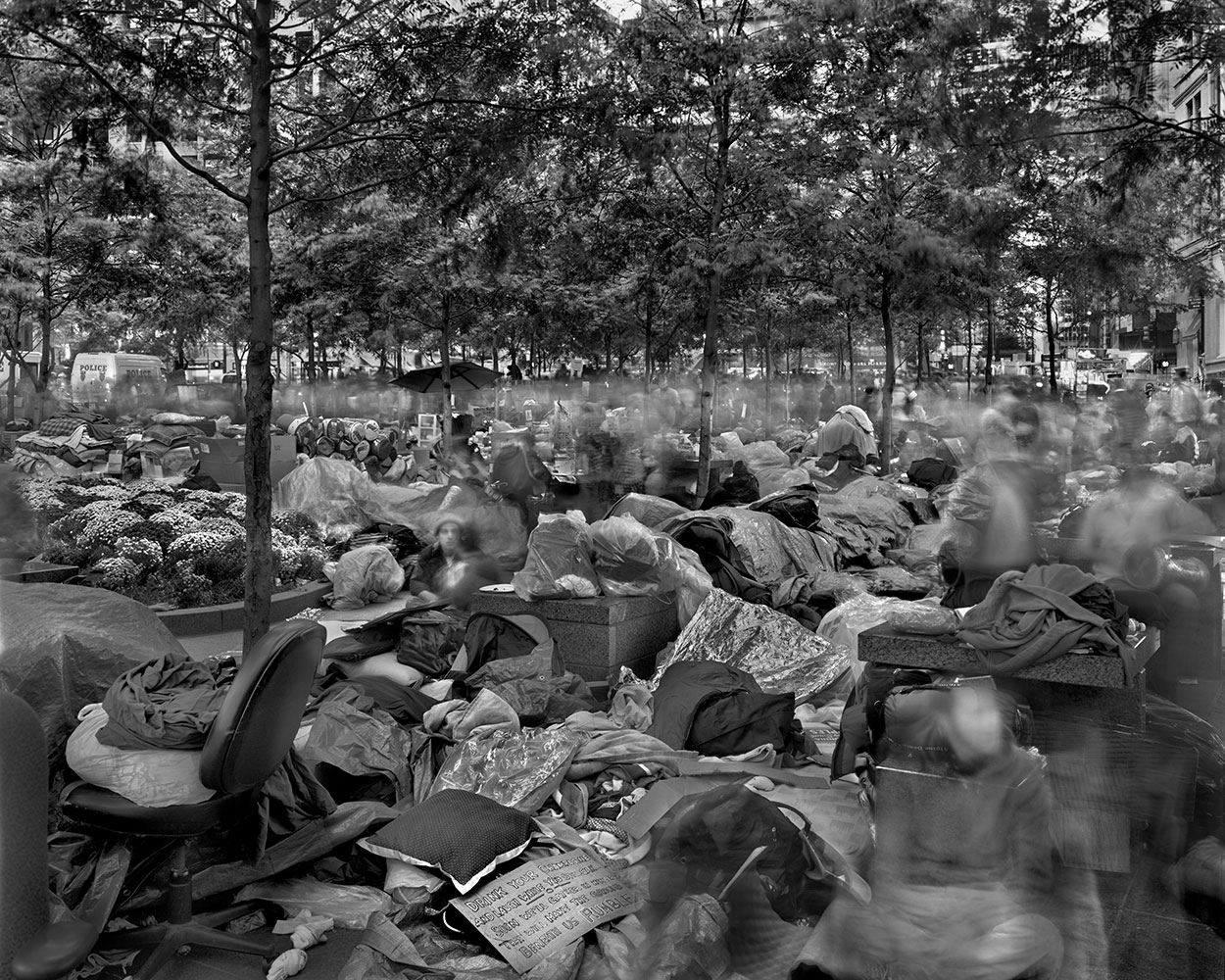
You probably remember the images. Blue tarps, foggy autumn mornings, and a sea of people packed into a concrete slab in Lower Manhattan. It was 2011. The world was still reeling from the 2008 financial collapse, and suddenly, a tiny, privately-owned square became the center of the universe. Honestly, if you walked past Zuccotti Park today, you’d see office workers eating overpriced salads. It’s quiet. But for two months, it was anything but.
The Zuccotti Park Occupy Wall Street movement wasn't just a bunch of kids in tents. It was a massive, messy, and surprisingly organized experiment in how people live together when they feel the system has totally failed them. People called it "Liberty Square." They built a library with 5,000 books. They had a kitchen that served thousands of meals a day. It was a city within a city, and it changed the way we talk about money and power forever. You might also find this connected story useful: The Middle East Diplomatic Theater Why Official Statements Are the Ultimate Distraction.
The Weird Legal Loophole That Started Everything
Most people think the protesters just picked a random park. They didn't. They actually wanted to go to One Chase Manhattan Plaza, but the NYPD beat them there and fenced it off. Zuccotti Park was the third choice. It was a lucky break, basically.
See, Zuccotti is a "Privately Owned Public Space" (POPS). This is a weird New York City legal quirk. Because it’s private, the normal city park rules—like closing at 1 a.m.—didn't apply at first. The police couldn't just kick everyone out for being there late unless the owners, Brookfield Office Properties, asked them to. For weeks, this legal gray area was the movement's shield. As extensively documented in latest articles by The Washington Post, the effects are worth noting.
- September 17, 2011: The first group arrives.
- The "Human Microphone": Since they didn't have permits for speakers, people would repeat the speaker's words in unison so everyone could hear. It sounded like a chant. It was haunting.
- The 99%: This is where that famous slogan went viral. It didn't start in a boardroom; it started on a Tumblr page and took over the park.
What Life Was Really Like Inside the Camp
It wasn't a vacation. It was grueling. If you were there, you’ve probably got stories about the rain or the constant noise of the Financial District. But the logistics were insane. They had a "General Assembly" where every single person had a vote. They used hand signals—twinkling fingers for "I agree," crossed arms for a "block."
They had a media center with better Wi-Fi than some hotels. They had a medical tent. They even had a "Progressive Stack" system for speaking, where they'd let people from marginalized groups talk first. It was an attempt at perfect equality that, frankly, got pretty complicated and sometimes caused more arguments than it solved.
The People's Library
One of the coolest things was the library. It started with a pile of books on a piece of cardboard. By the time the eviction happened, it was a fully cataloged collection. When the NYPD cleared the park on November 15, 2011, a lot of those books were thrown into garbage trucks. It was a heartbreaking moment for the occupiers. Later, the city actually had to pay a settlement for destroying them.
Why the Eviction Didn't Actually End It
Around 1:00 a.m. on November 15, Mayor Michael Bloomberg sent in the riot gear. It was over in hours. The tents were gone. The park was power-washed. A judge eventually ruled that while people had a right to protest, they didn't have a right to live there with "tents and structures."
But here’s the thing: the movement didn't die; it just changed shape. You can trace a direct line from Zuccotti Park Occupy Wall Street to the 2016 and 2020 Bernie Sanders campaigns. You can see its DNA in the fight for a $15 minimum wage. It shifted the "Overton Window"—that fancy term for what’s considered a normal political conversation. Before Occupy, talking about "wealth inequality" or "the 1%" was considered radical. Now? It’s basically the lead story on every news cycle.
Realities Most People Miss
Some critics say Occupy failed because it didn't have one specific leader or a single list of demands. That was actually by design. David Graeber, one of the intellectual engines behind the movement, argued that having a leader would just make it easier for the system to co-opt or crush them. They wanted to show that a different way of living was possible, even if just for a few months.
- It was global. Within weeks, there were "Occupy" camps in over 900 cities worldwide.
- The money was real. The movement raised over $700,000 in donations.
- Celebrity support. Everyone from Kanye West to Susan Sarandon showed up at the park.
What You Can Take Away From This Today
If you’re looking at the history of Zuccotti Park and wondering what it means for you now, it's about the power of physical space. In a world where we do everything on our phones, there is still something incredibly disruptive about a group of people standing together in a place they aren't "supposed" to be.
Actionable Steps for the Modern Activist
- Look for the POPS: Every city has weird legal spaces. If you're organizing, know the difference between a city park and a privately owned public space. The rules are different.
- Focus on the Narrative: The "99%" slogan worked because it was simple and inclusive. It didn't require a PhD to understand. If you want to change minds, simplify the message.
- Build the Infrastructure: The reason Occupy lasted two months wasn't just the passion; it was the kitchen and the sanitation crews. Movements run on their stomachs.
- Understand the "Spark" vs. the "Fire": Zuccotti Park was the spark. The fire is the policy change that happens years later. Don't get discouraged if a protest ends; look at where the people go next.
Zuccotti Park is back to being a quiet plaza now, but the ghost of the occupation is still there. Every time someone mentions the wealth gap or questions why billionaires pay lower tax rates than teachers, they are echoing a conversation that started on those granite benches in 2011. It was messy, it was loud, and it changed the world more than people like to admit.


