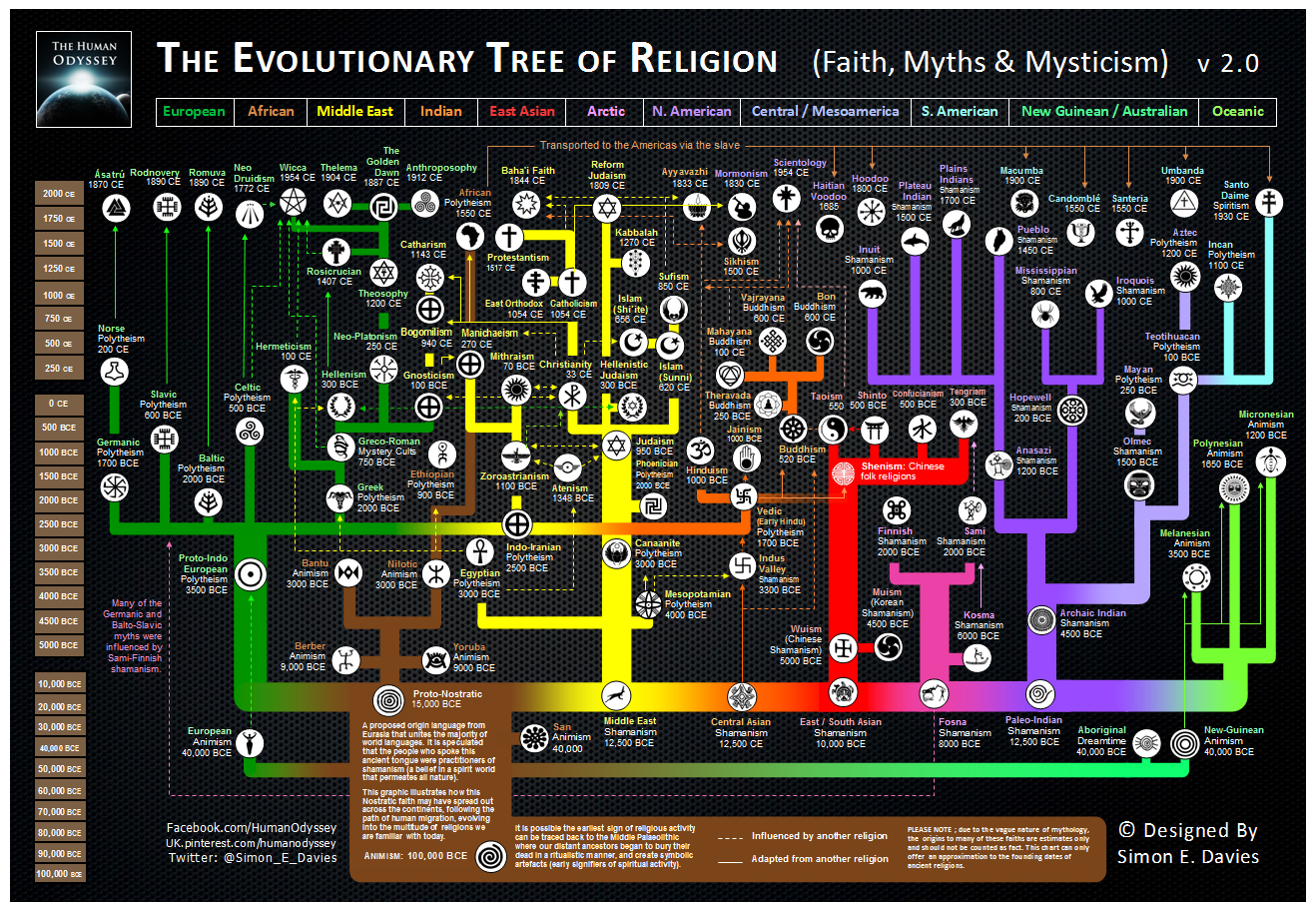
Defining "first" is a nightmare. Honestly, if you ask three different historians what was the first world religion, you’re going to get four different answers and a very long headache. It’s messy because "world religion" isn't just about who showed up to the party first. It's about who traveled. It's about whose ideas jumped across borders, languages, and ethnic lines to become something universal.
Religion is old. Really old. We have the Gobleki Tepe site in Turkey dating back 11,000 years, showing that humans were building massive stone temples before they even figured out how to farm wheat. But those were localized cults. They were tied to a specific hill, a specific tribe, or a specific ancestor. When we talk about a "world religion," we’re looking for the moment faith stopped being about "my tribe’s god" and started being about "the truth for everyone."
Most people point to Zoroastrianism. Some scream for Hinduism. Others argue that the Vedic traditions don't count because they were too tied to the Indian subcontinent initially. Let’s get into the weeds of what actually happened in the Bronze and Iron Ages.
The Persian Powerhouse: Why Zoroastrianism Takes the Lead
If we use the strict definition of a faith that moved across an empire and influenced everything it touched, Zoroastrianism is the heavyweight champion. Founded by the prophet Zarathustra (or Zoroaster) in ancient Iran, it basically flipped the script on how humans saw the universe. Before him, you had a chaotic mess of gods who were mostly jerks. Zarathustra showed up—scholars like Mary Boyce argue this happened as early as 1500 BCE, though others say 600 BCE—and said there’s one good god, Ahura Mazda, and one bad spirit, Angra Mainyu.
This was the birth of dualism. Good vs. Evil. Heaven and Hell. A final judgment.
Sound familiar? It should.
When the Achaemenid Empire under Cyrus the Great took over the known world, Zoroastrianism became the first truly "international" faith. It didn’t just stay in Persia. It influenced the Jews in Babylon, which eventually shaped Christianity and Islam. It was the state religion of three massive Persian empires. It was huge. It was everywhere. It was the first time a single ethical system was exported across thousands of miles to people of different ethnicities.
The "Eternal" Contender: Hinduism’s Deep Roots
Now, if you’re looking at sheer age and continuity, Hinduism (Sanatana Dharma) is the obvious answer. But there’s a catch. Hinduism isn't a "founded" religion. There’s no single guy who started it. It’s a river fed by a thousand streams.
The Rigveda, the oldest of the Vedas, was composed roughly between 1500 and 1200 BCE. These are hymns and rituals that are still used today. That’s insane longevity. However, for a long time, the Vedic religion was very much tied to the Indo-Aryan identity and the geography of the Indus and Ganges valleys.
Is it a "world religion" if it stays in one massive region?
Eventually, yes. It spread to Southeast Asia—think Angkor Wat in Cambodia—but that happened much later. If we’re talking about the very first instance of a faith breaking out of its local shell, Zoroastrianism arguably did it with more intent. But Hinduism wins the prize for being the oldest living tradition that eventually achieved global status. You can’t ignore the Upanishads. They introduced concepts like Karma and Reincarnation that have basically colonized the spiritual mind of the entire planet at this point.
What about the "Dead" Religions?
We often ignore the Egyptians and Sumerians because nobody worships Marduk or Ra anymore. But they were the pioneers of organized theology. The problem is they were "ethnic" religions. If you weren't Egyptian, you didn't worship Egyptian gods. You had your own.
The concept of a "World Religion" requires a certain kind of arrogance—the idea that our god is the only god, or at least the most important one for everyone, everywhere.
Akhenaten, the "heretic pharaoh" of Egypt (c. 1350 BCE), tried this. He pushed Atenism, a form of monotheism centered on the sun disc. He shut down other temples. He erased other gods' names. It was a world religion in his head, but it died the second he did. The people went right back to the old ways. It’s a fascinating "what if" of history, but it didn't have the legs to go global.
The Buddhist Expansion
We have to mention Buddhism. If the criteria for a "world religion" is successful missionary work, Buddhism is the actual winner. Around the 3rd century BCE, the Indian Emperor Ashoka went from being a bloodthirsty conqueror to a devout Buddhist. He sent missionaries to Sri Lanka, Greece, and Central Asia.
Buddhism was the first religion to consciously say, "This message is for everyone, regardless of your caste, your language, or your king."
It was portable. You didn't need a specific temple or a specific river. You just needed your mind. That portability is what allowed it to sweep through China and eventually the West. While Zoroastrianism was arguably earlier in its "global" reach via the Persian Empire, Buddhism was the first to spread through peaceful proselytizing rather than imperial decree.
The Semantic Trap: Why Scholars Fight About This
The phrase "world religion" is actually a pretty modern invention. It was coined in the 19th century by European scholars who were trying to categorize things. Usually, they picked "The Big Five":
- Hinduism
- Buddhism
- Judaism
- Christianity
- Islam
But this list is super biased. It leaves out the Sikhs, the Jains, and the Shinto traditions. And it definitely leaves out the ancient Persians.
When we ask what was the first world religion, we are really asking when humanity stopped thinking locally. We’re asking when we started looking at the person across the border and thinking, "We share the same spiritual reality."
Why the Answer Matters Today
Zoroastrianism is currently a "dying" religion in terms of numbers. There are maybe 100,000 to 200,000 Parsis (Zoroastrians) left, mostly in India and Iran. But their DNA is in almost everything you believe.
If you believe in a battle between light and dark, you’re thinking like a Zoroastrian. If you believe history has an "end" or a "purpose," you’re thinking like a Zoroastrian. If you think your moral choices today affect your soul after death, thank Zarathustra.
The "first" world religion wasn't just a set of rules. It was a psychological shift. It moved the divine from the local spring or the city gates into the human heart and the cosmic stage.
Understanding the Timeline
To keep things straight, here is how the chronological development roughly shook out based on current archaeological consensus:
- Animism/Shamanism (Prehistory): The "default" state of human belief. Spirits in trees, rocks, and animals.
- Vedic Tradition (c. 1500 BCE): The foundations of what becomes Hinduism are laid down in the Punjab region.
- Zoroastrianism (c. 1500–1000 BCE): Zarathustra preaches in Central Asia/Iran. This is the strongest candidate for the first "creedal" world religion.
- Atenism (c. 1350 BCE): A short-lived blip of monotheism in Egypt.
- Judaism (c. 1000–500 BCE): Transitions from a local henotheistic cult (worshipping one god among many) to strict monotheism during the Babylonian Exile.
- Buddhism (c. 500 BCE): Siddhartha Gautama finds enlightenment and the first global missionary push begins shortly after.
Actionable Insights for the Curious
If you want to actually understand how these ancient systems shaped your world, don't just read Wikipedia. You have to look at the primary texts and the physical footprints.
- Read the Gathas: These are the actual hymns attributed to Zarathustra. They are raw, personal, and surprisingly modern. You can find translations online by scholars like L.H. Mills.
- Trace the Silk Road: If you’re ever traveling in Central Asia (Uzbekistan or Tajikistan), look for the ruins of fire temples. You’ll see exactly how Zoroastrianism and Buddhism literally lived next door to each other for centuries.
- Look at your own metaphors: Next time you use the word "Paradise," remember it comes from the Old Persian word pairidaeza, meaning a walled garden. That is a direct linguistic gift from the first world religion to you.
- Compare the Rigveda and the Avesta: If you look at the oldest Hindu texts and the oldest Zoroastrian texts side-by-side, you’ll see they are cousins. The languages (Sanskrit and Avestan) are so similar they’re almost dialects. It’s a reminder that all our "different" world religions often come from the same ancient root.
The search for the "first" world religion isn't just a history lesson. It's an autopsy of the human soul. It shows us that even 3,000 years ago, we were trying to find a way to connect with people who weren't like us, through a truth we believed was bigger than all of us.