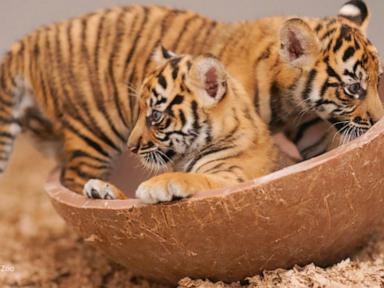
Every major news network just ran the exact same soft-focus segment. Anchor voices drop into that familiar, reverent cadence usually reserved for royal births or space landings. They beam over twin Sumatran tiger cubs born at the Fort Worth Zoo, flashing clips of roly-poly stripes, weighing them like oversized pumpkins, and tossing around words like milestone, hope, and survival.
It makes for great morning television. It drives ticket sales. And it is a profound distraction from the actual mechanics of extinction.
Let us stop pretending that breeding a pair of captive cubs in Texas alters the trajectory of a critically endangered apex predator facing down palm oil plantations, fragmented jungles, and relentless poaching syndicates in Sumatra. The lazy consensus of modern zoo public relations is that every birth behind glass is a victory for the species. It is not. It is an insurance policy for entertainment balance sheets disguised as zoological salvation.
The Arithmetic of Illusion
Let us look at the raw data instead of the nursery footage.
The International Union for Conservation of Nature pins the wild Sumatran tiger population somewhere below 650 individuals. Some independent tallies put it closer to 400. Their native habitat on the Indonesian island of Sumatra is getting carved up by commercial agriculture at a scale that makes local conservation efforts look like a thumb in a collapsing dam.
Now look at the captive population managed across global facilities through species survival plans. We have hundreds of tigers living out their lives behind concrete moats and faux-rock walls.
The fundamental premise peddled by mainstream media reports is that these captive populations serve as a direct reservoir to repopulate the wild when things stabilize. That argument collapses under the weight of basic biology and logistics. A tiger born in a North American zoo is imprinted on managed environments, fed a calibrated diet of pre-killed meat, and shielded from every natural pathogen and survival pressure that defines wild selection. You cannot simply drop a zoo-bred sub-adult into the Leuser Ecosystem and expect it to survive a week against territorial males, poachers, and human-wildlife conflict zones.
Reintroduction is not a drop-shipping operation. It requires vast, secure, contiguous wild habitats. And as long as those habitats are shrinking faster than a puddle in July, breeding more tigers in Texas changes zero math in the wild.
The Marketing Loop
Why do institutions push these births so aggressively? Follow the economics.
I have watched organizations sink millions into high-profile exhibit upgrades—like the expansive Asian and African predator habitats built to house these exact programs—only to rely on cute cub debuts to generate the attendance spikes required to pay off the capital expenditure. It is a brilliant feedback loop. Born on July 1, kept behind the scenes for months, and then rolled out for the autumn news cycle just as attendance traditionally dips.
David Muir and morning show hosts treat it like a pure act of biological grace. They omit the uncomfortable nuance: captive breeding programs for high-profile charismatic megafauna are largely about keeping the turnstiles spinning so the facility can fund its gift shops, parking lots, and minor administrative overhead. Meanwhile, actual field conservation units in Sumatra—the local rangers sleeping in muddy tents, intercepting snare lines, and paying informants to catch poachers—struggle year after year for basic operational funding.
We throw money at the nursery because people love babies. We starve the front lines because patrolling a muddy rainforest border does not make for a cute Instagram reel.
What Real Conservation Looks Like
If we actually cared about saving Panthera tigris sumatrae, we would stop obsessing over birth weights in air-conditioned veterinary clinics.
Real conservation is aggressively unglamorous. It looks like land buybacks to connect fragmented forest corridors. It looks like armed, well-paid anti-poaching patrols dismantling wire snares before they snap shut on a paw. It looks like economic pressure on governments and corporations driving the illegal deforestation of Riau and Jambi.
None of those initiatives fit into a thirty-second morning news segment. You cannot slap a catchy Indonesian name like Barani or Malu on a policy enforcement grid or a land-use treaty.
I am not suggesting that modern zoos do zero good. Accredited facilities maintain veterinary databases, fund minor field grants, and offer millions of urban citizens a rare look at an animal they would otherwise never comprehend. That has value. But let us call it what it is: education and entertainment.
Stop calling every captive litter a conservation milestone. Stop pretending that a cub born in Fort Worth is a proxy for a tiger roaming Sumatra.
The next time a network anchor smiles through a segment about newborn stripes and heavy-duty scales, remember what is actually happening. We are co-opting the slow-motion extinction of a magnificent animal to sell memberships, merchandise, and morning ratings, all while the real jungle goes up in smoke.


