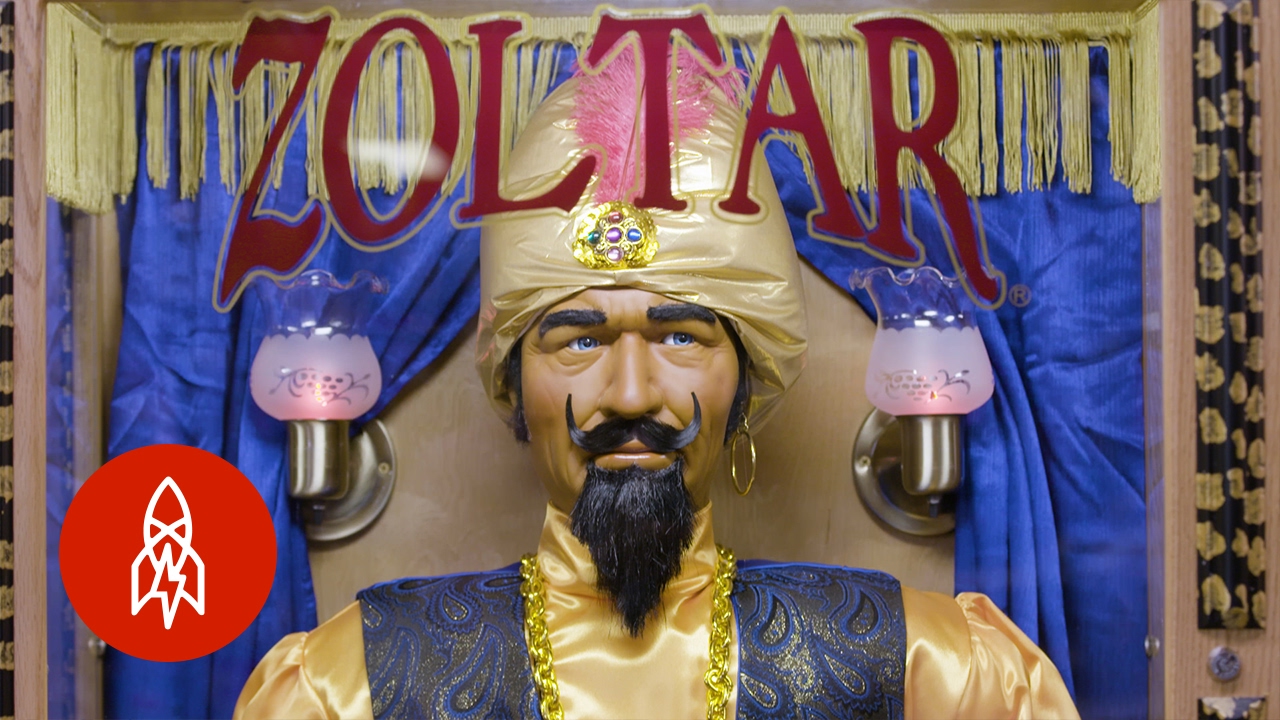
He just sits there. Yellow silk shirt, a gold turban, and that eerie, frozen grin behind a glass pane. If you grew up in the eighties or nineties, you know him instantly. He’s the big movie fortune teller machine from the 1988 classic Big, and honestly, he might be the most famous prop in cinema history that isn't a lightsaber or a DeLorean.
But here’s the weird part. Most people think the machine in the movie was a vintage antique from the turn of the century. It wasn't. It was custom-built for the film. Yet, decades later, you can find "Zoltar Speaks" machines in boardwalks and arcades across the globe. It's a strange case of life imitating art imitating a history that never quite existed in the way we remember it.
The Truth About the Machine in Big
Let's clear the air on the movie prop itself. In the film, a young Josh Baskin finds a "Zoltar Speaks" machine at a traveling carnival. He drops a quarter, wishes to be "big," and wakes up as Tom Hanks. Simple enough.
However, if you go looking for an original, pre-1988 "Zoltar," you're going to have a hard time. While fortune-teller machines have been a staple of penny arcades since the late 1800s—think of the famous "Zelda" or "Puss in Boots" machines—the specific design of the Zoltar we see in the movie was a creation of the production team. They needed something that looked ancient and mystical but had the mechanical reliability required for a film set.
The original prop was actually quite complex. It didn't just spit out a card; it had to look like it was breathing, living, and listening to a child's deepest desires. After the movie wrapped, the original prop eventually found its way into private collections. It's a holy grail for movie memorabilia collectors. People have spent years trying to track down every detail of its construction, from the specific shade of the facial paint to the exact fabric used for the vest.
Why We Are Still Obsessed With Arcade Oracles
Why does a creepy animatronic in a box still resonate? Maybe it’s the eyes. They don't quite track you, but they feel like they’re seeing right through your adult cynicism.
There is a psychological phenomenon at play here. These machines represent a "safe" version of the occult. It’s a game. You know it’s a motor and some printed cardboard, but there is that split-second before you pick up the card where you think, what if? Fortune-telling machines like the big movie fortune teller tap into a deep-seated human desire for external validation. We want to be told that things will work out, or that we are special. In Big, the machine represents the terrifying speed of growing up. Josh wanted the benefits of adulthood without the years of experience. The machine gave him exactly what he asked for, which, as we find out, is a bit of a nightmare.
The Rise of the Replica
Because the movie was such a massive hit, a company called Characters Unlimited, Inc. eventually licensed the name and look. If you see a Zoltar today at a Pier 39 in San Francisco or a random tourist trap in Gatlinburg, it’s likely one of these modern recreations. They are incredibly popular.
- They use high-tech animatronics.
- The voice acting is often modeled directly after the film's tone.
- The cards often feature the same "Your Wish is Granted" text.
These aren't just toys. They are high-end revenue generators. Business owners buy them because they have an "Instagrammable" quality that 100-year-old antiques sometimes lack. They are bright, they are loud, and they carry the weight of 80s nostalgia.
The History of Real Fortune Teller Machines
Before Zoltar, there was Esmeralda. There was the Gypsy Queen.
In the early 1900s, companies like Roovers Brothers and Mills Novelty Company dominated the arcade scene. These machines were often terrifying by modern standards. Some featured wax figures with real human hair. Others used primitive Edison wax cylinders to actually "speak" to the patron.
One of the most famous real-world inspirations for the big movie fortune teller was likely the "Zeno" machines or the various "Zoltan" machines that appeared in the 1960s. Zoltan was particularly interesting—it was a pedestal-style machine where you picked up a telephone receiver to hear your "prophecy." It felt more like a secret conversation than a public spectacle.
But Big changed the aesthetic. It moved the fortune teller away from the "creepy basement" vibe and into the "magical carnival" realm. It made the machine a bridge between worlds.
The Engineering of a Prophecy
How does a machine "know" your future? It doesn't, obviously. It's a randomizer.
Inside a classic machine, there is a stack of pre-printed cards. A mechanical arm or a roller system pushes the bottom card through a slot. In the movie version, the "magic" was the lack of a power cord. That was the big reveal—Josh realizes the machine wasn't even plugged in.
In the real world, modern Zoltars are powered by sophisticated microcontrollers. They can be programmed to say different phrases depending on the time of day or how many people are walking by. Some even have motion sensors to "shout" at passersby. It’s a far cry from the purely mechanical levers of 1910, but the soul of the machine remains the same.
The "Big" Impact on Pop Culture
You see the influence everywhere. From The Simpsons to Stranger Things, the trope of the "mystical arcade machine" is a shorthand for "something life-changing is about to happen."
It’s about the loss of innocence. When Josh Baskin stands in front of that machine, he’s a kid. When he leaves, he’s still a kid, but the world sees him as a man. The big movie fortune teller acts as a catalyst for a mid-life crisis that happens twenty years too early.
There's also the "Zoltar" cameo in other films and TV shows. It has become a visual icon for "New York in the 80s," right alongside yellow taxis and graffiti-covered subways. It’s amazing that a fictional machine created for a Tom Hanks movie managed to colonize the real world so effectively.
How to Spot a "Real" Antique vs. a Movie Replica
If you're a collector or just a fan, knowing what you're looking at is key.
Real antiques from the pre-1940 era will almost always have cast-iron components. They are incredibly heavy. The glass is often wavy, and the clothing on the manikin is usually dry-rotted or heavily restored. These machines can fetch $20,000 to $50,000 at specialized auctions like Morphy’s.
A "Big" movie replica, even a high-quality licensed one from the last twenty years, will have modern wiring and likely use plastic or fiberglass for the internal housing. They are still valuable—often retailing for $5,000 to $10,000—but they aren't "relics" in the historical sense.
The biggest giveaway? The name. If it says "Zoltar," it's almost certainly a post-1988 creation or a very specific homage. If it's a "Zoltan," you might have a 60s original. If it’s "Verbo," you’re looking at something truly rare.
Practical Steps for the Nostalgic Fan
If you've ever wanted your own big movie fortune teller experience, you don't actually have to track down a carnival in Jersey.
First, check out the official licensed replicas if you have the budget. They are the gold standard for home theaters. If you're on a budget, there are dozens of "miniature" Zoltans and Zoltars sold as desk toys. They don't have the same presence, but they still spit out those tiny yellow cards.
Second, if you're in New York, visit the FAO Schwarz flagship store. They’ve historically kept a Zoltar machine there as a tribute to the movie (even though the original movie scene was filmed at Playland in Rye, New York). It’s a rite of passage for film buffs.
Third, look into the history of "Penny Phrenology." It’s the actual science (well, pseudoscience) that birthed these machines. Understanding the history of how humans have tried to automate "luck" makes the movie machine much more fascinating.
Ultimately, the big movie fortune teller serves as a reminder that we all want a shortcut to our dreams. We want to put a coin in a slot and come out the other side as the person we've always wanted to be. Just be careful what you wish for—you might end up having to navigate a 1980s corporate toy company without a high school diploma.
To truly appreciate the craftsmanship, look for local "Museums of Fun" or mechanical instrument museums. Places like the Musée Mécanique in San Francisco or the Pinball Hall of Fame in Las Vegas often house the spiritual ancestors of the Zoltar machine. Seeing them in person, hearing the whir of the gears, and smelling the old ozone from the motors provides a context that no 4K Blu-ray can match. If you're looking to buy, always verify the manufacturer's plate; genuine movie-era replicas from the late 80s are becoming increasingly rare and are starting to appreciate in value among Gen X collectors.