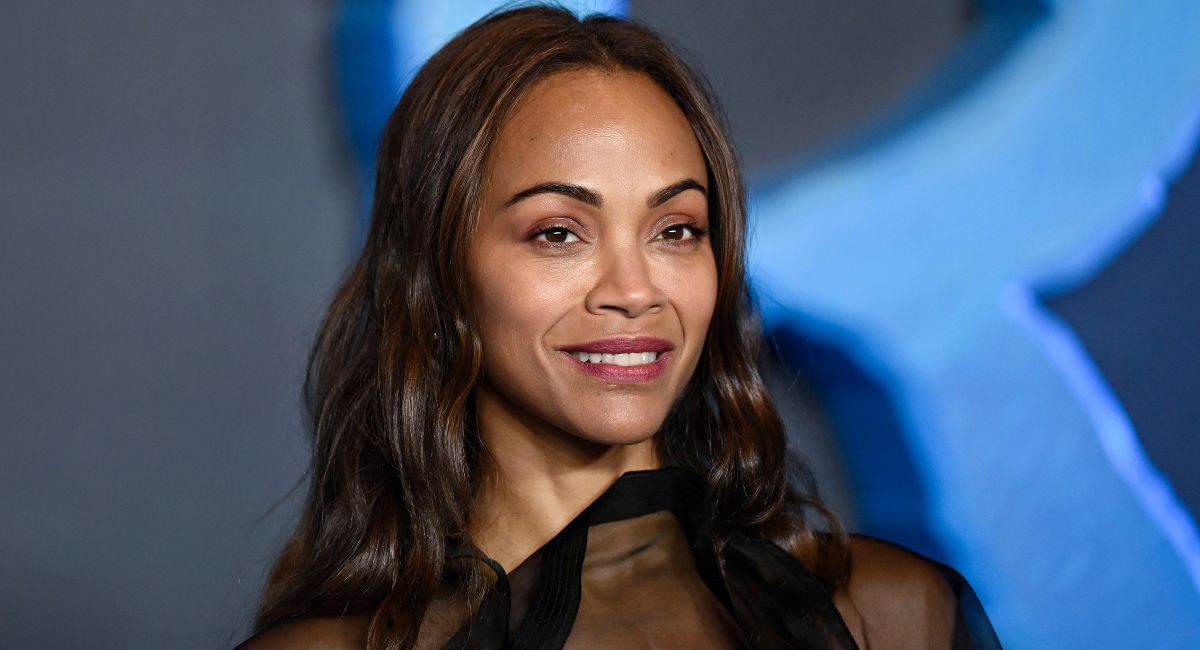
It is a weirdly common phenomenon in Hollywood. You see an actor for decades, you watch them lead the biggest franchises in cinematic history—literally Avatar, Avengers, and Star Trek—and yet, you somehow miss a fundamental part of who they are. For years, fans have been surprised to find out that Zoe Saldana speaks Spanish. Not just "celebrity-on-a-press-tour" Spanish. We're talking first-language, native-level fluency that she’s been carrying since she was a kid in Queens and the Dominican Republic.
Honestly, it says more about the industry’s narrow casting than it does about her. For a long time, Saldana was primarily cast in roles where her "Afro" identity was the focus, or she was literally painted green or blue. Her Latina heritage was often sidelined by the "big machine" of blockbuster filmmaking.
The Dominican Roots and the Queens Connection
Zoe was born in New Jersey, but her household was a linguistic melting pot from day one. Her father, Aridio Saldaña, was Dominican, and her mother, Asalia Nazario, is Puerto Rican. If you know anything about Caribbean households, you know the language isn't just a tool; it's the atmosphere.
Things took a dramatic turn when she was nine. Her father died in a tragic car accident, a moment that shattered her world. Her mother, struggling to keep things afloat in New York, made the heavy decision to send Zoe and her sisters to the Dominican Republic to live with their grandparents.
That move was a total culture shock.
In New York, she could "code-switch." In the D.R., that luxury vanished. She has recently opened up about being bullied in school because her Spanish wasn't "Dominican enough" yet, or because she stood out as an American kid. "You can’t speak English; you have to speak only Spanish," she recalled in a recent Harper’s Bazaar interview. Those seven years in the Caribbean didn't just teach her the language—they baked it into her identity. She studied ballet at the Espacio de Danza Academy, finding her voice through movement before she ever felt fully comfortable using her literal voice in a professional setting.
Why Emilia Pérez Changed Everything
If you’ve only seen her as Gamora or Neytiri, you’re missing out. For twenty-five years, Saldana essentially waited for a role that allowed her to be her full self. That finally happened with Emilia Pérez, the 2024/2025 musical thriller that took the world by storm.
In the film, she plays Rita, a high-powered lawyer in Mexico. It was her first major role performed entirely in Spanish.
Winning the Best Actress prize at Cannes (shared with her co-stars) and eventually her first Oscar in 2025, she finally silenced anyone who doubted her range. Interestingly, she gave her character a Dominican backstory to bridge the gap between her own heritage and the Mexican setting. It wasn't just a job; it was what she described as an "exorcism." She was working outside the "machine," as she puts it, finally leaning into the "comfort language" she uses at home.
The Linguistic Breakdown
- First Language: Spanish (Dominican/Puerto Rican household).
- Current Status: Fully bilingual and fluent.
- The Spanglish Factor: She admits she speaks a lot of Spanglish with her sisters.
- Multilingualism: Because of her background, she also understands French, Italian, and Portuguese.
Speaking Spanish at Home (and the Struggle is Real)
It's one thing to speak a language; it's another to pass it on. Zoe is married to Marco Perego, an Italian artist. You’d think their house is a polyglot’s dream, and it is, but it takes work.
She’s been very vocal about the "conscious effort" required to keep Spanish alive for her three sons. In many interviews, she’s mentioned that because she is so used to English in the professional world, she has to catch herself. "It’s English out there and Spanish in the house," she says. It’s a battle many immigrant parents face—the "English baby" syndrome where kids naturally gravitate toward the dominant language of their environment.
Addressing the Critics and the "Latina Enough" Debate
Identity is messy. Because Zoe is Afro-Latina, she’s often faced a double-edged sword of criticism. Some people didn't realize she was Latina at all, while others questioned her "authenticity" when she played certain roles.
There was even some friction regarding Emilia Pérez. When the film won big at the 2025 Oscars, some Mexican critics felt the film (directed by a Frenchman) relied on stereotypes. Zoe, ever the diplomat but firm in her roots, apologized to those who felt offended but stood by the art. She argued that the story of these women was universal, whether they were from Mexico, the D.R., or even "Black from Detroit."
She doesn't like being put in a box. She has famously said, "I am American first," but that doesn't mean she’s "less" Dominican or Puerto Rican. She’s just tired of people using labels to limit her.
What You Can Learn From Zoe’s Journey
If you’re trying to reconnect with your own heritage or learn a language, Zoe’s story offers some pretty solid takeaways.
First, immersion is king. Those seven years in the D.R. were hard, but they gave her a gift she uses to this day. Second, don't let your "day job" define your identity. Just because she was "the girl in the big sci-fi movies" for twenty years didn't mean she wasn't speaking Spanish behind the scenes and waiting for the right moment to show it.
Actionable Next Steps:
- Watch her interviews in Spanish: If you're a language learner, look up her press junkets for Emilia Pérez on YouTube. Her accent is a fascinating mix of her Caribbean roots and her life in L.A./New York.
- Check out "From Scratch": While it’s largely in English and Italian, you can see her navigating a multilingual world, which mirrors her real life.
- Support Afro-Latino Cinema: Look for projects that don't force actors to choose between their "Blackness" and their "Latinidad."
Zoe Saldana is proof that you don't have to be one thing. You can be a Marvel superhero and a Spanish-language powerhouse all at once. It just took the rest of the world a little while to catch up.