You probably think you know your sign. Most people do. They see the little glyph on a necklace or a tattoo and think, "Yeah, that's me, the stubborn Bull." But the history of zodiac symbols and pictures is actually a messy, beautiful overlap of ancient Babylonian math, Greek mythology, and Renaissance art that most horoscopes just glaze over. It isn't just about personality traits. It’s a map.
The symbols we use today—those weird little squiggles—are called glyphs. They aren’t just random doodles; they are shorthand for massive, complex constellations that have guided civilizations for millennia. Honestly, if you look at the original Babylonian MUL.APIN tablets from 1000 BCE, the way they saw the sky was way different than the glossy illustrations you see on Instagram today. They didn't even have a "Libra" at first; those stars were just the "Claws of the Scorpion."
The Weird History Behind Zodiac Symbols and Pictures
Why do we use these specific drawings? It’s kind of wild when you dig into it. Take Capricorn. Most people call it the Goat. But look at the zodiac symbols and pictures from a few hundred years ago. It’s a Sea-Goat. Half-goat, half-fish. This traces back to the Sumerian god Enki, a deity of water and creation. When we strip away the "fish" part to make it a simple mountain goat, we lose the symbolism of the sign's ability to navigate both the emotional depths (water) and the material heights (earth).
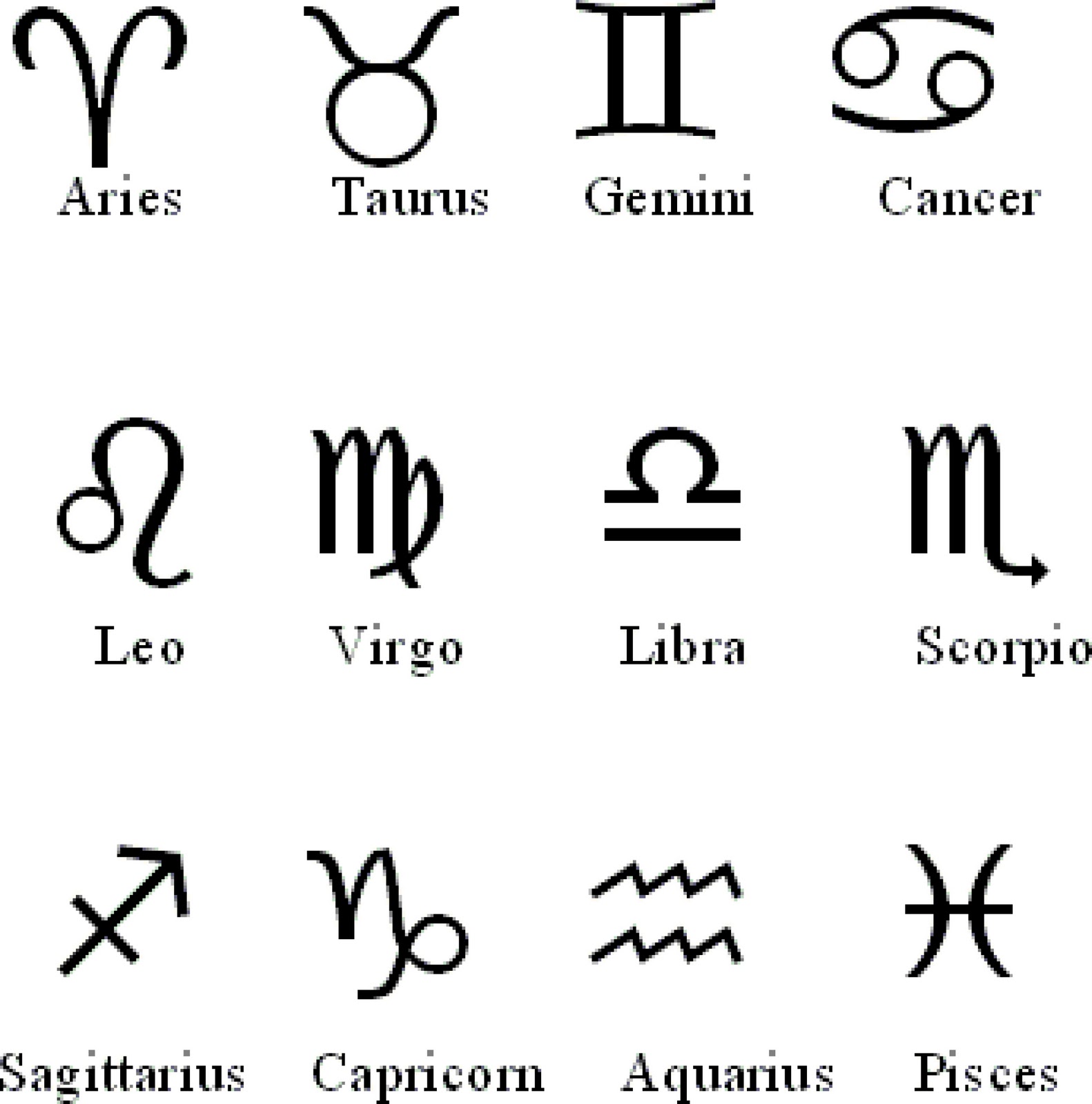
Then you have Aries. The ram. People see the "V" shape and think "horns." While that's true, ancient esotericists viewed that glyph as a fountain of life or a sprout emerging from the ground. It represents the vernal equinox—the literal beginning of the astrological year. It is an explosion of energy.
Aries: The Ram ($21$ March – $19$ April)
The ram isn’t just about being aggressive. The Golden Fleece from the story of Jason and the Argonauts is the core myth here. The glyph represents the head and horns of a ram, but in a psychological sense, it's the "I am" of the zodiac. It is pure, raw identity.
Taurus: The Bull ($20$ April – $20$ May)
The circle with a crescent on top. Simple, right? But Taurus is ruled by Venus. The bull in ancient Mediterranean cultures wasn’t just a farm animal; it was a symbol of incredible fertility and power. Think about the Bull of Minos. The picture of the bull represents groundedness, but it’s also about the literal weight of the earth.
Gemini: The Twins ($21$ May – $20$ June)
The Roman numeral II. It’s the easiest of the zodiac symbols and pictures to recognize. It represents duality. Castor and Pollux. One mortal, one immortal. This is the sign of the mind, and the picture usually shows two people holding hands or standing back-to-back. It’s about the bridge between the self and others.
Cancer: The Crab ($21$ June – $22$ July)
This one is weird. The "69" sideways. It's not what you think. It represents the claws of a crab, but it’s also meant to look like a mother’s breasts, symbolizing the nurturing nature of the sign. It’s a closed-off, protective shape. Crabs carry their homes on their backs. They are soft inside and hard outside.
Why the Images Changed Over Time
The way we visualize the zodiac hasn't stayed static. In the Middle Ages, zodiac imagery was often used in medical texts. They had this thing called the "Zodiac Man." It was a picture of a human body with the different zodiac symbols and pictures pointing to specific body parts. Aries ruled the head. Pisces ruled the feet. If you were having surgery on your leg, a medieval doctor might check if the moon was in Sagittarius (the sign ruling the thighs) and tell you to wait. It sounds like superstition now, but at the time, this was the cutting edge of science and observation.
Leo: The Lion ($23$ July – $22$ August)
The glyph looks like a script "n" with a tail. It’s the tail of the lion, or the mane. But more importantly, it represents the heart. Leo is the sun. The picture of the lion reflects the Nemean lion slain by Hercules. It’s about the struggle to master one's own ego.
Virgo: The Virgin ($23$ August – $22$ September)
The "M" with a loop. The loop represents the folded legs of a chaste maiden or a sheaf of wheat. Virgo is the only sign represented by a woman. It’s about the harvest. In many ancient zodiac symbols and pictures, Virgo is shown holding a stalk of grain, specifically the star Spica.
Libra: The Scales ($23$ September – $22$ October)
The only inanimate object in the bunch. It’s a sunset. Or a balance scale. It used to be part of Scorpio, but the Romans separated it to emphasize justice and equilibrium. The top line has a bump—that’s the fulcrum.
Scorpio: The Scorpion ($23$ October – $21$ November)
It looks like the Virgo "M" but has an arrow at the end. That’s the stinger. Scorpio is intense. In older woodcuts, you sometimes see it as an eagle or a phoenix. The idea is that Scorpio has three stages of evolution: the crawling scorpion, the soaring eagle, and the reborn phoenix.
The Modern Shift to Minimalism
Lately, the aesthetic of zodiac symbols and pictures has shifted toward line art. It’s very "minimalist chic." While it looks great on a phone lock screen, we’re losing the "decans." Decans are ten-degree breakdowns of each sign that have their own specific sub-images. For example, the first ten days of Leo have a different vibe (and traditionally a different sub-image) than the last ten days.
We’ve basically "flattened" astrology for the sake of quick consumption. When you look at a 17th-century celestial atlas by someone like Andreas Cellarius, the pictures are dense. They’re crowded with stars and mythological monsters. Today, we just want a clean SVG file. There's nothing wrong with that, but it's like reading the SparkNotes of a thousand-page novel. You get the plot, but you miss the soul.
Sagittarius: The Archer ($22$ November – $21$ December)
The arrow pointing up. It’s a centaur—half-man, half-horse—aiming at the stars. It’s the bridge between animal instinct and high-level philosophy. The arrow is always tilted toward the heavens.
Capricorn: The Sea-Goat ($22$ December – $19$ January)
That strange "V" and "S" mashup. As I mentioned before, it’s the goat-fish. It represents the climb. The goat climbs the mountain, the fish swims the depths. It is the master of both worlds, though modern pictures usually just show a goat with long horns.
Aquarius: The Water Bearer ($20$ January – $18$ February)
Two zig-zag lines. People think it’s water. It isn’t. It’s air. Specifically, it’s waves of electricity or "prana." Aquarius is an air sign. The "water" being poured by the figure in the picture is actually knowledge or collective consciousness being poured into the world.
Pisces: The Fish ($19$ February – $20$ March)
Two fish tied together by a cord. They are swimming in opposite directions. One goes up, one goes down. It’s the struggle between the physical world and the spiritual world. The cord is the only thing keeping the soul from drifting away entirely.
Finding the "Hidden" Symbols
If you look closely at the zodiac symbols and pictures in old cathedrals—like the one in Chartres, France—you’ll see the zodiac carved into the stone. Why? Because for a long time, the church saw the zodiac as a way to track the "Great Clock" of God. It wasn't "witchcraft"; it was timekeeping.
The symbols are everywhere once you start looking. You’ll see the Leo lion in bank logos (strength and gold). You’ll see the Virgo maiden in agricultural branding. These aren't just for horoscopes. They are part of our collective visual language.
How to Use This Knowledge
Don't just look at your sun sign. If you want to actually use zodiac symbols and pictures for anything meaningful, look at your "Big Three": your Sun, Moon, and Rising signs.
- Find your full birth chart using a reputable site like Astro-seek or Cafe Astrology. You'll need your exact birth time.
- Look at the glyphs for your Rising sign (the sign on the Eastern horizon when you were born) and your Moon sign.
- Compare the traditional pictures. If you're a Leo Sun but a Scorpio Rising, your "Lion" is wearing "Scorpion" armor.
- Notice the elements. Are your symbols mostly pointy (Fire/Air) or curvy (Earth/Water)? This visual "weight" tells you if you're more driven by logic and action or emotion and physical reality.
The symbols are tools. They are meant to be meditated on, not just glanced at in a newspaper. When you see the picture of your sign, don't just think "that's me." Ask yourself why those specific stars were grouped together that way three thousand years ago. Usually, the answer is a lot more interesting than "you're going to have a lucky Tuesday."
Next Steps for Deepening Your Understanding
To move beyond the basic "clip art" version of astrology, start by researching the Egyptian Dendera Zodiac. It is one of the oldest complete depictions of the zodiacal constellations and shows how the symbols we use today were originally blended with Egyptian cosmology. After that, look up your Sabian Symbols. These are 360 specific phrases and "word pictures" for every single degree of the zodiac. They provide a much more granular, poetic image of your personality than a single animal or object ever could. Finally, if you are interested in the visual art side, find a copy of the Splendor Solis, an alchemical manuscript with some of the most stunning zodiac-adjacent imagery ever produced. It will completely change how you "see" the signs.