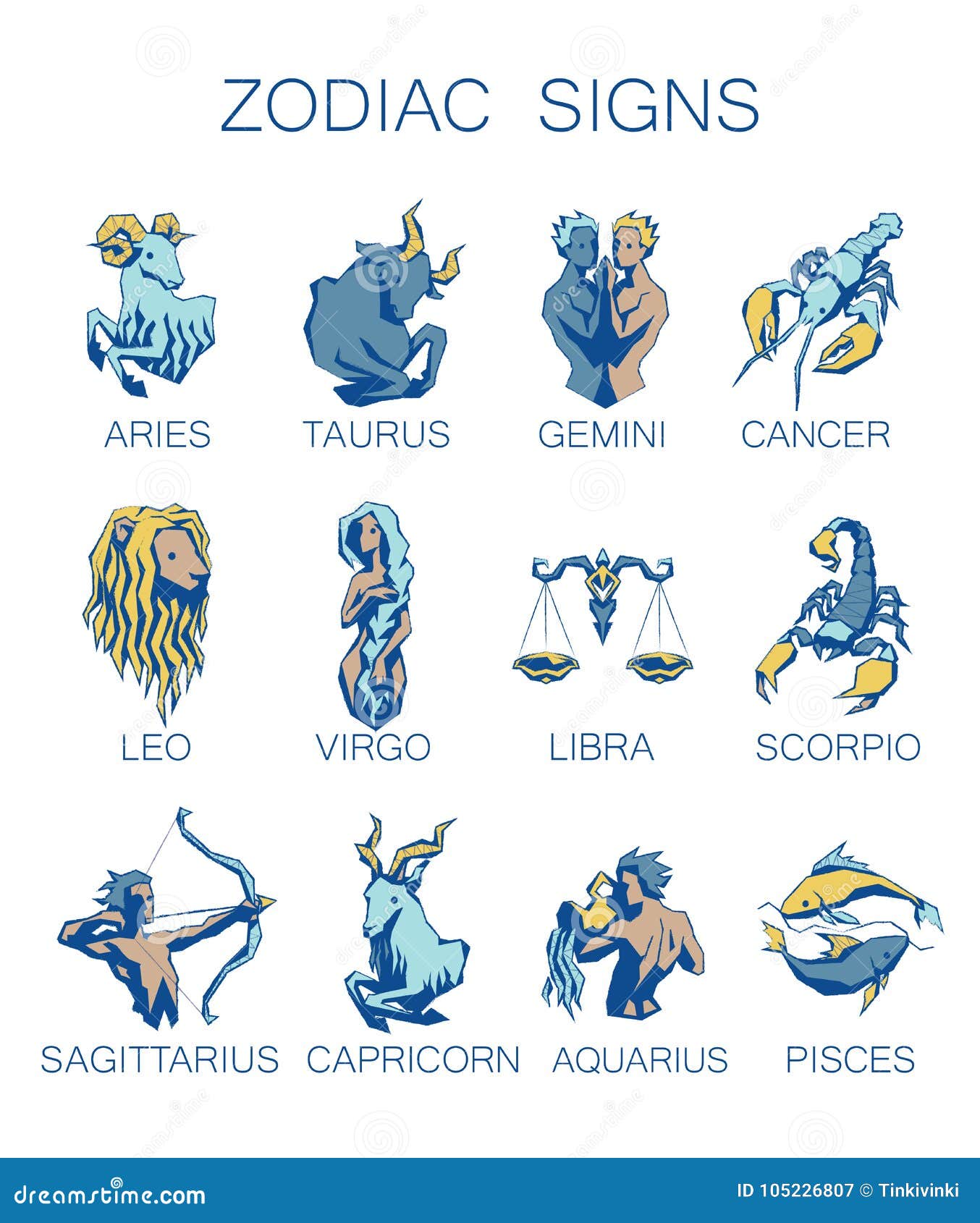
You’ve seen them everywhere. They’re etched into gold pendants, tattooed on wrists, and plastered across every "Which Pizza Topping Are You?" quiz on the internet. But most people just see a squiggle and think "Aries" or "Pisces" without actually knowing why that specific doodle exists. Those little icons—technically called glyphs—aren't just random choices made by a bored Greek astronomer. They’re actually a condensed shorthand for complex astronomical and mythological concepts that have survived for thousands of years.
Honestly, the history is a bit messy. It’s a mix of Mesopotamian star-tracking, Greek mythology, and medieval alchemy. If you’ve ever wondered why Capricorn looks like a weird "V" with a curly tail or why Gemini is basically just a Roman numeral two, you’re looking at a visual language that predates modern English by a long shot.
The Real Story Behind the Fire Signs
Let's start with the heavy hitters. People often get the zodiac sign symbols for fire signs confused because they look so abstract.
Aries is the first sign, and its glyph looks like a "V" with curved horns. Most people say it’s the Ram. They’re right, but there’s more to it. Some astrologers, like those following the lineages of the Hermetic Order of the Golden Dawn, argue it also represents the human nose and eyebrows—the most prominent feature of the face, which Aries (ruling the head) is said to govern. It's about outward force.
Then you have Leo. The Leo glyph is basically a circle with a swooping tail. Is it a lion’s mane? Or is it the tail? Actually, many historians point back to the Greek word leon. If you look at ancient scripts, the glyph is a simplified version of the first letter. But if you're into the anatomical side of astrology, that circle and tail supposedly mimic the heart and the spine, which Leo is said to rule in the body. It’s a literal map of "backbone."
Sagittarius is the most straightforward. It's an arrow. But notice the line cutting through the bottom. That's the bow. It represents the Centaur, specifically Chiron, aiming for something higher than the dirt. It’s the only symbol that’s an actual weapon, which tells you everything you need to know about the Sagittarian "truth-telling" vibe.
Why Some Glyphs Look Like Science Experiments
Earth signs are where things get weirdly technical. Take Virgo. It looks like an "M" with a looped tail tucked inward. Now, compare that to Scorpio (a water sign), which is an "M" with a pointed tail sticking out.
Virgo’s symbol is often interpreted as a maiden carrying a shaft of wheat. The "M" stands for maiden, and the loop represents the "chastity" or the internal focus of the sign. It’s a closed system. It’s about refinement and keeping things contained.
On the flip side, Capricorn is the one everyone fails to draw correctly on the first try. It looks like a "V" or a "7" with a loop at the end. That is the Sea-Goat. The top part is the goat’s horns, and the curly bit is the fish tail. It’s a nod to the Babylonian god Enki, who was a god of water and creation. It symbolizes the ability to climb the highest mountains while still navigating the deepest emotional waters. Most people forget Capricorn is part "sea" and think it’s just a mountain goat. Big mistake.
Taurus is just a circle with ears. Or is it? It’s the Bull, obviously. But in ancient Egyptian iconography, this shape mirrored the sun disk being cradled by the moon. It’s about fertility and grounded power. Simple. Heavy. Sturdy.
The Air Signs and the Geometry of Connection
Air signs use very geometric zodiac sign symbols. They feel less "animal" and more "human-made."
- Gemini: It’s the Roman numeral II. It represents the Twins, Castor and Pollux. It’s the concept of duality—light and dark, silence and speech.
- Libra: This one is unique. It’s the only symbol in the entire zodiac that isn’t a living creature. It’s an object—the scales. The glyph itself shows the sun setting or rising over the horizon. It represents equilibrium. It's the point where day and night are equal.
- Aquarius: Two zig-zag lines. Most people think it’s water. It’s not. Well, not exactly. Aquarius is an Air sign. Those ripples represent waves of electricity, or "air waves," and the flow of knowledge. It’s the "Water Bearer" pouring out insight, not literal H2O.
The Mystery of the Water Glyphs
Water signs have symbols that feel very fluid. Cancer is the one that confuses people. It looks like a "69" sideways. It’s not what you think. It represents the claws of a crab, but it’s also meant to mimic the breasts, as Cancer rules the chest and nurturing. It represents the protective, cyclical nature of the sign—the idea of holding something close to the center.
Scorpio is the "M" with the stinger. Unlike Virgo, which is closed off, Scorpio’s energy is directed outward. That tail is a spear or a stinger. It’s a warning. It’s also one of the few signs with multiple symbols—the Scorpion, the Eagle, and the Phoenix—but the glyph focuses on the "sharp" end of the deal.
Finally, Pisces. Two crescents joined by a line. Two fish swimming in opposite directions but tethered together. One fish is swimming toward the heavens (spirituality), and the other is swimming toward the bottom of the ocean (materiality). The horizontal line is the bridge. It’s the struggle of being a human with a soul.
Why the Symbols Actually Matter in 2026
We live in a world that is increasingly digital and disconnected. Using these zodiac sign symbols is a way of tapping into a collective shorthand that has existed for millennia. When you look at the glyph for Mercury or the symbol for Aries, you aren't just looking at a logo. You’re looking at a piece of software that has been running in the background of human consciousness since the Bronze Age.
These symbols were used by doctors in the 1600s to diagnose patients. They were used by farmers to know when to plant corn. Today, we use them for self-reflection.
The nuance is what matters. If you’re just reading a horoscope that says "Aries is angry," you're missing the point. The Aries glyph—that "V" shape—is about the fountain of life. It’s the spark. Understanding the symbol helps you understand the energy behind the personality.
How to Use This Knowledge
Don't just memorize them. Observe them. If you’re looking at your own birth chart, look at where the symbols sit.
- Look at the "M" signs: If you have a lot of Virgo or Scorpio in your chart, notice the difference between the "tucked in" energy and the "stinging" energy. It explains a lot about how you handle conflict.
- Identify the "Bar": In Libra and Pisces, there’s a horizontal bar. That represents the earth or a connection point. These are signs that act as bridges.
- The Circle: Notice which symbols incorporate the circle (Leo, Taurus). The circle represents the spirit or the sun. These signs usually have a very strong sense of self or a "core" that is hard to shake.
If you want to get serious about it, start drawing them by hand. There is a specific "flow" to writing a glyph that feels different than writing letters. It's more like drawing a sigil. Once you get the hang of the curves of the Capricorn glyph or the sharp angles of Aquarius, you start to see these patterns in the world around you.
The zodiac isn't just a list of twelve names; it's a visual language of the human experience. Whether you believe the stars control your fate or you just like the aesthetic, these symbols are the oldest "emojis" in history, and they aren't going anywhere.
To really get the most out of this, go look at your full birth chart—not just your sun sign. See which zodiac sign symbols show up in your Moon and Ascendant positions. You might find that the "hidden" symbols in your chart explain your personality way better than your main sign ever did. Use a reputable site like Astro.com or Alabe to get the actual visual chart, and pay attention to how those glyphs interact with each other.