Ever looked at a horoscope and thought, "This is 100% not me"? Most people check their zodiac months and dates once and then spend their whole lives identifying as a Leo or a Scorpio without ever questioning the math. But honestly, the system we use is kinda broken. It’s based on a snapshot of the sky taken thousands of years ago. The earth wobbles. Space moves. Yet, we’re still using a Babylonian calendar that doesn't account for the fact that the North Star isn't even the same star it was when the pyramids were built.
It's weird.
If you've ever felt like your "official" sign is a total miss, there is actually a scientific reason for it. We’re talking about the difference between Tropical and Sidereal astrology, plus a "13th sign" that NASA mentions every few years just to watch the internet melt down. Let's get into what's actually happening up there.
The Problem with Traditional Zodiac Months and Dates
Western astrology uses the Tropical zodiac. Basically, it fixes the 12 signs to the seasons, not the actual stars. When the Sun hits the vernal equinox around March 21st, that's Aries. Period. It doesn't matter if the Sun is actually in the constellation of Pisces at that moment (which, by the way, it is).
Ancient astronomers in Mesopotamia established the zodiac months and dates we recognize today. They divided the sky into 12 neat little 30-degree slices. It was clean. It was symmetrical. But the universe is messy. Because of a phenomenon called "precession of the equinoxes," the earth's axis shifts over a 26,000-year cycle. This means the constellations have drifted about 30 degrees since the zodiac was formalized.
If you were born on the first day of Aries, the sun was likely physically sitting in front of the stars of Pisces. This creates a massive disconnect for people who want their astrology to be "accurate" to the physical sky. Astronomers like Neil deGrasse Tyson often point this out to debunk astrology, but for those who study the craft, it's just a different way of measuring time. You've basically got one camp following the seasons and another following the stars.
The Actual Calendar (The One You Know)
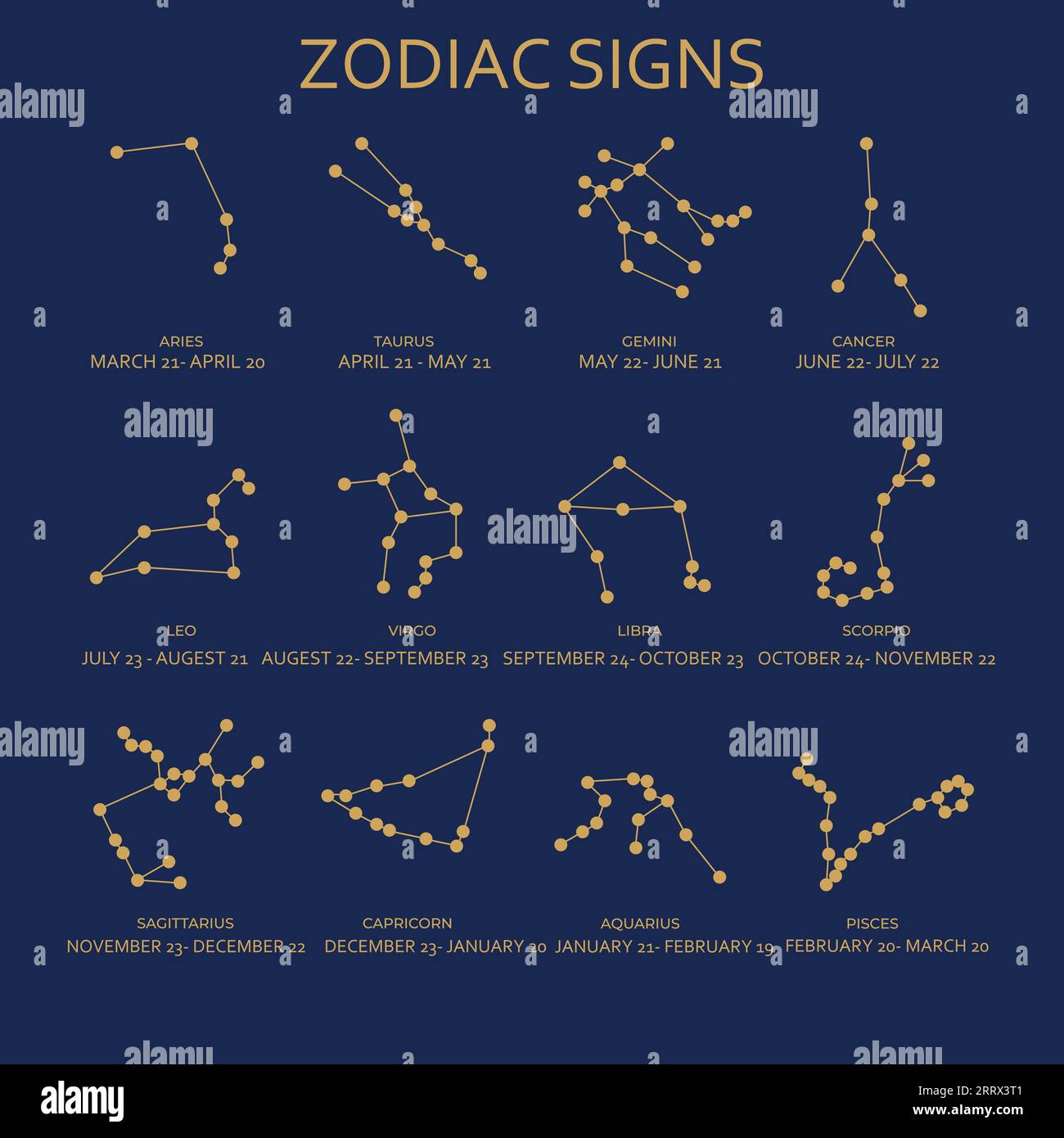
Most of us still use the standard dates. If you’re looking for a quick reference, here is how the traditional months are split, though keep in mind these "cusp" dates can shift by a day depending on the year:
Aries starts the wheel from March 21 to April 19. Then comes Taurus, holding down the fort from April 20 to May 20. Gemini takes over May 21 through June 20. Cancer (June 21 to July 22). Leo (July 23 to August 22). Virgo (August 23 to September 22). Libra (September 23 to October 22). Scorpio (October 23 to November 21). Sagittarius (November 22 to December 21). Capricorn (December 22 to January 19). Aquarius (January 20 to February 18). Finally, Pisces (February 19 to March 20).
That Ophiuchus Drama
Every few years, a viral post goes around saying "NASA changed your zodiac sign!" It usually claims there’s a 13th sign called Ophiuchus (the Serpent Bearer). People freak out.
NASA didn't change anything. They just did the math.
The Sun actually passes through the constellation Ophiuchus between November 30 and December 18. The Babylonians knew this. They just ignored it because 13 signs didn't fit into a 12-month calendar. If you were born in early December and you’ve never felt like a fiery, travel-obsessed Sagittarius, maybe you’re actually a Serpent Bearer. It sounds cooler, anyway. Ophiuchus is associated with healing, knowledge, and—unsurprisingly—snakes. But unless you’re using Vedic or Sidereal astrology, your "official" Western sign remains the same.
Why the Cusp is a Myth (Sorta)
You'll hear people say, "I'm a Leo-Virgo cusp, so I'm a mix of both."
In technical astrology, there is no such thing as being two signs at once. The Sun can only be in one place at a time. It’s binary. However, because the Sun is a big object and doesn't just "blink" from one sign to the next, the energy transition is real. Also, if you’re born on a cusp, your "inner" planets—like Mercury or Venus—are almost certainly in the neighboring sign.
Imagine a Taurus born on May 20. They might feel like a Gemini because their Mercury is already in Gemini. It's not the "cusp" making them chatty; it's the actual planetary placement. This is why looking at just zodiac months and dates is like reading the title of a book and claiming you know the whole story.
The Impact of Your Rising Sign
If your sun sign feels wrong, it’s probably because your Rising sign (Ascendant) is more visible to the world. The Rising sign is the constellation that was coming over the eastern horizon at the exact minute you were born. It changes every two hours. This is why two people born on the same day can be total opposites. One might have a "loud" Aries rising, while the other has a "quiet" Capricorn rising.
How to Actually Use This Information
Stop looking at the little paragraph in the back of a magazine. It's too generic. If you want to use the zodiac months and dates for something meaningful, you have to look at your "Big Three":
- The Sun: Your core identity. Your ego.
- The Moon: Your emotional world. How you act when you're alone in your kitchen at 2 AM.
- The Rising: Your social mask. How people perceive you before they get to know you.
There are plenty of free tools like Astro-Seek or Cafe Astrology where you can plug in your birth time and see where the planets actually were. It’s way more specific than just knowing you’re a "September Libra."
Real-World Nuance: The Cultural Split
It is worth noting that Western astrology isn't the only game in town. In India, Jyotish (Vedic astrology) is huge. They use the Sidereal zodiac, which does account for the Earth's wobble. In that system, your sign almost certainly moves back by about 23 days. So, most Western Leos are actually Vedic Cancers.
Which one is right?
That's the big debate. Western astrology is more psychological and symbolic. It’s about the "seasons" of the human experience. Vedic astrology is more karmic and predictive. It’s about where the stars physically sit in the sky. Neither is "wrong," they’re just different lenses. It's like measuring temperature in Celsius vs. Fahrenheit. Different numbers, same heat.
Actionable Steps for the Astrologically Curious
If you want to move beyond the surface level of zodiac months and dates, do this:
- Find your birth certificate. You need your exact birth time. "Around 4 PM" isn't good enough because the Rising sign moves fast.
- Run a full birth chart. Look at where your Mars (drive) and Venus (love) are. This explains why a "sensitive" Cancer might actually be a beast in the boardroom—they probably have Mars in an ambitious sign like Capricorn.
- Check the Transits. Don't just read your horoscope. Look at where the planets are now compared to your birth chart. That's how professional astrologers actually make "predictions."
- Observe the Lunar Cycle. Instead of worrying about your month, watch the Moon. It changes signs every two and a half days. You might find you're consistently productive when the Moon is in a certain sign, regardless of what your "month" says.
The stars aren't controlling your life, but they are a pretty interesting clock. Whether you're a hardcore believer or just someone who likes a good personality quiz, understanding the mechanics behind the dates makes the whole thing a lot more grounded. Forget the newspaper blurbs. Look at the actual math of the sky.