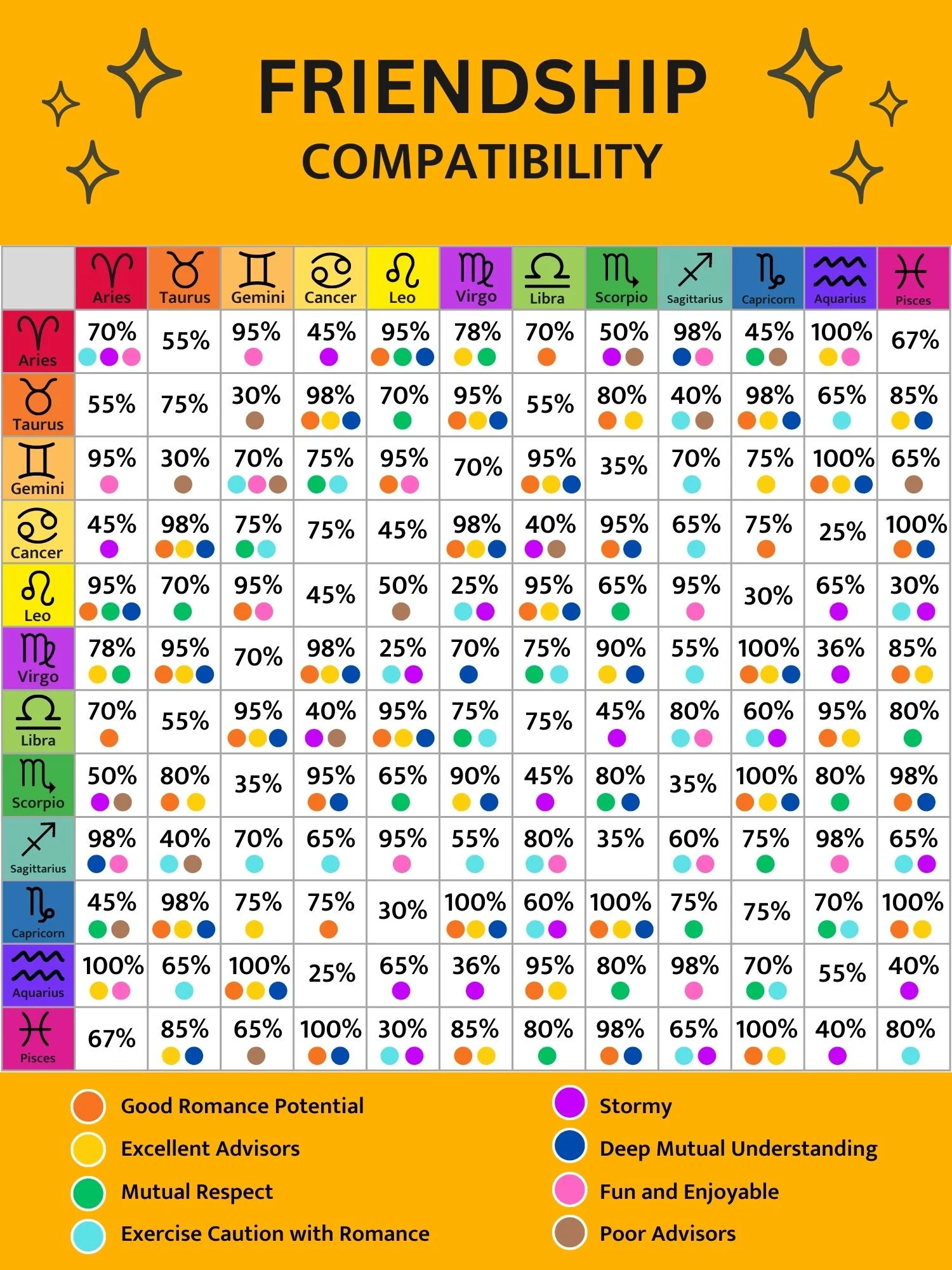
You’ve probably done it. Sitting on your couch, phone in hand, typing a crush's birthday into a search engine to see if you’re "destined" or "doomed." It's a bit of a guilty pleasure. Most of us start by looking up zodiac compatibility by date of birth because we want a shortcut to understanding human connection. We want to know if a Leo can actually survive a long-term relationship with a Scorpio without someone losing their mind.
But honestly? Most of the "compatibility scores" you find online are kind of garbage.
They rely on "Sun Sign" astrology, which is basically the equivalent of judging a 500-page novel by its front cover. If you’re only looking at the month and day you were born, you’re missing the nuance of the Moon, the Rising sign, and where Venus was hanging out at the exact moment you took your first breath. Astrology is a complex map of the sky, not just a twelve-category personality test.
The math behind zodiac compatibility by date of birth
To get a real answer about how two people mesh, you have to look at Synastry. This isn't just "Do our signs match?" It’s a technical overlay of two birth charts. Think of it like a transparency film. You lay one person's chart over the other to see where the planets collide.
When people search for compatibility based on their birthday, they’re usually looking for the "Element" connection. This is the most basic layer. Fire signs (Aries, Leo, Sagittarius) tend to feed each other. Air signs (Gemini, Libra, Aquarius) communicate on the same wavelength. Then you have the Earth signs (Taurus, Virgo, Capricorn) who want stability, and Water signs (Cancer, Scorpio, Pisces) who are all about the "feels."
But here’s where it gets weird. Sometimes a "bad" match—like an Aries and a Capricorn—actually works better in the real world than a "perfect" one. Why? Because friction creates heat. Without a little bit of planetary tension, a relationship can get boring fast. A "perfect" match can sometimes be so similar that neither person grows. They just sit there, agreeing with each other until the spark dies out.
Why your "Big Three" matter more than you think
If you want to use zodiac compatibility by date of birth effectively, you need more than just the day. You need the time. And the location.
Without the birth time, you don't know your Rising sign (the Ascendant). The Rising sign is the "front door" of your personality. It dictates how you interact with the world. If your Sun signs are compatible but your Rising signs are in a "square" aspect (90 degrees apart), you might have great core values but constantly argue about how to spend a Saturday afternoon or how to decorate the living room.
Then there’s the Moon. While the Sun is your ego, the Moon is your emotional safety. If your Moon is in a Water sign and your partner’s Moon is in an Air sign, you might feel like they’re "too logical" when you’re upset. They’ll try to solve the problem while you just want to be held. That’s a classic compatibility gap that a simple Sun-sign calculator won't tell you.
Real-world examples of "impossible" matches
Look at famous couples. They often defy the "rules." Take a look at Pierce Brosnan (Taurus) and Keely Shaye Smith (Libra). Traditionally, Taurus and Libra are both ruled by Venus, so there’s a shared love of beauty, but they are "quincunx"—meaning they have almost nothing in common by element or modality. Yet, they’ve been married for decades.
This happens because astrology isn't destiny. It’s a weather report. If the report says it’s going to rain, you don't cancel the picnic; you just bring an umbrella. Knowing your zodiac compatibility by date of birth is about knowing where you might need that umbrella. It helps you anticipate where the communication might break down so you can work on it before it becomes a dealbreaker.
Navigating the "Red Flags" in your chart
People freak out when they see a "low compatibility" score.
"Oh no, I’m a Gemini and they’re a Virgo, we’re doomed!"
Slow down. Both Gemini and Virgo are ruled by Mercury. You both value communication and intellect. The "problem" is that Gemini is Air (scattered, social) and Virgo is Earth (grounded, meticulous). The Gemini wants to go to three different parties in one night, and the Virgo wants to stay home and organize the spice rack.
Is that a dealbreaker? No. It’s a negotiation.
The Saturn Factor
When professional astrologers look at zodiac compatibility by date of birth, they look for Saturn. In pop astrology, Saturn is the "malefic" or the "taskmaster." It sounds scary. But in synastry, Saturn is the "glue."
If you have a strong Saturn connection between two charts, that couple is likely to stay together even when things get rough. You might have the most "compatible" Sun signs in the world, but if there’s no Saturn holding you together, you might drift apart the second a better option comes along. Saturn provides the sense of duty and "we’re in this together" energy that long-term marriages require.
Beyond the Sun: Venus and Mars
You can't talk about romance without mentioning Venus and Mars.
- Venus is how you love and what you value.
- Mars is how you pursue what you want and your physical chemistry.
If your Mars signs are in a harmonious aspect (like a trine or a sextile), the physical chemistry is usually through the roof. If they’re "opposed," you might find yourselves in a constant power struggle. Some people actually like that power struggle—it keeps things spicy. Others find it exhausting.
This is why two people with "compatible" birthdays can sometimes feel zero chemistry. Their Suns are happy, but their Mars and Venus are basically speaking different languages. One wants a slow, romantic buildup (Venus in Taurus), and the other wants a fast-paced, adventurous chase (Mars in Aries).
How to actually use astrology for your relationship
Stop looking for a "Yes" or "No" answer. Astrology isn't a magic 8-ball.
Instead, use it as a tool for empathy. When you understand that your partner isn't being "stubborn" just to annoy you, but because their Taurus Sun literally needs time to process change, you stop taking it personally. You start seeing their traits as a biological or cosmic blueprint rather than a personal attack.
Practical steps for checking compatibility
- Get the full data. If you can, find out the birth time. Without it, you’re guessing the Rising sign and the Moon’s exact degree.
- Look for the "Big Three." Check the Sun, Moon, and Rising signs. If at least two of these "match" by element (Fire with Fire, etc.), you have a solid foundation.
- Check the "Aspects." Look for Conjunctions (planets in the same spot) or Trines (planets 120 degrees apart). These are the "easy" parts of the relationship.
- Acknowledge the Squares. Don't ignore the 90-degree angles. These are the areas where you will grow. This is where the work happens.
- Focus on Venus. If your Venus signs are compatible, you’ll likely enjoy the same lifestyle, which is huge for long-term happiness.
Astrology provides a language for things we already feel but can't quite name. It’s a framework.
If you’re serious about checking zodiac compatibility by date of birth, move past the memes. Download a synastry chart. Look at the houses. See where your partner's planets "fall" in your chart. If their Sun falls in your 7th House (the house of partnership), they will feel like a natural mate. If it falls in your 12th House, they might feel like a mysterious, almost psychic connection that’s hard to ground in reality.
The stars might nudge you in a certain direction, but you’re the one driving the car. Use the map, but don't forget to look at the road in front of you.
To get the most accurate read, stop using basic calculators and start looking at the "Degree" of each planet. A Sun at 1 degree of Leo is very different from a Sun at 29 degrees of Leo (the "Anaretic" degree). The latter is often more tired, more seasoned, and carries a different energy altogether. Digging into these specifics is how you move from "entertainment" to actual "insight."
Start by pulling a free Synastry report from a reputable site like Astro.com or CafeAstrology. Look specifically for your "Moon-Moon" connection first. This will tell you if you can actually live together without driving each other crazy within a week. Once you understand the emotional baseline, the rest of the chart—and the relationship—starts to make a lot more sense.