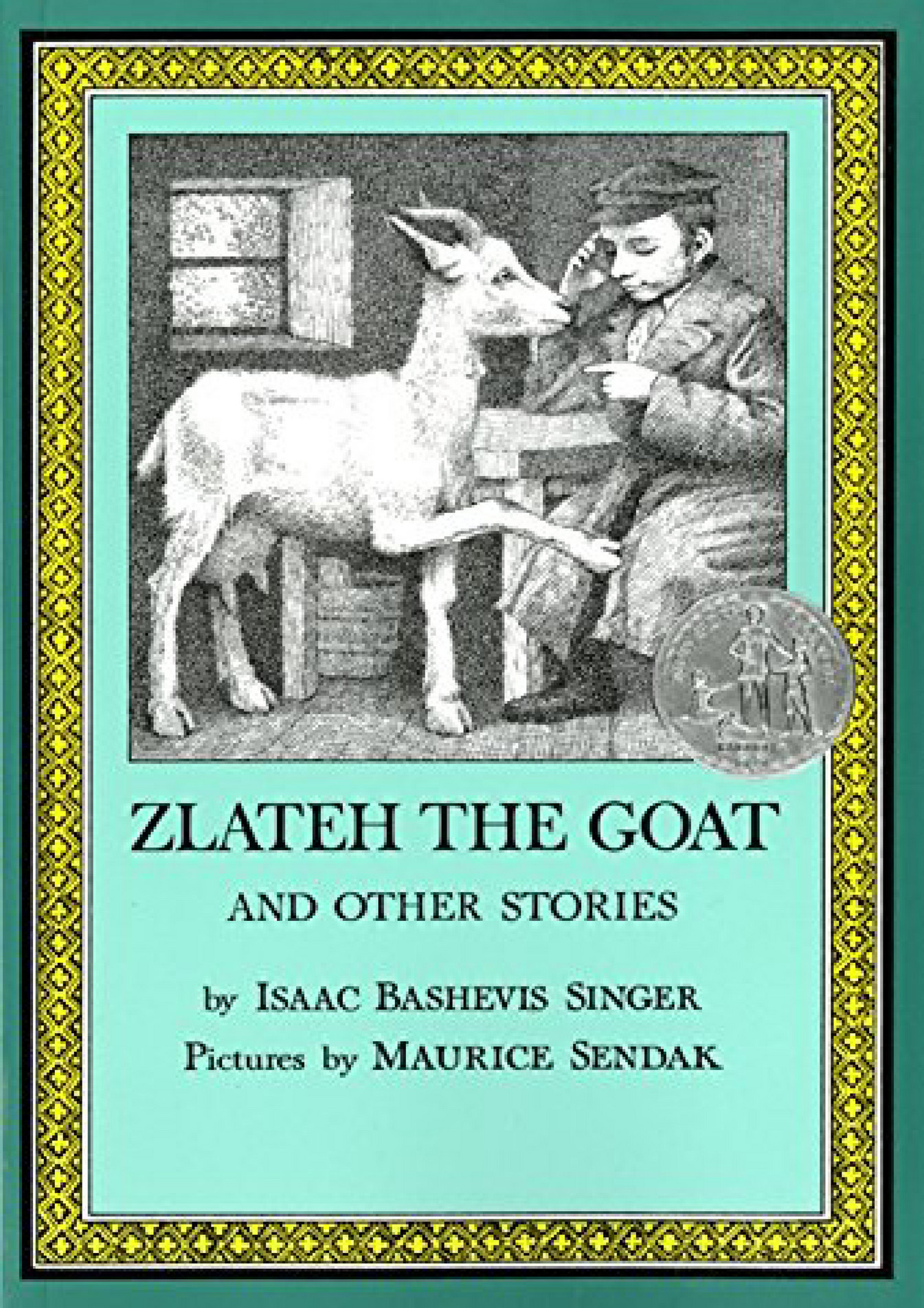
Ever have a story from your childhood just... stick? Not because it was flashy, but because it felt real in a way most "kiddy" books don't? Honestly, that’s Zlateh the Goat.
Most people remember it as that snowy book with the weird, scratchy drawings. But if you actually sit down with it as an adult, you realize Isaac Bashevis Singer wasn’t just writing a fable. He was writing about survival, the weight of family poverty, and the weirdly deep bond we have with animals.
What Really Happens in the Story
The setup is pretty gut-wrenching. It’s Hanukkah time in a small Polish village. But there’s no snow. No snow means no one is buying furs from Reuven, the local furrier. Basically, the family is broke.
To buy candles, flour, and gifts, Reuven decides he has to sell Zlateh, the family’s old goat, to the butcher. He sends his twelve-year-old son, Aaron, to take her to town.
The Betrayal (Sorta)
Zlateh is a good goat. She’s patient. She trusts humans because they’ve always fed her. When Aaron puts a rope around her neck, she just licks his hand. She doesn't know she's being led to her death for eight gulden.
Then, the weather turns.
A massive, "mighty" blizzard hits. It’s the kind of storm that kills people. Aaron loses the road. The world turns white. At this point, the story stops being about a trip to the butcher and turns into a survival thriller.
The Haystack that Changed Everything
Aaron finds a massive haystack in a field. He hollows out a nest inside for himself and Zlateh.
This is the core of the Zlateh the Goat book. For three days, they are buried under the snow. It’s warm inside the hay, but they’re trapped.
- Zlateh becomes the hero. She eats the hay (the walls are literally made of food).
- Aaron survives on goat milk. He milks her directly into his mouth because he’s starving.
- The Bond. They talk. Well, Aaron talks. Zlateh says "Maaaa," which Aaron decides means "I love you" or "We’re in this together."
By the time the storm clears and they make it back home, there's no way Aaron is taking her to the butcher. The family is so happy he's alive that they don't care about the money anymore. Zlateh becomes a permanent family member, living out her days on a diet of carrots and pancakes.
Why the Sendak Illustrations Matter
You can't talk about this book without talking about Maurice Sendak. Yeah, the Where the Wild Things Are guy.
He didn't use his usual whimsical style here. He used this dense, old-school crosshatching that looks like 19th-century etchings. It makes the village of Chelm feel ancient. The drawings are moody. Some might even say they're a bit creepy for a kids' book.
Sendak was a first-generation Jewish-American. His family died in the Holocaust. For him, illustrating Singer’s stories was a way to "re-create a world he never knew"—the world of the Polish shtetl. When you look at those black-and-white lines, you're looking at a ghost world.
The "Chelm" Connection
While the title story is a serious drama, the rest of the book (Zlateh the Goat and Other Stories) is actually pretty funny. It’s set in Chelm, the legendary "Village of Fools" in Jewish folklore.
In Chelm, the "Seven Elders" are the dumbest people on earth, but they think they’re geniuses. One story involves them trying to "capture" the moon in a barrel of water so they can have light at night. It’s slapstick, but with a weirdly philosophical edge.
The Controversy You Probably Missed
Here’s a fun fact: school textbooks actually censored this story in the 70s.
In the original, Aaron says, "We must accept all that God gives us." In a 1975 Macmillan textbook, they changed it to "We must accept all that is given us." They stripped the religious context out to make it more "universal."
Singer was annoyed. He felt the specific Jewishness of the story was what made it work. If you take out the faith and the specific cultural weight of Hanukkah, it’s just a kid in a haystack.
Actionable Takeaways for Readers
If you're thinking about picking up a copy or reading it to your kids, here’s how to get the most out of it:
- Look at the 1966 Edition. Try to find a version that preserves the original Sendak prints. The textures are lost in cheap digital reprints.
- Read it Aloud. Singer wrote these in Yiddish first. They have a specific rhythm. The sentences are meant to be heard.
- Talk about the Moral Gray Area. Ask your kids: Was the dad wrong for selling the goat? It’s a great way to talk about tough choices and poverty without being preachy.
- Pair it with History. If you're using this for homeschooling or a book club, look up photos of pre-war Polish villages. It gives the "fairytale" a haunting reality.
Zlateh the Goat isn't just a story about a kid and his pet. It’s a Nobel Prize winner’s tribute to a culture that was almost wiped off the map. It’s about the fact that sometimes, the thing you think you have to sacrifice is the very thing that saves your life.
If you want to explore more of Singer's work, check out his other collection, A Day of Pleasure. It covers his real-life childhood in Warsaw and hits many of the same emotional notes.