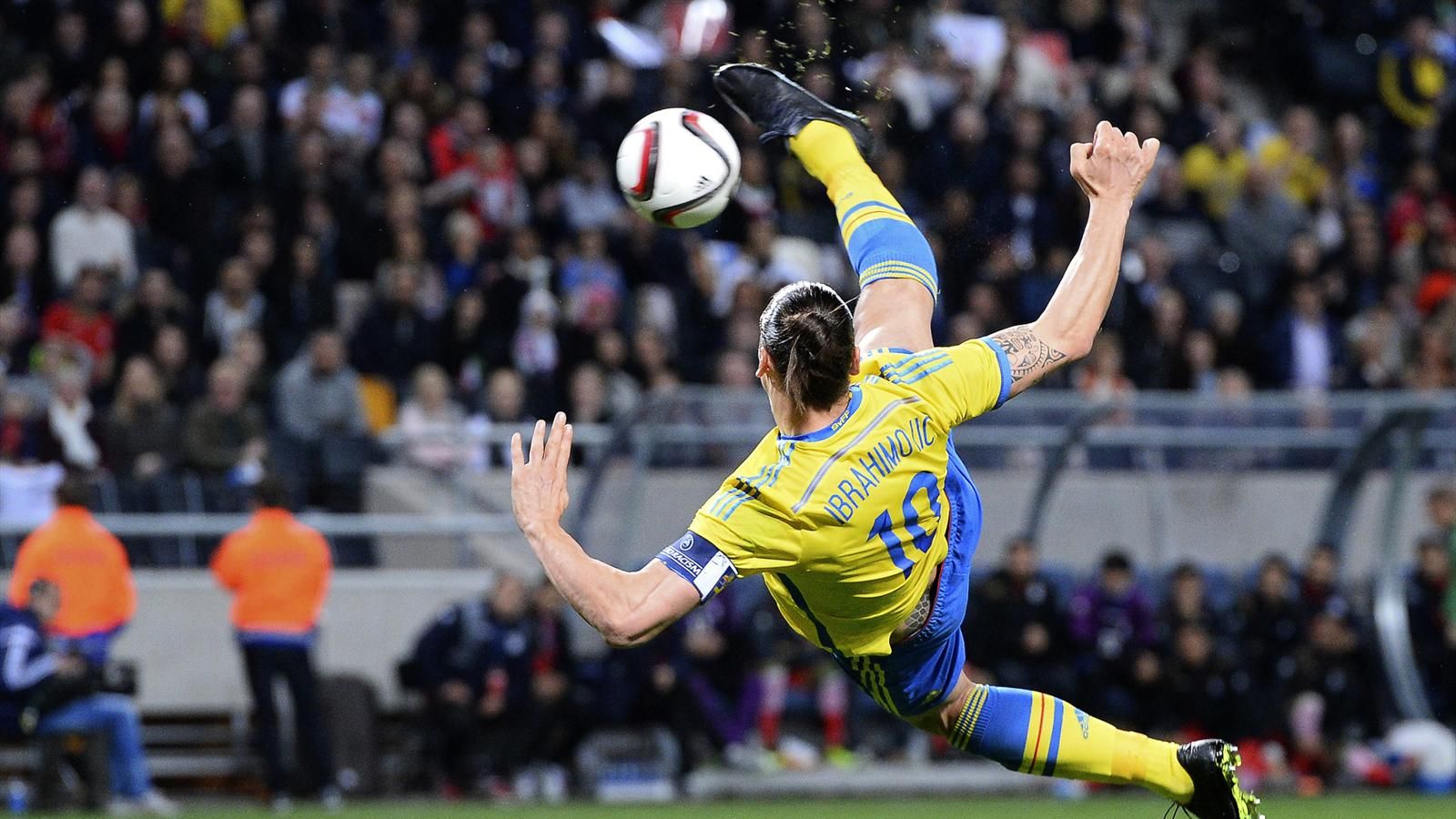
If you were watching TV on November 14, 2012, you probably remember where you were when the laws of physics decided to take a night off. It was a friendly. Sweden versus England. Usually, these mid-week internationals are forgettable affairs, the kind of games where managers swap half the team at halftime and everyone just hopes nobody gets an ankle injury. But this was the opening of the Friends Arena in Solna, and Zlatan Ibrahimovic decided to turn a stadium christening into a religious experience.
The Zlatan Ibrahimovic bicycle kick isn't just a goal. It’s a "where were you" moment.
Most people remember the overhead strike, but they forget the context. England was actually leading 2-1 until the 77th minute. Then Zlatan happened. He scored a hat-trick to put Sweden 3-2 up. Most players would have been happy with that. They would have spent the last few minutes shielding the ball by the corner flag or killing time. Not Zlatan. In the 91st minute, a long, hopeful ball was hoofed downfield. Joe Hart, the England keeper, rushed out of his box to head it clear. He didn't get much on it. The ball looped up, high and awkward, landing about 30 yards from goal.
The 30-Yard Impossibility
Standard football logic says you chest that ball down. You wait for it to land, maybe turn your defender, or just hold it up to burn the clock. Zlatan didn't wait.
As the ball hung in the frosty Swedish air, Ibrahimovic turned his back to the goal. He wasn't even looking at the target when he launched his 6'5" frame into the sky. It was a pure instinct play. He caught the ball at its highest point, about six feet off the ground, with a scissor motion that belonged in a martial arts movie rather than a football pitch.
The distance was roughly 30 yards (27.4 meters). From that range, an overhead kick shouldn't just be difficult; it should be mathematically stupid. If he hits it too hard, it sails into the stands. Too soft, and the retreating Ryan Shawcross or Joe Hart clears it easily.
But the trajectory was perfect.
It was a long, agonizing arc. The ball didn't scream into the net; it teased it. It hovered over the retreating defenders, bounced once just inside the six-yard box, and tucked itself into the roof of the net. Even the England fans, who had spent the night mockingly chanting that Zlatan was "just a shit Andy Carroll," stood up and cheered. You kind of have to, right? When someone does something that shouldn't exist, tribalism usually takes a backseat to awe.
Why This Goal Changed the "Zlatan Narrative"
Before that night, there was a weirdly persistent myth in the UK that Ibrahimovic was overrated.
Critics called him a "flat-track bully." They said he couldn't do it against English teams or on the big stage. It sounds insane now, given he ended his career with over 500 goals, but at the time, his lack of success in the Premier League (which he hadn't joined yet) was used as a stick to beat him with.
That fourth goal—his fourth of the night—didn't just win the game. It ended the debate.
Stan Collymore’s commentary on the night became almost as famous as the goal itself. He screamed, "I have just seen the most insane goal I have ever seen on a football pitch!" It wasn't hyperbole. Usually, commentators have a few canned phrases ready for a great goal, but Collymore sounded like he’d just seen a glitch in the Matrix.
The Science of the Strike
People talk about "luck" with this goal. Sure, Joe Hart’s header was poor. It was a defensive "gift." But capitalizing on a mistake with a 30-yard bicycle kick is like responding to a typo by writing a Shakespearean sonnet.
Technically, the Zlatan Ibrahimovic bicycle kick required three things to go perfectly:
- The Rotation: Zlatan is a black belt in Taekwondo. You can see it in how he rotates his hips. Most players would have lost their balance, but he used his core strength to stay level while horizontal.
- The Weight: He didn't lace the ball. He used the top of his foot to "lob" the kick. If he’d hit it with full power, the ball would have never dipped in time.
- The Spatial Awareness: He knew exactly where the goal was without looking. That’s pure elite-level mapping of the pitch.
The goal was so good it won the 2013 FIFA Puskás Award. Interestingly, because it happened in late November 2012, it missed the cutoff for the 2012 awards. It was so undeniably better than everything else that year that it basically had the 2013 trophy wrapped up 11 months early.
Common Misconceptions About the Match
It’s easy to think this was a competitive qualifier because of the intensity. It wasn't. It was an international friendly.
- The "Small Team" Argument: People sometimes say Zlatan only did this because it was a "meaningless" game. Actually, the pressure was high. It was the first game at the new national stadium.
- The Shawcross Factor: This was Ryan Shawcross’s debut for England. He came on as a sub and had the misfortune of being the guy fruitlessly chasing Zlatan’s shot into the net. He never played for England again. Talk about a rough night at the office.
- The "Open Goal" Myth: Some critics say it was an "easy" finish because Hart was out of his goal. Try standing 30 yards away from a goal, turning your back, jumping in the air, and hitting a ball into a 24-foot wide gap while falling. It’s not easy.
Honestly, the most Zlatan thing about the whole situation was his reaction. After the game, when asked about the goal, he was remarkably chill. He told reporters, "I saw the keeper come out and tried to put it in the goal. I hit it well and when I was on the ground I saw a defender trying to clear it, but it went in."
He talked about it like he’d just successfully parked a car in a tight spot.
What You Can Learn From the "Ibra" Approach
There is actually some practical wisdom in this moment if you look past the ego. Ibrahimovic succeeded because he was willing to look ridiculous.
Most players won't try a bicycle kick from 30 yards because if they miss, they look like an idiot. They’ll be on every "fails of the week" compilation for a month. Zlatan didn't care about the downside. He only saw the possibility of the upside.
If you're looking to analyze this for your own game or just to win an argument at the pub, keep these details in mind:
- Watch the landing: Zlatan lands on his side/shoulder, not his back. That’s how he avoided injury throughout his career while doing these "acrobatic" stunts.
- Check the reaction of the bench: The Swedish substitutes weren't celebrating at first; they were literally holding their heads in disbelief.
- The Shirt: He got a yellow card for taking his shirt off afterward. Best yellow card in the history of the sport.
To truly appreciate the Zlatan Ibrahimovic bicycle kick, you have to watch the wide-angle replay. The TV broadcast doesn't do justice to how high the ball actually went. It clears the heads of every player on the pitch by a massive margin. It was a lob, a strike, and a gymnastic feat all rolled into one.
Next time you’re watching a boring 0-0 draw, just remember that for one night in Stockholm, football actually turned into a video game.
Actionable Insights for Fans:
- Watch the Stan Collymore version: If you only watch the highlights with music, you’re missing half the experience. The raw shock in the commentator's voice is part of the history.
- Compare it to the 2013 Puskás finalists: Look at Nemanja Matić's volley for Benfica or Neymar’s strike for Brazil from that year. They are world-class, but they don't have the "physics-defying" quality of Zlatan's.
- Analyze the Taekwondo connection: Look at Ibrahimovic’s "mancala" or "kick-start" goals for PSG and Ajax. You’ll see the same hip flexibility that made the England goal possible.
The goal remains the gold standard for "unconventional" football. It wasn't about team tactics or a beautiful passing move. It was just one man being better at moving his body than anyone else on the planet for three seconds.