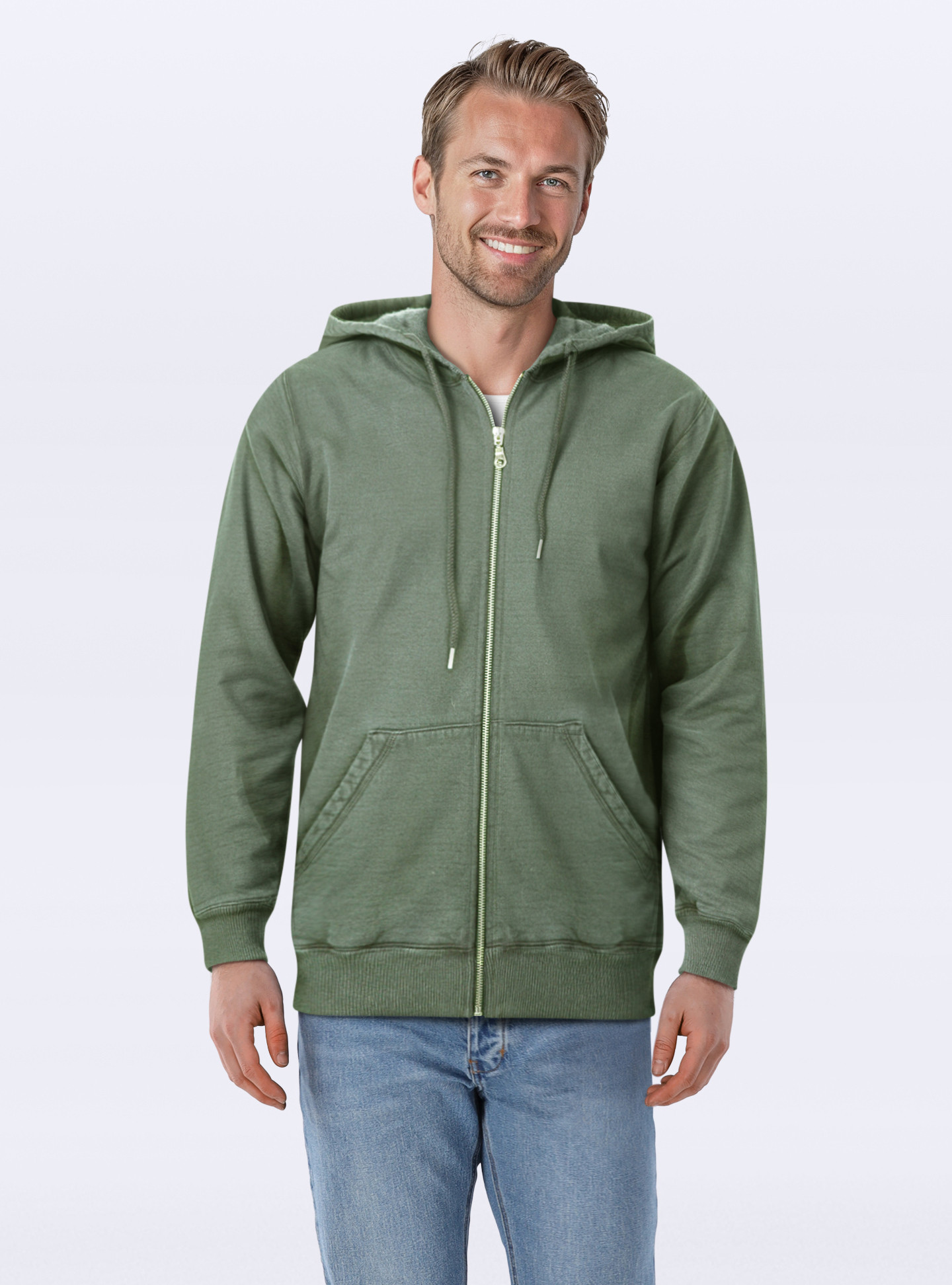
They are everywhere. Walk into any coffee shop in Seattle, a gym in Brooklyn, or a tech office in Austin, and you will see it: the hooded sweatshirt with zipper. It’s the unofficial uniform of the modern world. But here is the thing that drives me crazy. Most people treat the zip-up like a cheap afterthought, something they just toss in the backseat of the car "just in case."
It’s actually a complex piece of engineering. Really.
Think about the tension. When you wear a pullover, the fabric distributes weight evenly across your torso. But the second you introduce a vertical split—the zipper—you change the structural integrity of the garment. If the fabric is too light, the zipper "snakes" and bunches up like a vertical accordion. If the zipper is too heavy for the knit, the collar sags and looks like a sad, deflated balloon. We’ve all been there. You buy a hoodie that looks great on the hanger, but after one wash, the zipper teeth start rippling, and you look like you're wearing a topographical map of the Andes on your chest.
The Science of the "S" Curve in a Hooded Sweatshirt with Zipper
Why does that rippling happen? It’s basically physics. Most hoodies are made of cotton or cotton-poly blends, which are "knitted" fabrics. Zippers, however, are usually attached to a polyester tape that doesn't stretch. When you wash a cotton hooded sweatshirt with zipper, the cotton fibers swell and then shrink. The zipper tape? It stays the exact same length. This mismatch creates the dreaded "zipper bulge."
Premium brands like American Giant or Reigning Champ solve this by pre-shrinking their fabric or using a higher "gram per square meter" (GSM) weight. If you're looking for a hoodie that actually stays flat, you need to check the weight. Look for something in the 350 to 400 GSM range. Anything lighter is basically a t-shirt with a hood, and it will fail you by the third wash. Honestly, if you can see light through the fabric when you hold it up to a window, put it back. You're buying a rag, not a garment.
Then there’s the hardware. Most people don't think twice about the metal bits, but the zipper is the heart of the thing.
YKK is the gold standard for a reason. Specifically, look for the YKK #5 or #8 Vislon zippers. These are chunky, durable, and—most importantly—they slide smoothly. If you feel a "catch" when you’re zipping up in the fitting room, that zipper is going to lose a tooth within six months. Metal zippers look cooler and feel "heritage," but they’re heavy. Plastic molded zippers are actually better for high-performance or lightweight hoodies because they don't weigh down the center of the garment. It's a trade-off. Do you want the rugged, workwear aesthetic of a Carhartt, or the sleek, athletic feel of a Lululemon?
Why the Hood Construction Usually Sucks
Have you ever put on a hoodie and realized the hood is so small it barely covers your ears? Or so big it falls over your eyes like a blindfold? This is usually because of "economies of scale" in manufacturing. Cheap brands use a single-layer hood. It’s flimsy. It has no structure. It looks like a wet paper bag.
A high-quality hooded sweatshirt with zipper should almost always have a double-layered or "self-lined" hood. This gives it enough weight to sit properly on your shoulders without collapsing. It also provides better insulation. Look at the "neckline" too. A good hoodie has a slightly overlapping "crossover" neck where the hood meets the zipper. This prevents the wind from hitting your throat directly. It’s a small detail, but you’ll notice the difference when you’re walking the dog at 6:00 AM in January.
The Rise of the "French Terry" vs. "Fleece" Debate
People use these terms interchangeably. They shouldn't.
- Fleece is that fuzzy, brushed interior. It’s warm. It’s cozy. But it sheds. If you’ve ever taken off a new fleece hoodie and found your white undershirt covered in blue fuzz, you know the struggle. Over time, that fuzz "pills" and gets thin.
- French Terry is different. It’s characterized by those little loops on the inside (called "piles"). It’s more breathable. It’s more durable. It doesn't shed.
If you live in a place with actual seasons, French Terry is the superior choice for a hooded sweatshirt with zipper. It layers better under a denim jacket or a wool overcoat because it isn't as bulky as high-loft fleece. Plus, it absorbs moisture better. It's the "thinking man's" fabric.
Styling Mistakes You’re Probably Making
Stop wearing baggy zip-up hoodies with baggy sweatpants. You look like a thumb.
The hooded sweatshirt with zipper is a layering tool, not a tent. Because it has a vertical line (the zipper), it’s actually quite slimming if worn correctly. Leave it unzipped over a crisp white tee. This creates two vertical lines that draw the eye down, making you look taller and leaner. It's an old stylist trick that works every single time.
Also, pay attention to the cuffs. If the ribbed cuffs on the sleeves and waist are loose and floppy, the whole hoodie looks "tired." You want a ribbing that has a bit of spandex (elastane) in it. This ensures that when you push your sleeves up to your elbows, they stay there. There is nothing more annoying than a sleeve that won't stay pushed up when you're trying to wash your hands or do the dishes.
The Workwear Influence: Carhartt and the 12-Ounce Beast
We can't talk about the hooded sweatshirt with zipper without mentioning the "Heavyweights." In the world of construction and trade work, the hoodie isn't fashion; it’s PPE (Personal Protective Equipment). Brands like Carhartt and Arborwear use a 12-ounce or even 13-ounce fabric. That is incredibly thick.
These hoodies often feature a "DWR" (Durable Water Repellent) coating. Rain literally beads off them. If you’re looking for something to wear while actually working outside, these are the only real choice. They have "roomy" fits to allow for movement, which means they run big. If you're a size Large in most brands, you’re probably a Medium in a workwear zip-up. Keep that in mind or prepare to be swallowed by fabric.
Real-World Longevity: How to Not Ruin It
You spend $80 or even $150 on a premium hooded sweatshirt with zipper, and then you kill it in the dryer. Heat is the enemy of elastic fibers and cotton.
- Zip it up before washing. This prevents the metal teeth from snagging other clothes or the hoodie's own fabric.
- Wash cold. Always.
- Turn it inside out. This protects the outer face of the fabric from friction and pilling.
- Air dry if you can. If you must use a dryer, use the lowest heat setting possible.
If you follow these steps, a high-quality hoodie can easily last you ten years. I have a 12-year-old zip-up that still looks brand new because it has never seen the inside of a high-heat dryer cycle.
Sustainable Choices: Looking Beyond Cheap Cotton
The fashion industry is a mess when it comes to the environment. Most cheap hoodies are made from conventional cotton, which uses a staggering amount of water and pesticides. If you want to feel better about your purchase, look for "GOTS" (Global Organic Textile Standard) certified cotton.
Recycled polyester is also becoming huge. Brands like Patagonia use polyester made from recycled plastic bottles. It sounds weird, but it feels exactly like the "virgin" stuff. It’s durable, it wicks moisture, and it keeps plastic out of the ocean. It's a win-win.
Actionable Next Steps for Your Next Purchase
Buying a hooded sweatshirt with zipper shouldn't be a gamble. Before you hit "checkout" or head to the register, do a quick mental audit of these points:
- Check the GSM: Aim for 300+ for longevity. If the website doesn't list the weight, it's probably light and flimsy.
- The "Pinch Test": Pinch the fabric of the hood. If it feels thin and single-layered, keep looking. A double-layered hood is non-negotiable for a good silhouette.
- Zipper Inspection: Look for the YKK branding on the slider. It’s the industry standard for a reason. Avoid generic, "no-name" plastic zippers that feel gritty when they move.
- The Interior: Decide between the warmth of brushed fleece or the breathable, non-shedding durability of French Terry based on your climate.
- Shoulder Seams: Ensure the seam sits right at the edge of your shoulder bone. If it drops down your arm, the hoodie is too big and will make you look slouched.
Stop treating your hoodies like disposable items. When you find the right one—one with the right weight, a sturdy zipper, and a hood that actually holds its shape—it becomes the most versatile tool in your wardrobe. It’s the bridge between loungewear and streetwear. Treat it well, and it’ll be the last one you need to buy for a long time.