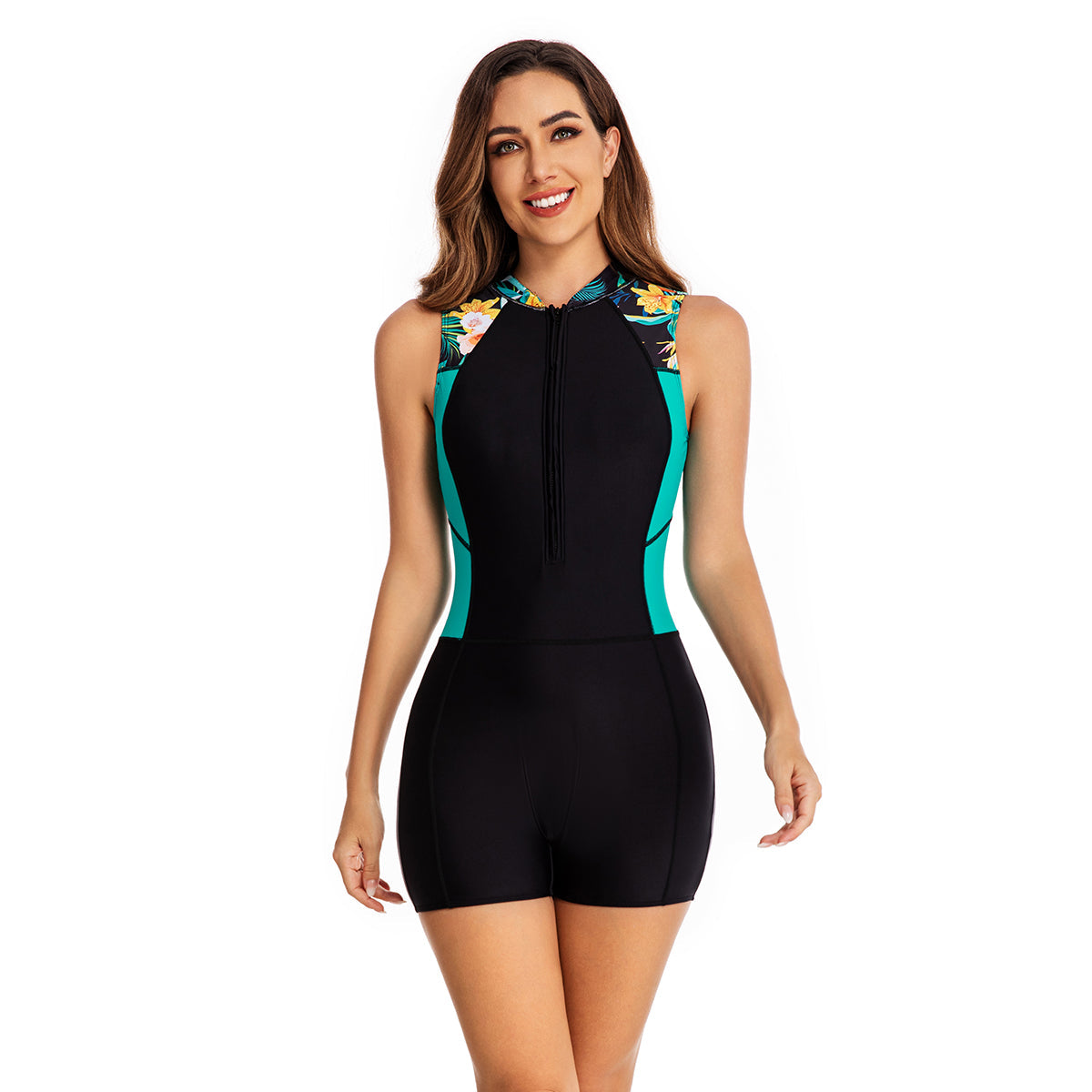
You’re standing on a beach in Maui, or maybe just at the local community pool, and you’re trying to adjust a tiny string knot behind your neck that is slowly carving a canyon into your vertebrae. We’ve all been there. It’s annoying. It’s also exactly why the zip up bathing suit has transitioned from a niche "surfer girl" aesthetic into a mainstream powerhouse. Honestly, the shift isn't just about looking like an extra in a Bond movie—though that’s a definite perk. It’s about the sheer relief of not having to perform a literal circus act just to get in and out of wet spandex.
Zip-front swimwear is basically the utility vehicle of the fashion world. It works.
Most people think of these as "sporty," which is true, but that’s a narrow way to look at it. Brands like Cynthia Rowley and Seea have proven that a zipper isn't just a fastener; it’s a design element that changes the entire silhouette of the body. When you have a vertical line running down the torso, it creates a visual elongation that a standard scoop neck just can't match. Plus, you control the "vibe." Zip it all the way up for a high-neck, modest look that protects your chest from sun damage, or pull it down when you’re just lounging. It’s versatile. Really versatile.
The unexpected engineering of a good zipper
Not all zippers are created equal. If you buy a cheap zip up bathing suit from a fast-fashion site, you’re going to have a bad time. Salt water is brutal. It corrodes metal. Sand gets into the teeth. A real, high-quality suit uses plastic molded zippers—specifically YKK zippers—that won't seize up after one weekend at the coast.
Look for a "zipper garage." That’s the little fold of fabric at the very top. Without it, that metal bit is going to chafe your neck or chin all day. It’s a tiny detail, but it’s the difference between a suit you love and one that stays at the bottom of the drawer. Professional athletes, like those sponsored by Rip Curl or Roxy, rely on these designs because they need to know their suit isn't going to fly open during a wipeout.
Why surfers were right all along
Surfers have been using the zip up bathing suit (specifically long-sleeve springsuits) for decades. Why? Because wax on a surfboard is basically sandpaper for your skin. If you lay chest-down on a board in a regular bikini, you’re going to get "board rash." The zipper allows for a tight, compressive fit that keeps the fabric from shifting.
But it’s not just for the pros. For anyone who has kids, a zip-front suit is a godsend. You’re bending over, picking up toddlers, chasing them through the sand—you need a suit that stays put. A zipper offers security that ties and slides simply cannot provide. You aren't constantly checking to see if a strap slipped. You're just... living.
Sun protection and the UPF factor
Let’s talk about skin health for a second because it's kinda important. The area right on your sternum and upper chest is one of the first places to show sun damage and "crepy" skin as we age. Most traditional swimsuits leave this area completely exposed.
A zip up bathing suit often comes with a higher neckline or even long sleeves. Many of these are rated UPF 50+, which means they block 98% of the sun’s rays. It’s essentially wearable sunscreen. Dermatologists like Dr. Shereene Idriss often emphasize that physical blockers (like clothing) are more reliable than chemical sunscreens that we often forget to reapply every two hours. If you're out on a boat or snorkeling for three hours, that zipper is your best friend.
Choosing the right material: Neoprene vs. Lycra
Materials matter a lot here.
- Neoprene: This is what wetsuits are made of. It’s thicker, it’s insulating, and it sucks everything in. It gives you that "sculpted" look. However, it can be hot if you’re just sitting on a towel in 90-degree weather.
- Lycra/Spandex blends: These feel like a normal swimsuit. They’re breathable and dry quickly. They don't offer the same "hold" as neoprene, but they’re much more comfortable for all-day wear.
Most fashion-forward zip-ups use a heavyweight Italian Lycra. It’s the middle ground. It feels premium, holds its shape, and doesn't get saggy when wet. Brands like Tory Burch and Bondi Born have mastered this.
Addressing the "scuba" stereotype
One big misconception is that a zip up bathing suit will make you look like you’re about to go deep-sea diving. Honestly, only if you want it to. Modern designs incorporate floral prints, color-blocking, and even ruffles. You can find "monokini" styles with side cut-outs and a front zip that look incredibly high-fashion.
There is also the "Easy Off" factor. Think about the last time you tried to peel a wet, sandy one-piece over your shoulders. It’s like trying to escape a straightjacket made of rubber. With a front zipper, you just unzip and step out. It’s a game changer for public changing rooms or even just a quick bathroom break.
Real-world durability and care
If you want your suit to last, you have to treat it differently than a $20 Target bikini.
- Rinse immediately. Salt and chlorine eat away at the elastic fibers and the zipper mechanism.
- Close the zipper before washing. If you throw it in a machine (though hand-washing is better), an open zipper can snag on other clothes or even damage the suit itself.
- Avoid the dryer. Heat is the enemy of spandex. It kills the "snap-back" quality of the fabric.
Styling beyond the water
The cool thing about a zip up bathing suit, especially the ones with sleeves, is that they double as bodysuits. Throw on a pair of high-waisted denim shorts or a linen midi skirt, and you have a full outfit. It’s perfect for those beach-to-bar transitions where you don't want to carry a whole change of clothes.
Because the fabric is designed to be compressive, it smooths everything out like shapewear. It’s a very intentional, "put-together" look. You aren't just wearing a swimsuit; you're wearing an outfit.
Is it right for your body type?
The short answer is yes, but the placement of the zipper changes things.
- Larger busts: A front zip is incredible because it acts like a sports bra. It locks everything in place. You can choose exactly how much cleavage you want to show.
- Short torsos: Look for vertical color-blocking alongside the zipper. It draws the eye up and down, creating the illusion of length.
- Athletic builds: Neoprene zip-ups emphasize shoulders and back muscles, giving that "strong" aesthetic that is very popular right now.
Actionable steps for your next purchase
If you're ready to ditch the flimsy triangles and move into something more substantial, follow these steps to ensure you don't waste your money.
First, check the zipper brand. If it doesn't say YKK or look like heavy-duty molded plastic, put it back. Metal zippers on cheap suits will rust or get stuck, 100% of the time.
Second, consider the "zip-length." A half-zip is great for style, but a full-zip (that goes all the way down to the waist) is what you want if ease of entry is your primary goal. Full-zip suits are significantly easier to get on and off if you have limited shoulder mobility.
Third, look at the seams. "Flatlock" stitching is what you want. This is where the seams lay flat against your skin instead of sticking out. It prevents chafing, which is a common issue with the more structured fit of a zip up bathing suit.
Finally, check the lining. A good suit should be double-lined, especially if it’s a lighter color. The zipper adds weight to the front of the suit; if the fabric is too thin, the zipper will sag and create an awkward bulge. A thick lining provides the structural integrity needed to keep the zipper straight and the silhouette smooth.
Stop worrying about knots coming undone in the surf. Get a suit that locks you in and lets you actually move. Whether you're diving into a wave or just trying to survive a day at the water park with three kids, the zipper is the upgrade you didn't know you needed.