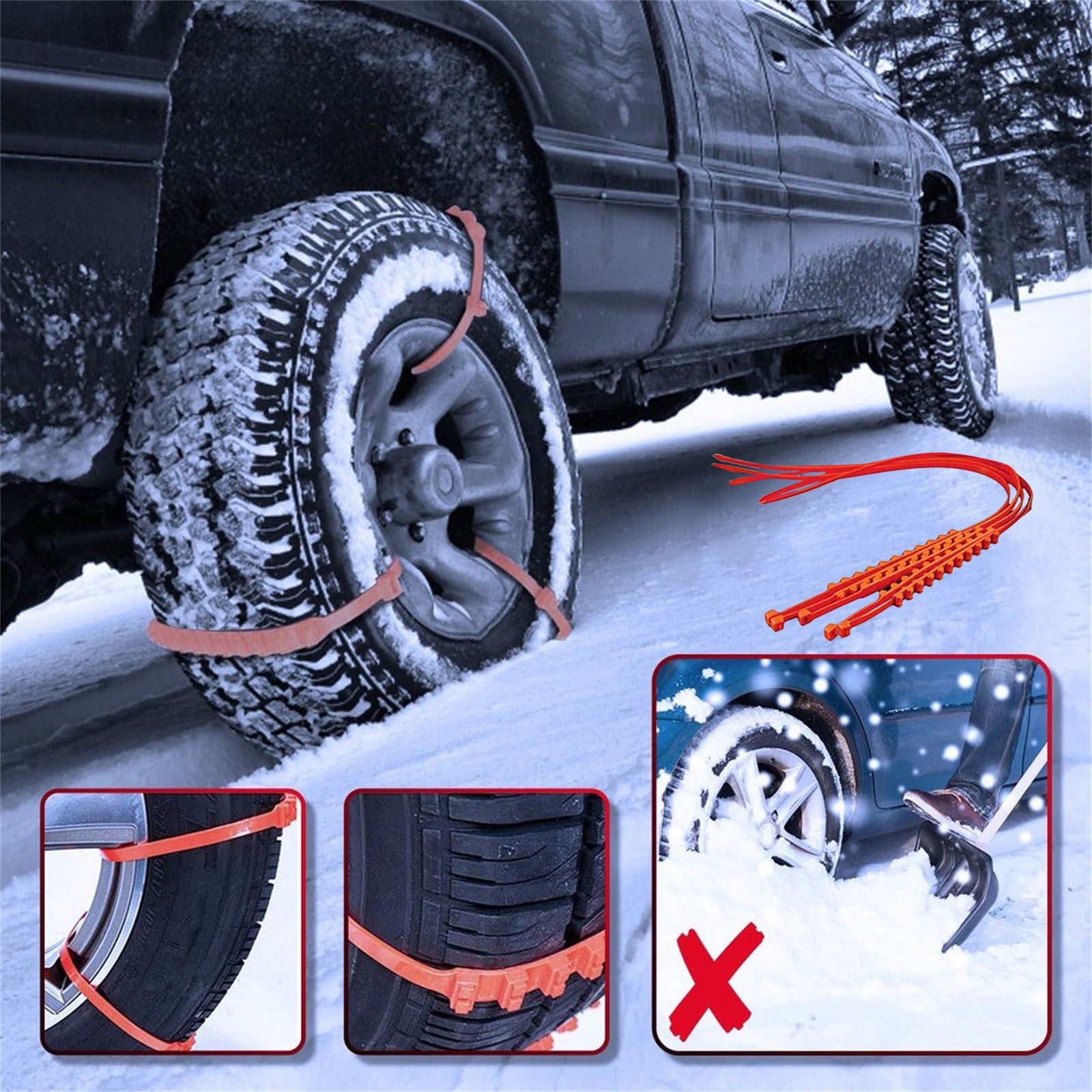
You’ve seen the video. It’s snowing hard, some guy is stuck in a driveway, and he pulls out a bag of heavy-duty plastic fasteners. He loops them through the rims, cinches them tight, and suddenly the car has "traction." It looks like a genius DIY move. Cheap. Fast. Simple. But honestly, using zip ties as tire chains is one of those internet hacks that works great for a thirty-second clip and fails miserably in the real world.
Getting stuck sucks. I get it. You're cold, you're late, and the hardware store is miles away. But putting plastic on a two-ton machine spinning at high RPMs against frozen asphalt? That's a recipe for a bad afternoon.
The Physics of Why Zip Ties Fail
Let’s be real for a second. Traditional tire chains are made of hardened steel for a reason. Steel handles friction. Plastic doesn't. When your tire spins, it generates heat. Even in sub-zero temperatures, the friction between the zip tie and the road surface creates enough thermal energy to soften the nylon. Once that plastic reaches its limit, it snaps.
It happens fast.
One second you have a bit of grip, the next, you’ve got plastic shards flying into your wheel well. If you have a modern car, those shards aren't just litter. They’re projectiles. They can snag on sensor wires, brake lines, or even your ABS hardware.
Standard zip ties are usually made of Nylon 6/6. While this material is tough, it becomes incredibly brittle in extreme cold. It loses its "give." When you hit a patch of pavement that isn't covered in deep snow, the impact is like hitting the tie with a hammer. It shatters. Most people don't realize that zip ties as tire chains only have a prayer of working on soft, uncompressed powder. The moment you hit ice or a cleared road, they're toast.
Commercial "Zip Tie" Chains Aren't Much Better
You might have seen the orange or yellow "emergency traction cleats" sold on Amazon or at gas stations. They look like giant, beefed-up zip ties with little plastic cleats on them. They’re marketed as a "modern alternative" to bulky chains.
Don't be fooled.
These are essentially glorified zip ties. While they use slightly thicker plastic and better ratcheting mechanisms, they suffer from the same fundamental flaw: they are temporary and fragile. The Missouri Department of Transportation and various state patrols in the "Snow Belt" have repeatedly warned that these devices do not meet the legal requirements for "tire chains" in mountain passes. If you see a sign that says "Chains Required," and you show up with plastic ties, you're probably getting a ticket. Or worse, you're getting turned around.
Damage to Your Vehicle
Think about your rims. Unless you have old-school steel wheels with huge gaps, those ties are going to rub. They vibrate. They wiggle. As the tire rotates, the tie shifts, sanding down the finish on your expensive alloy wheels.
There's also the clearance issue. Most modern sedans and crossovers have very little space between the inner sidewall of the tire and the strut assembly. A metal chain is designed to sit low and tight. A zip tie has a bulky "head" where the locking mechanism sits. If that head rotates to the inside of the tire, it can smack against your suspension components thousands of times per mile.
When Traction Goes Wrong
A friend of mine tried this once. He thought he was being clever. He used the "extra heavy duty" 175lb-rated ties. He got about fifty feet out of his driveway before the first one snapped. The sound was like a gunshot.
The tie didn't just fall off. It wrapped itself around his brake caliper. He spent the next hour in the freezing slush, crawling under his car with a utility knife, trying to cut away melted plastic that had fused to a hot brake rotor.
It’s just not worth it.
If you are genuinely worried about getting stuck, there are better ways. Sand. Kitty litter (the non-clumping kind). Traction boards like Maxtrax or even the cheaper knock-offs. These provide a surface for your tires to grab without being physically attached to the rotating mass. They help you get out of a hole, which is all zip ties are really trying to do anyway.
Better Alternatives for Real Emergencies
If you can't or won't use real chains, look into "snow socks." These are fabric covers made of high-tech fibers that use friction to grip ice and snow. They are much easier to install than chains and, unlike zip ties as tire chains, they won't destroy your car if they fail. They’re actually legal in many places where traditional chains are required, like certain passes in California or Colorado, provided they are Type-S cleared.
- Tire Socks: Easy to slip on, great for short distances, won't break your ABS sensors.
- Traction Mats: Heavy-duty rubber or plastic mats you shove under the drive wheels.
- Lowering Tire Pressure: In a true "life or death" stuck scenario, dropping your PSI to 15-20 can increase your contact patch significantly. Just remember to air back up immediately.
The reality is that winter driving is about preparation, not MacGyver-style hacks. A set of dedicated winter tires, like Bridgestone Blizzaks or Michelin X-Ice, will outperform any zip tie or "emergency cleat" every single day of the week. They use a specialized rubber compound that stays soft in the cold—the exact opposite of what happens to a plastic zip tie.
Safety Ratings and Legal Realities
Let’s talk about the "DOT Approved" myth. You will see some of these plastic traction products claiming to be DOT compliant. The Department of Transportation doesn't really "approve" individual consumer products like this in the way people think. Usually, they just meet certain material standards.
In states like Washington or Oregon, the State Patrol has very specific definitions of what constitutes a "traction device." If the device cannot withstand the torque of a vehicle climbing a 6% grade, it’s not a traction device. It’s a toy.
If you're caught in a chain-control zone with zip ties, you're looking at fines that can exceed $500. More importantly, if you slide off the road and cause an accident while using unapproved equipment, your insurance company might have a very difficult time justifying your claim. They love to use the term "negligence." Using a product in a way it wasn't intended—like using industrial fasteners as automotive safety equipment—is a textbook definition.
Survival Is Not a DIY Project
There is a time and place for zip ties. They’re great for holding a bumper together after a fender bender. They’re perfect for cable management behind your TV. They are not, and will never be, a substitute for steel and tension.
If you find yourself looking at a bag of zip ties and a snowbank, stop. Think. Is the risk of a snapped brake line worth the fifty feet of movement you might get? Probably not. Call a tow. Wait for the plow. Dig.
Actionable Steps for Winter Traction
Don't wait until the blizzard hits to figure this out. Here is what you actually need to do to stay safe:
- Check your tires now. If your tread depth is below 5/32 of an inch, you’re already at a disadvantage. Replace them before the first frost.
- Buy a real set of chains. Practice putting them on in your dry driveway. Doing it for the first time in a storm is a nightmare.
- Keep a "Go-Bag" in the trunk. Include a small shovel, a bag of sand, and a set of traction boards.
- Know your vehicle. Is it Front-Wheel Drive (FWD), Rear-Wheel Drive (RWD), or All-Wheel Drive (AWD)? This changes where your traction devices go. Hint: They go on the wheels that provide the power.
- Ignore the viral "hacks." If it seems too good (and cheap) to be true, it’s likely going to cost you a lot more in repairs later on.
Using zip ties as tire chains might get you a few likes on social media, but it won't get you home safely in a mountain pass. Stick to equipment designed for the job. Your car, and your safety, are worth more than a $5 bag of plastic.