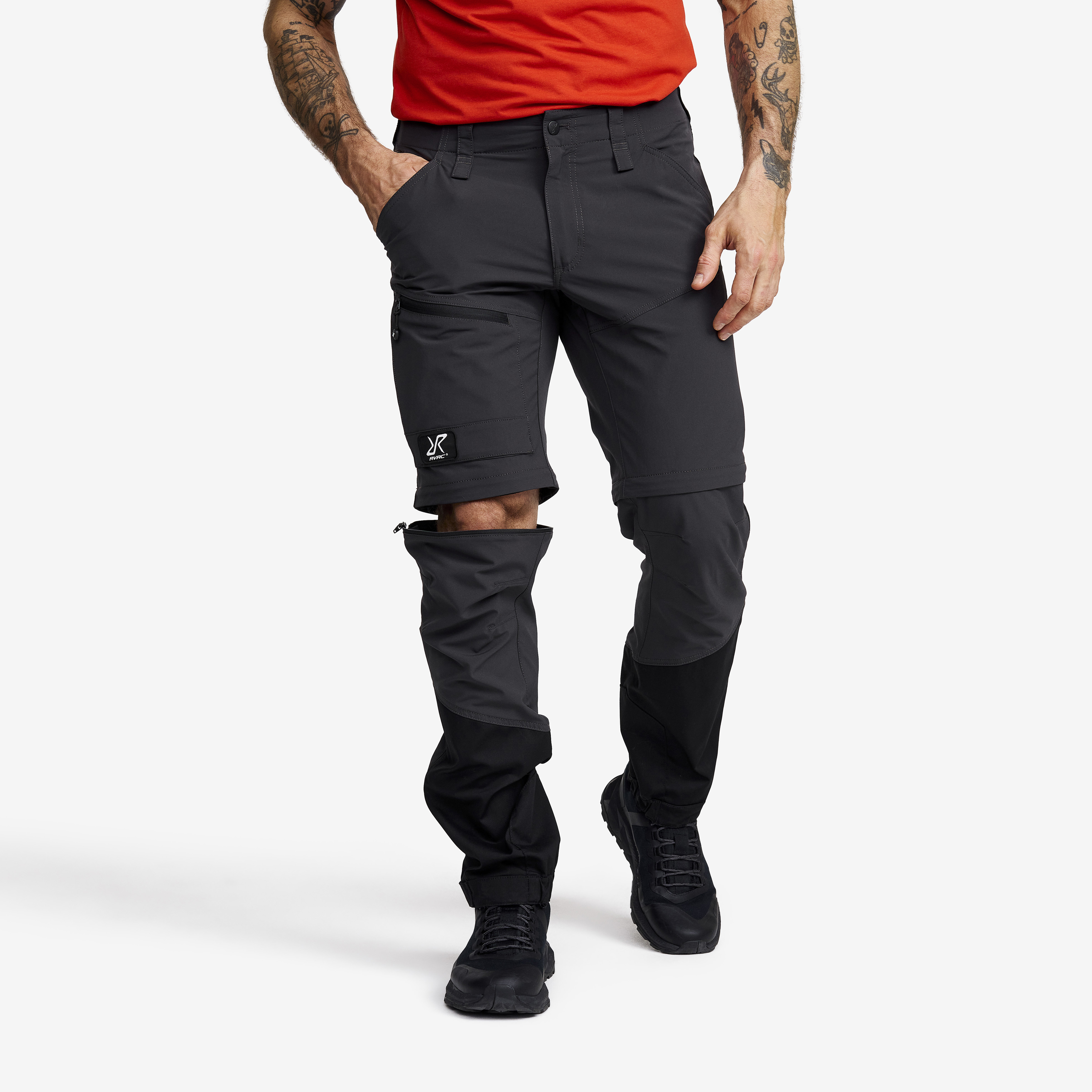
They are objectively ridiculous. You’re standing on a trail, mid-thigh deep in a wardrobe crisis, fumbling with a tiny plastic zipper while your shins get eaten by mosquitoes. It is the peak "dad on vacation" look. Yet, zip off pants men are having a massive, unironic moment right now, and it isn't just because of the Gorpcore trend taking over city streets.
It’s about utility. Pure, unadulterated function.
Most people think convertible pants are just for hikers who can’t decide if they’re cold. That’s wrong. They are a masterclass in modular engineering. Brands like Arc’teryx, Patagonia, and even high-fashion houses are leaning into the "2-for-1" logic because travel is getting more expensive and luggage space is becoming a luxury. Why pack two items when one zipper solves the problem?
The engineering of the modern convertible
Early versions were terrible. Let's be honest about that. They were made of heavy, scratchy nylon that swished loudly with every step, sounding like two garbage bags rubbing together. The fit was always "garbage bag," too—massive, billowy legs that looked like you were wearing stovepipes.
But things changed when textile tech caught up.
Modern zip off pants men use four-way stretch fabrics. Think of brands like Outdoor Research and their Ferrosi line. They use a blend of 86% nylon and 14% spandex. It’s light. It breathes. It doesn't make that annoying swish-swish sound when you walk through a quiet museum or a silent forest. More importantly, designers realized that the zipper doesn't have to be a rigid, uncomfortable ring around your thigh. They started using "zipper garages"—small fabric flaps that tuck the hardware away so it doesn't chafe your skin during a ten-mile trek.
Why the "V" shape matters
The biggest complaint used to be the "sausage casing" effect. You know the one. You zip off the legs, and suddenly the shorts are tighter than the pants were because the zipper has zero stretch.
Smart designers fixed this by offseting the zipper. Instead of a perfect horizontal circle, many high-end convertible pants now use a slightly angled or articulated zipper path. This follows the natural muscle line of the quad. It sounds like overkill. It’s not. If you’re scrambling over rocks in the Dolomites or just stepping up onto a high bus platform in Southeast Asia, that extra 5% of mechanical stretch determines whether you move freely or rip a seam.
Versatility isn't just a marketing buzzword
Think about a typical travel day. You start in a chilly airport terminal. You land in a humid tropical climate. Then you have to visit a temple or a formal site where shorts are banned.
If you're wearing standard chinos, you're sweating through the arrival. If you're wearing shorts, you're buying a sarong at the temple gate. But with zip off pants men can adapt in literally twelve seconds. It is the ultimate "gray man" strategy for travel. You blend in everywhere because you can change your silhouette on the fly.
- Weight savings: A pair of Patagonia Gi III pants weighs about 10 ounces. Carrying a separate pair of shorts and pants would double that weight and triple the bulk in your carry-on.
- Dry time: Most of these are synthetic. If you get caught in a downpour in Tokyo, they’ll be dry by the time you finish your ramen. Cotton jeans would stay damp for three days.
- The "Secret" Utility: Many men use the zip-off feature for temperature regulation without actually removing the legs. You just unzip them halfway. It’s like having windows for your legs. It looks crazy, but when the sun is hitting the back of your calves at 2:00 PM, you won't care.
Addressing the "Style" elephant in the room
Can you actually look good in these?
Yes. But you have to be careful. The "safari" look—tan pants, socks with sandals, and a floppy hat—is hard to pull off unless you're actually on a safari. For the rest of us, the trick is color and taper.
Darker colors like charcoal, navy, or "ash" hide the zipper line. From five feet away, a pair of black zip off pants men just look like technical trousers. Brands like Prana and their Zion line have mastered the "stealth" convertible. They use a low-profile zipper and color-matched teeth. It’s subtle.
Also, look at the rise. Old-school outdoor gear had a massive rise that sat above the belly button. Modern cuts sit on the hips like a pair of Levi’s. This single change in tailoring transformed the category from "retirement home chic" to "urban explorer."
The Rise of Gorpcore and Streetwear
In 2024 and 2025, we saw a massive shift. High-fashion brands like 1017 ALYX 9SM and Nike ACG (All Conditions Gear) started putting zippers on everything. Suddenly, having a visible zipper on your thigh became a status symbol. It signals that you value "readiness." It’s the fashion equivalent of carrying a multi-tool. Even if you only use the pliers once a year, you like knowing they’re there.
Real world testing: The durability factor
I’ve seen people complain that zippers are a "failure point."
"What if the zipper breaks?" they ask. "Then you're stuck with one long leg and one short leg."
Honestly? It almost never happens with YKK zippers. YKK is the gold standard. If the pants you're looking at don't use YKK or SBS zippers, put them back. A cheap zipper will snag on the fabric or lose a tooth, and then you truly are in trouble.
Specific brands have different philosophies on this:
- REI Co-op: Usually focuses on value. Their zippers are solid, but the fabric is a bit thicker and more "rugged."
- Kuhl: They use a unique "stealth" zipper system where the zipper is hidden under a deep welt. It’s the most "pant-like" look you can get.
- Fjallraven: These guys are the tanks of the world. They use G-1000 fabric (polyester and cotton). It’s not as light, but you can walk through briars and thorns without a scratch. Their zip-offs are built for decades, not seasons.
The color coding trick you didn't know you needed
Here is a pro-tip that separates the experts from the amateurs.
When you zip the legs off, you now have two identical-looking fabric tubes. In the dark of a tent or a dimly lit hostel room, it is surprisingly hard to tell which one is the left leg and which is the right.
The best zip off pants men brands use color-coded zippers. One side might have a red zipper pull, the other a blue one. Or the interior stitching might be different colors. If the pair you’re buying doesn't have this, you can do it yourself with a Sharpie or a small piece of colored thread. It saves you five minutes of frustration every single morning.
Technical specs to look for before buying
Don't just buy the first pair you see on a clearance rack. Look at the tag.
DWR Coating: This stands for Durable Water Repellent. It’s a chemical treatment that makes water bead off the surface. It’s great for light mist, but it wears off over time. You can wash it back in with products like Nikwax.
UPF Rating: Your legs can get sunburned through thin fabric. A UPF 50+ rating means only 1/50th of the sun's UV radiation passes through. If you're hiking at high altitudes, this is non-negotiable.
Gusseted Crotch: This is a diamond-shaped piece of fabric sewn into the crotch. It redistributes the stress on the seams. If you plan on doing anything more active than sitting in a lawn chair, you need a gusset. Without it, the "zip off" mechanism creates a tension point that leads to blowouts.
The verdict on the "Convertible" lifestyle
Are they perfect? No.
There is a weird sensation of a cold metal ring touching your leg when you first put them on in the morning. And yes, you will occasionally get a "tan line ring" around your mid-thigh if you wear them as shorts for too long.
But the utility is undeniable. We are moving toward a world of "one-bag" travel and minimalist living. The zip off pants men wear today are a bridge between those worlds. They are tools.
If you want to get started, don't go full "tactical" with twenty pockets. Find a slim-fit, dark-colored pair with four-way stretch. Use them on a day hike. Then use them on a flight. You’ll realize that the convenience of being able to "shed skin" as the temperature rises is worth a little bit of a fashion risk.
Actionable steps for your next purchase
- Check the Zipper Brand: Ensure it’s YKK. If the brand doesn't list the zipper manufacturer, it’s usually a sign of cost-cutting.
- Perform the "Squat Test": Put the pants on and do a deep squat. If the zippers dig into your thighs or feel like they’re going to pop, size up or look for a brand with more spandex content.
- Match Your Activity to Fabric: If you’re rock climbing or bushwhacking, get a nylon/cotton blend (like Fjallraven). If you’re traveling in the tropics or trail running, go for 100% lightweight recycled polyester or a thin nylon stretch.
- Test the "Conversion" Speed: Practice zipping the legs on and off while wearing them. If it takes more than 30 seconds per leg, the zipper teeth are likely too small or the fabric guard is too floppy. You want a smooth, one-handed glide.
- Wash Care: Never use fabric softener on technical pants. It clogs the fibers and kills the breathability and the DWR coating. Just use a mild detergent and hang them to dry—they’ll be ready in an hour anyway.
Buying the right gear is about removing friction from your life. Convertible pants do exactly that. They take the "what should I wear?" question out of the equation. You wear the pants. If it gets hot, you wear the shorts. It’s that simple.