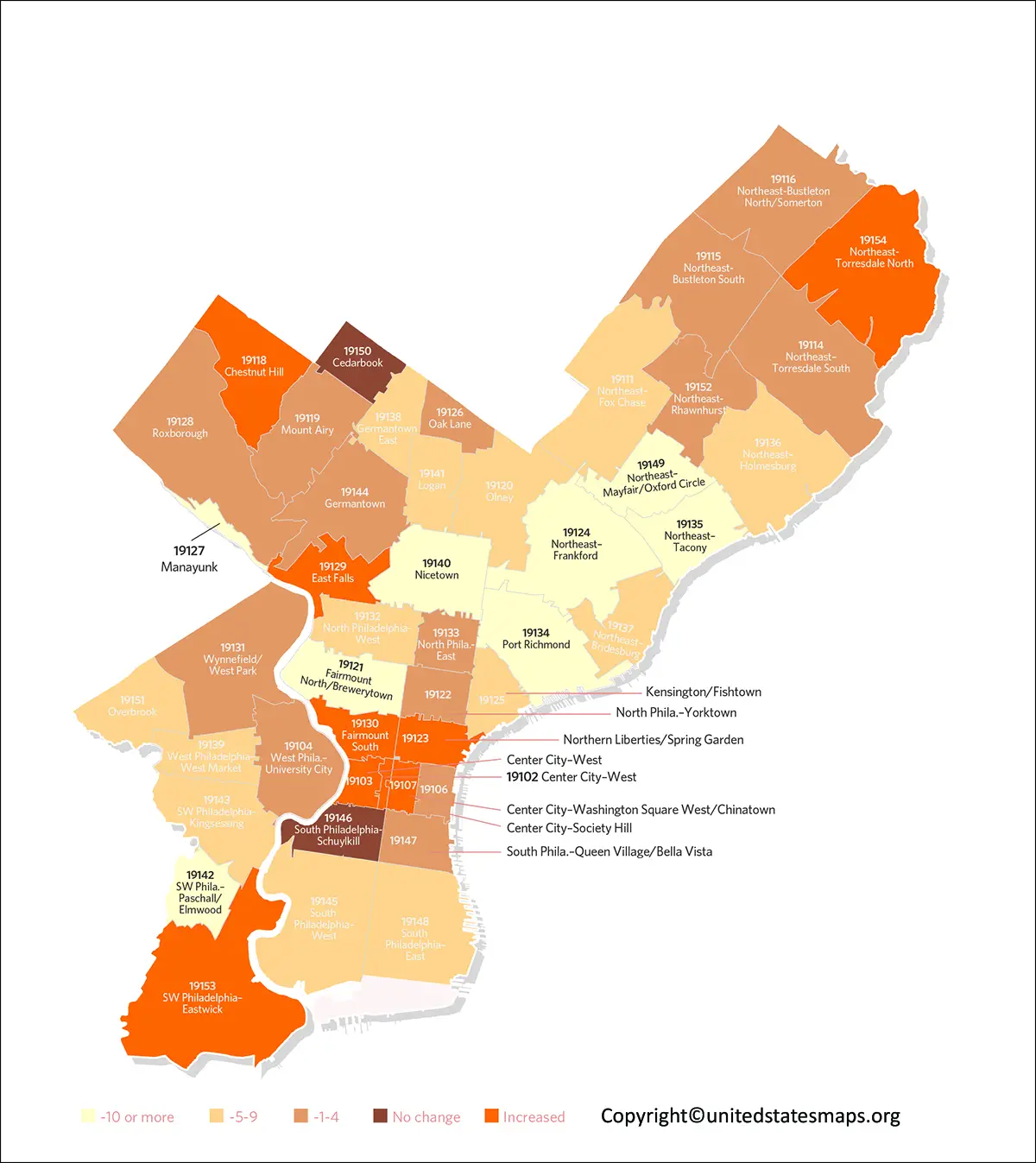
Philadelphia is a city of neighborhoods. Everyone knows that. But if you're looking at a map of zip code Philadelphia Pennsylvania United States, you’re actually looking at a complex web of nearly 90 distinct zones that tell a story far more interesting than just where the mail goes. Honestly, if you think a zip code is just a five-digit number for your Amazon packages, you've missed the boat on how this city actually functions.
The city has roughly 87 zip codes. Some are tiny slivers of the downtown skyline, while others cover massive swaths of the Far Northeast where the vibe is more "suburban cul-de-sac" than "Rocky Balboa." Also making news recently: Why the Dimpled Koala Fossil Changes Everything You Thought You Knew About Australian Wildlife.
The Great Divide: Wealth, History, and Postmarks
Most people looking up a zip code Philadelphia Pennsylvania United States are usually hunting for one of two things: a place to live or a place to visit. But here’s the kicker. The numbers don't always match the vibes. Take 19106. It’s basically the birthplace of American democracy. You’ve got Independence Hall, the Liberty Bell, and cobblestone streets that’ll ruin your heels. It also happens to be one of the wealthiest zips in the city, with median household incomes often soaring past $129,000.
Then you look at 19132. It’s only a few miles away in North Philly. The median income there? Roughly $30,974. More insights regarding the matter are covered by Vogue.
That’s a massive gap. It’s the kind of disparity that defines the city's current struggle with gentrification and urban renewal. In 2026, we’re seeing a shift where the "hottest" zips aren't just the expensive ones. People are flocking to places like 19125 (Fishtown) and 19123 (Northern Liberties) because they want the brewery-per-square-mile ratio to be as high as possible.
Why the Post Office is Your Best Real Estate Agent
If you’re moving here, the zip code is your primary filter.
- 19103 & 19102: This is the Rittenhouse Square and Center City core. If you want to walk to a high-end steakhouse and live in a high-rise, this is it. It’s expensive. Average rents for a two-bedroom in early 2026 are hovering around $2,100 to $2,300.
- 19104: University City. Home to Penn and Drexel. It’s a weird mix of brilliant neuroscientists and college kids eating late-night halal. It’s incredibly dense—think 14,000 people per square mile.
- 19118 & 19119: Chestnut Hill and Mt. Airy. This is the "Garden District." It’s where you go when you want trees and stone houses but still want to be within city limits. It’s leafy, progressive, and feels like a different planet compared to the concrete of South Philly.
Sorting Through the South Philly Chaos
South Philadelphia is a beast of its own. If you’re looking at zip code Philadelphia Pennsylvania United States for the southern part of the city, you’re looking at 19145, 19146, 19147, and 19148.
19147 is the "cool" South Philly—Queen Village and Bella Vista. It’s where the Italian Market is. You can smell the roasted peppers and fresh cannoli. It’s also where home prices have stayed remarkably resilient. Even with the "lock-in effect" easing up in 2026 and inventory rising by about 16%, 19147 remains a seller's market because, well, people like being near good pasta.
19146 is the Graduate Hospital area. It’s seen some of the most dramatic changes in the last decade. It’s gone from "maybe don't walk there at night" to "there’s a stroller on every corner and a $9 oat milk latte in every hand."
The 2026 Outlook: What’s Actually Changing?
Experts like Alex Capozzolo and Stephanie Biello have been tracking the 2026 market closely. What they’re seeing is a "stabilization." The frenzy of the early 2020s is gone. Mortgage rates are expected to settle around 6.15% to 6.3% by the end of the year.
What does that mean for the zip codes?
It means the "fringe" areas are getting more attention. 19128 (Roxborough) and 19127 (Manayunk) are becoming the go-to for people who are priced out of the city center but aren't ready to move to the suburbs of Montgomery County yet. You get the hills, the trails, and the Wissahickon Valley Park right in your backyard.
Surprising Facts About Philly's Zips
- 19112: This is the Navy Yard. It’s a zip code that’s almost entirely businesses and industrial offices. Not many people "live" there in the traditional sense, but thousands work there.
- 19154: The Far Northeast. It’s the most "suburban" the city gets. You’ll see detached houses and lawns. It’s got a population density of about 5,000 per square mile, which is practically empty compared to University City.
- 19122: Often associated with Temple University and the rapidly developing Kensington/Norris Square area. It’s a flashpoint for the city’s debates on housing affordability.
How to Use This Information
If you're trying to navigate the zip code Philadelphia Pennsylvania United States landscape, don't just look at a map. You have to look at the tax abatements, the SEPTA regional rail lines, and the school catchments.
For instance, the 19130 zip (Fairmount/Brewerytown) is great for young professionals because you can walk to the Art Museum, but the parking is a nightmare that will test your soul.
On the flip side, if you go out to 19115 or 19116 in the Northeast, you’ll actually find a parking spot, but you’re looking at a 45-minute commute to get a decent cheesesteak from John's Roast Pork in South Philly.
Actionable Steps for Navigating Philly Zip Codes
To make sense of the Philadelphia landscape right now, you should prioritize these steps:
- Check the "First-Time Homebuyer" Programs: Many programs in 2026 are specific to certain "under-resourced" zip codes like 19134 or 19140. You might qualify for grants just by picking the right street.
- Verify the Catchment: If you have kids, a zip code isn't enough. One side of the street in 19147 might be in a top-tier school catchment, while the other side isn't. Check the School District of Philadelphia’s locator tool.
- Look at the 2026 Assessment: Philly just went through a massive property tax reassessment. Some zip codes saw taxes jump by 30%. Before you buy or rent, ask about the current tax bill, not the one from three years ago.
- Test the Commute: Don't trust Google Maps. If you're looking at 19119, try driving to Center City at 8:15 AM on a Tuesday. The Schuylkill Expressway (I-76) is famously called "The Sure-Kill" for a reason.
Philadelphia is a city that rewards those who look past the surface. Whether you're in the high-rent district of 19103 or the gritty, artistic heart of 19125, the zip code is just the beginning of the story.