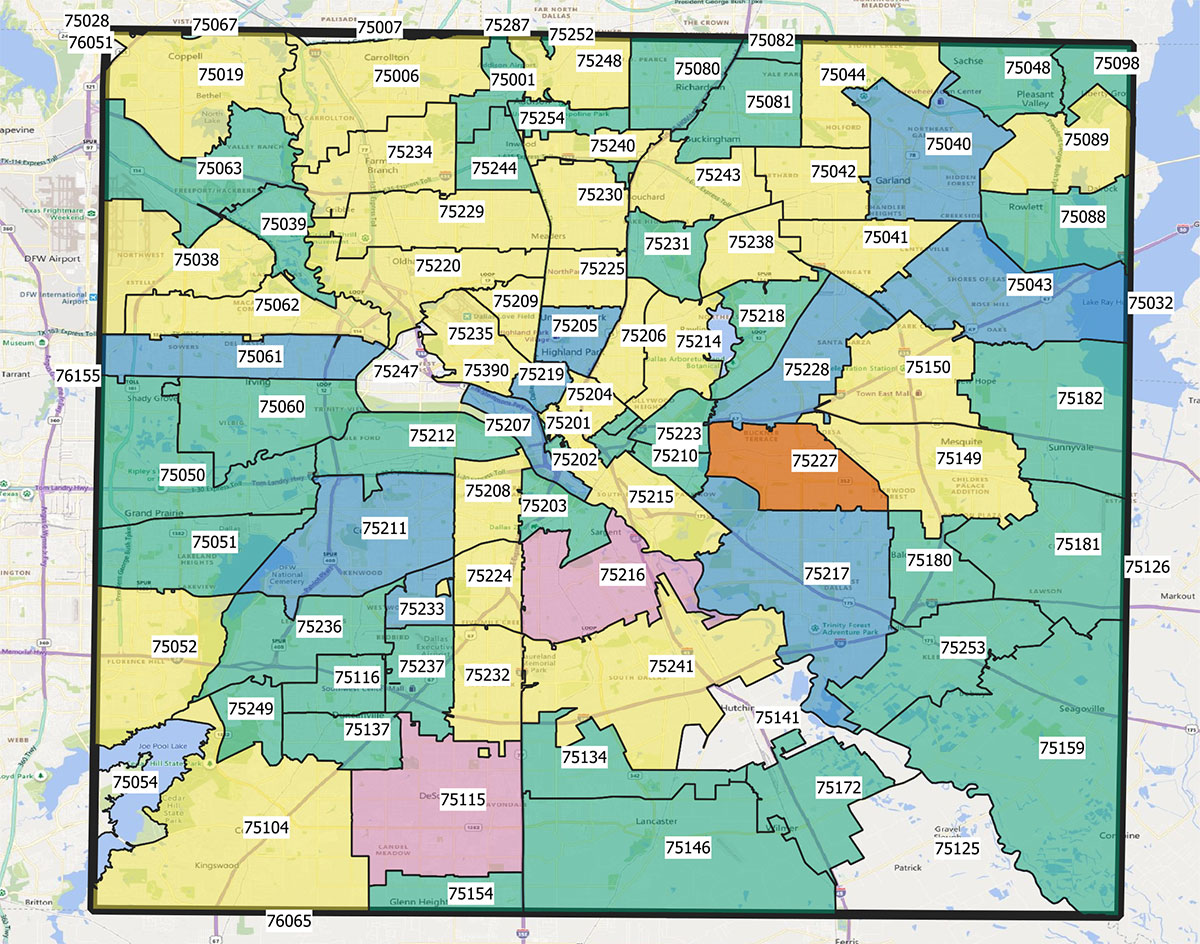
You’re staring at a map of North Texas. It looks like a jagged stained-glass window of overlapping zones, but those numbers—those five digits we call zip codes—actually dictate everything from your car insurance premiums to whether you can get a decent taco at 2 a.m. If you’re searching for a zip code Dallas USA, you aren’t just looking for a mailing address. You’re trying to find a vibe. Dallas isn’t a monolith. It is a collection of tiny kingdoms, and if you get the zip code wrong, you might end up in a suburban sprawl when you really wanted a loft with a view of a neon Pegasus.
Let’s be real for a second. Most people think Dallas is just "Dallas." But the USPS recognizes dozens of individual codes within the city limits alone. Some are power players. Others are quiet, tree-lined secrets. If you’re moving here, investing here, or just trying to mail a package to your aunt in Highland Park (which, technically, isn't even Dallas, but we’ll get to that), you need to know which numbers carry the weight.
The Hierarchy of Zip Code Dallas USA
The most famous number in this city? Probably 75205. This is the "Bubble." It covers University Park and parts of Highland Park. Technically, these are independent municipalities, but they are geographically swallowed by Dallas. If you have 75205 on your mail, people assume you’ve "arrived." It’s home to Southern Methodist University (SMU) and some of the most expensive real estate in the Southern United States. Expect manicured lawns that look like they were trimmed with nail scissors.
Then you have 75201. This is the heart of the Downtown and Arts District. It’s where the high-rises live. You’ve got the Klyde Warren Park—a park literally built over a highway—acting as the backyard for billionaires living in glass towers. It’s urban. It’s loud. It’s where the Dallas Museum of Art and the Nasher Sculpture Center reside. If you want to walk to work and never touch a steering wheel, this is your spot.
But maybe you’re more into the "Brooklyn of Texas" feel. That’s 75208 and 75211. This is North Oak Cliff and Kessler Park. These areas have hills. Real hills! In Dallas! It’s shocking. Bishop Arts District is the crown jewel here, filled with independent bookstores, pie shops like Emporium Pies, and zero chain restaurants. It’s the antithesis of the shiny, corporate gloss you find in 75254 (North Dallas/Far North).
The Suburban Spread and the Numbers That Matter
North Dallas is a whole different beast. As you move toward the 75248 and 75252 areas, the lots get bigger. The schools are often the primary draw here. This is where the city starts to bleed into Richardson and Plano. It’s convenient. You’re near the Tollway and George Bush Turnpike. It’s basically the land of the "super-commuter."
- 75204 (Uptown): This is where the young professionals flock. It’s high-density. It’s got the Katy Trail. If you see someone jogging with a $1,000 stroller and a goldendoodle, they probably live here.
- 75206 (Lower Greenville): Old-school Dallas meets new-school cool. Lower Greenville Avenue is a stretch of bars, rooftop patios, and the legendary Trader Joe’s. It feels lived-in.
- 75214 (Lakewood): Bordering White Rock Lake. This is where the "old money" that doesn't want to live in the Bubble goes. It’s historic, eclectic, and very protective of its trees.
- 75207 (Design District): Formerly just warehouses, now it’s high-end furniture showrooms and breweries. It’s industrial-chic.
Why These Numbers Actually Affect Your Wallet
Look, a zip code Dallas USA isn't just about where you sleep. It’s a data point for every algorithm in your life. Insurance companies use these numbers to determine how likely your car is to get dinged or stolen. 75201 might have higher premiums because of the density and garage thefts, while 75248 might be lower because of the suburban security.
Property taxes in Dallas County are no joke. However, if your zip code falls into a different "taxing entity," like a specific school district (DISD vs. RISD), your yearly bill can swing by thousands of dollars. People will fight—literally show up at town halls and yell—to stay within certain boundaries.
There is also the "Delivery Desert" factor. Believe it or not, some zip codes in South Dallas, like 75216 or 75217, have historically struggled with access to fresh groceries and rapid delivery services. While the city is working on "equity zones," the reality on the ground is that your zip code still determines how fast an Amazon driver or an ambulance gets to your door.
The Mystery of 75251 and the "Tiny" Zips
Did you know Dallas has zip codes that are basically just one or two buildings? It’s true. Large corporate complexes or massive government entities sometimes get their own designation just to handle the sheer volume of paper mail. It’s a relic of the pre-digital age that still exists. 75251 is a weird little pocket near the High Five Interchange (that massive stack of highways that looks like a concrete roller coaster). It’s tiny, mostly commercial, but essential for logistics.
The Cultural Divide of the Trinity River
The Trinity River is the great geographical divider of Dallas zip codes. North of the river, you have the traditional wealth and the business hubs (75201, 75205, 75225). South of the river, you have the historic soul of the city (75203, 75208, 75216). For decades, there was a massive economic gap between these zones.
Honestly, that’s changing fast. Gentrification—a word that makes some people cheer and others cringe—is tearing through 75212 (West Dallas). Ten years ago, you wouldn't have found a $15 cocktail there. Now, with Trinity Groves, it’s a foodie destination. The zip code stayed the same, but the tax appraisals tripled. It’s a complicated story of "progress" versus "displacement" that is written in the property records of these specific numbers.
How to Find Your Specific Dallas Zip Code
If you are standing on a street corner and need to know where you are, Google Maps is the obvious choice. But if you’re looking at a zip code Dallas USA list for business mailing, you have to be careful about "preferred city names."
- Check the USPS ZIP Code Lookup tool. It’s the only source of truth.
- Look for "Alias" names. Some zip codes are shared with suburbs like Addison, Carrollton, or Farmers Branch.
- Watch the boundaries. In Dallas, a zip code can change right in the middle of a block. One side of the street is 75206, the other is 75214.
A Quick Cheat Sheet for the Main Areas
| Area Name | Primary Zip Codes | The Vibe |
|---|---|---|
| Downtown | 75201, 75202 | Skyscrapers and museums |
| Uptown/Victory Park | 75204, 75219 | Young, active, expensive |
| Oak Cliff | 75208, 75211 | Artsy, hilly, historic |
| Lake Highlands | 75231, 75238 | Families and mid-century moderns |
| Preston Hollow | 75220, 75225, 75229 | Estate homes and private schools |
| South Dallas | 75210, 75215 | Fair Park and historic neighborhoods |
The Future of Dallas Zips: Will They Change?
As the population of the DFW metroplex explodes—we’re talking hundreds of people moving here every single day—the USPS occasionally has to "split" zip codes. It hasn't happened to the core Dallas codes in a while, but the outskirts are feeling the pressure. When a zip code gets too crowded, the mail carriers can't keep up, and the system breaks.
We’ve seen it in the northern suburbs like Celina and Prosper, and eventually, the high-density infill in areas like 75204 might force a change. For now, the map is stable, but the demographics inside those maps are shifting like sand.
What most people get wrong is thinking that a zip code is a permanent social status. It’s not. Dallas is a city that loves to reinvent itself. A "bad" zip code in 1995 is the "it" neighborhood in 2026. Just look at the Design District (75207). It went from "don't go there after dark" to "I can't afford a parking spot here" in the blink of an eye.
Practical Steps for Navigating Dallas Zip Codes
If you're moving to or doing business in Dallas, don't just pick a number based on a map. Do your homework.
Drive the boundary lines. Seriously. Go to the edge of 75206 and 75214. You’ll see the architecture change, the street lights change, and sometimes even the quality of the pavement change. It tells you a lot about where the city’s money is being funneled.
Check the school zone maps. A huge mistake people make is assuming a zip code equals a school district. It does not. You can live in a Dallas zip code but be zoned for Richardson ISD. That is a massive distinction for your property value and your kids' education. Always verify the specific ISD (Independent School District) map alongside the zip code.
Look at the "Last Mile" logistics. If you’re running a business, 75235 and 75247 are gold. Why? Because they are right next to Love Field airport and the major freight lines. If your business depends on moving physical goods, those are the most efficient numbers in the city.
Verify the "City" line. This is a weird one. Some addresses in 75287 have a Dallas zip code but are actually in Collin County or Denton County. This affects your court system, your police department, and your voter registration. Always check which county you’re in, because "Dallas" is bigger than just Dallas County.
The story of a zip code Dallas USA is really the story of the city’s growth, its struggles with segregation, and its current boom. Whether you're looking for the luxury of 75225 or the grit and potential of 75212, those five digits are the key to understanding how this Texas giant actually functions. Don't just look at the number; look at what's happening on the ground inside it.
Actionable Next Steps:
- Use the USPS LookUp Tool: Enter specific street addresses to confirm the exact +4 extension, which is vital for accurate shipping in high-rise areas like 75201.
- Cross-Reference with DCAD: Visit the Dallas Central Appraisal District (DCAD) website. Search by zip code to see recent sales trends and tax rate histories for that specific zone.
- Check Crime Maps by Zip: Use the Dallas Police Department’s public data portal to filter by zip code. This provides a more nuanced view of neighborhood safety than general city-wide statistics.
- Confirm School Districts: Use the "School Finder" tools on DISD, RISD, or PISD websites to ensure the zip code matches your desired educational boundary.