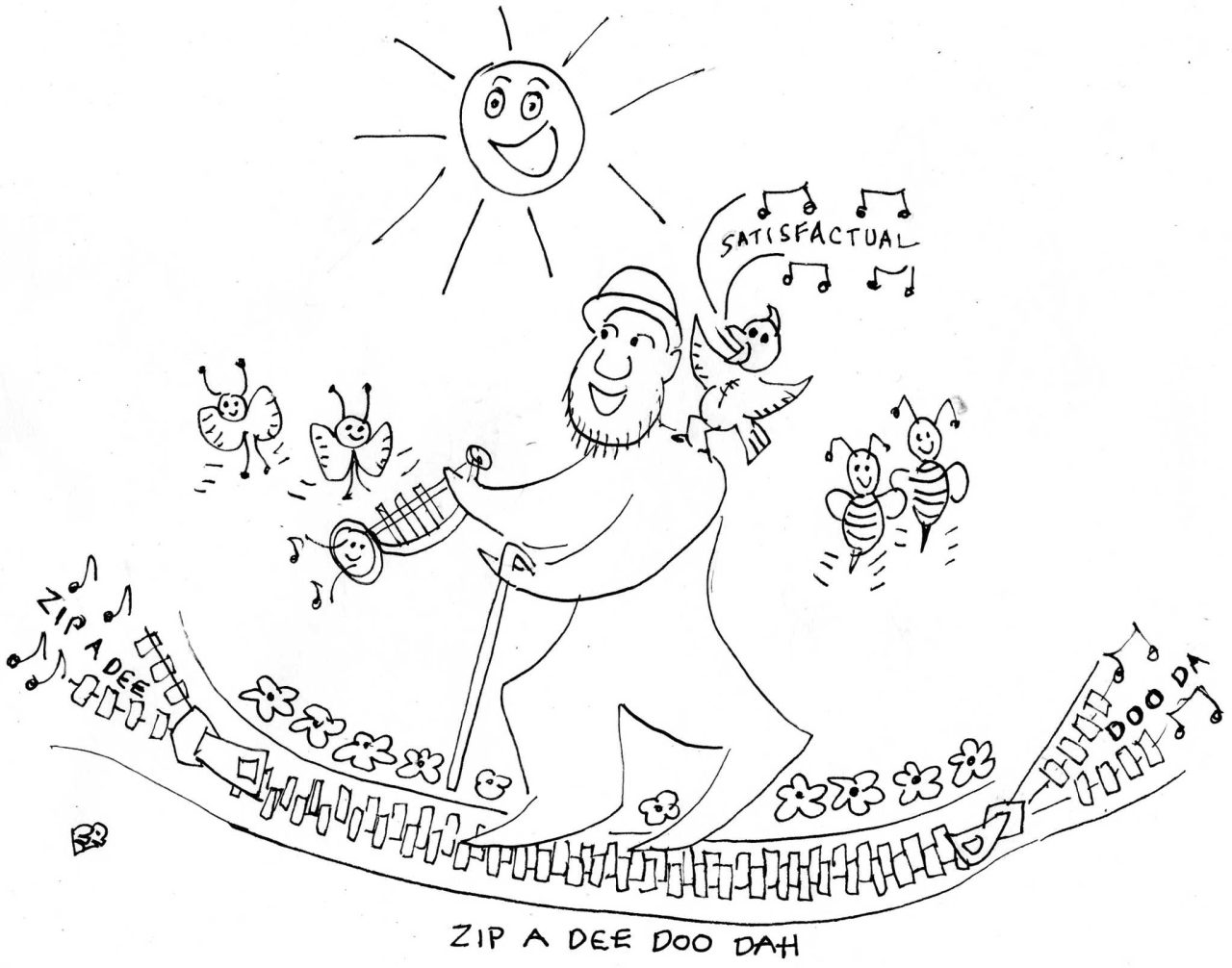
You know the tune. Even if you’ve never seen the movie it came from—and honestly, most people under the age of 50 haven’t—the melody of Zip-a-Dee-Doo-Dah is probably hard-wired into your brain. It’s bubbly. It’s infectious. It’s the ultimate "everything is great" anthem.
But lately, it's been vanishing.
If you walk through a Disney park today, you’ll notice a conspicuous silence where that whistling refrain used to be. It’s not a technical glitch. It’s a deliberate, multi-year scrub of one of the most successful songs in cinematic history. James Baskett won an Honorary Academy Award for his performance of it in 1947, yet Disney is currently treating the track like a PR radioactive isotope.
Why? Because Zip-a-Dee-Doo-Dah is inseparable from Song of the South, a 1946 film that has been locked in the Disney "vault" for decades due to its controversial portrayal of the post-Civil War South.
The Problem With a "Feeling"
The song itself, written by Allie Wrubel and Ray Gilbert, isn't explicitly about anything offensive. It’s about a "wonderful day" and a "wonderful feeling." On its own, it’s a masterpiece of simple, optimistic songwriting. The issue is the context.
In the film, Uncle Remus sings it while strolling through a plantation setting that critics, historians, and even contemporary Disney leadership argue glosses over the brutal reality of the Reconstruction-era South. It presents a "pastoral" view of a time that was anything but peaceful for Black Americans. While Walt Disney originally intended the film to be a heartwarming collection of folk tales, the resulting imagery created a version of history that many find deeply reductive and harmful.
Disney’s current CEO, Bob Iger, hasn't minced words about this. During a 2020 shareholders meeting, he stated that the film is "just not appropriate in today’s world."
That’s a big statement for a company built on nostalgia.
The Great Splash Mountain Purge
For years, the song survived because of Splash Mountain. The log flume ride was a staple of Disneyland and Magic Kingdom, and Zip-a-Dee-Doo-Dah served as its grand finale. It was the "safe" way to keep the characters—Br'er Rabbit, Br'er Bear, and Br'er Fox—alive without having to address the movie they came from.
Then 2020 happened.
Following a massive cultural shift and a viral petition, Disney announced they would retheme Splash Mountain into Tiana’s Bayou Adventure, based on The Princess and the Frog. This wasn't just a cosmetic change. It was the final nail in the coffin for the song’s official presence in the parks.
- They pulled the track from the Magic Kingdom entrance loops.
- It was removed from the Disneyland Resort's "Esplanade" music.
- The "Festival of Fantasy" parade quietly swapped it out for different music.
It was a slow, methodical erasure. You can still find it on some old CDs or buried in Spotify playlists, but the "Official Disney" stamp of approval is effectively gone.
What Most People Get Wrong About Zip-a-Dee-Doo-Dah
There’s a common argument that the song is "innocent" because it doesn't contain slurs or direct hate speech. That’s true. However, semantic history matters.
Historians have pointed out that the phrase "Zip-a-Dee-Doo-Dah" bears a striking resemblance to "Zip Coon," a song from 19th-century minstrel shows. While Disney’s songwriters claimed the phrase was just a bit of catchy nonsense, the phonetical overlap with minstrelsy—where white performers wore blackface to mock Black culture—is too close for many modern scholars to ignore.
It’s about the "vibe" of the era. If you’re trying to build a brand that is inclusive to everyone, keeping a song that reminds a significant portion of your audience of a painful, caricatured past is bad business. Simple as that.
Can You Still Hear It Anywhere?
Surprisingly, yes.
While the American parks have scrubbed it, international parks like Tokyo Disneyland have been slower to change. Splash Mountain still exists there in its original form. Why the discrepancy? It mostly comes down to cultural context. In Japan, the characters are viewed as cute, trickster animals from a cartoon, largely disconnected from the American history of the Antebellum South.
But even there, change is likely coming. Disney likes brand consistency. If the song is "bad" in California, it's eventually going to be "bad" in Tokyo.
The Irony of the Academy Award
James Baskett, the actor who sang the song, was the first Black man to win an Oscar. He was a pioneer.
When Disney erases Zip-a-Dee-Doo-Dah, they are also, in a way, erasing his legacy. This is the nuance that many film historians struggle with. How do you condemn a film for its stereotypes while celebrating the Black artist who gave a phenomenal, soulful performance within it?
Baskett couldn't even attend the film's premiere in Atlanta because of Jim Crow laws. He was a victim of the very system the movie tried to paint as "whimsical." That’s the heavy irony that makes the song so complicated.
The Future of "Problematic" Classics
Disney is in a tight spot. They own a massive library of content that was made in a different time with different standards.
Instead of deleting everything, they’ve taken a two-pronged approach:
- Content Warnings: On Disney+, movies like Dumbo, Peter Pan, and The Aristocats have unskippable warnings about "harmful stereotypes."
- Total Removal: Song of the South is one of the few pieces of media they have decided is simply irredeemable.
Zip-a-Dee-Doo-Dah falls into that second category because it is so iconic. You can’t put a "warning" on a song playing over a loudspeaker at a theme park. It’s either there or it isn’t.
Steps for Enthusiasts and Historians
If you’re interested in the preservation of film history or just curious about how music evolves, there are a few things you can do to see the full picture.
First, look for the work of Floyd Norman. He was Disney’s first Black animator and has written extensively about the complexities of Song of the South. He offers a perspective that isn't just "this is bad" or "this is good," but rather a look at the people who worked on it.
Second, check out the You Must Remember This podcast series on the film. It is perhaps the most deeply researched deep-dive into the production, the casting of James Baskett, and the eventual cultural fallout.
Third, pay attention to the music in Tiana’s Bayou Adventure. It’s a masterclass in how Disney is trying to replace the old "Southern sound" with authentic New Orleans jazz and zydeco. It’s a shift from "imagined history" to "celebrated culture."
Ultimately, the song isn't going to disappear from the internet. It's too big for that. But as a symbol of the "Disney magic," its time has passed. The sun has set on that particular "wonderful day."
To understand the full scope of this transition, compare the original 1946 soundtrack recordings with the new compositions for the parks. You'll hear a distinct shift in how the company uses music to define "happiness." While the old tracks relied on a specific type of mid-century Americana, the new stuff is much more grounded in specific, real-world musical traditions. It’s a fascinating evolution of a brand trying to grow up without losing its soul.